Cocoa Bears? – Weak E.U. Grindings And Solid African Harvests Drive Prices

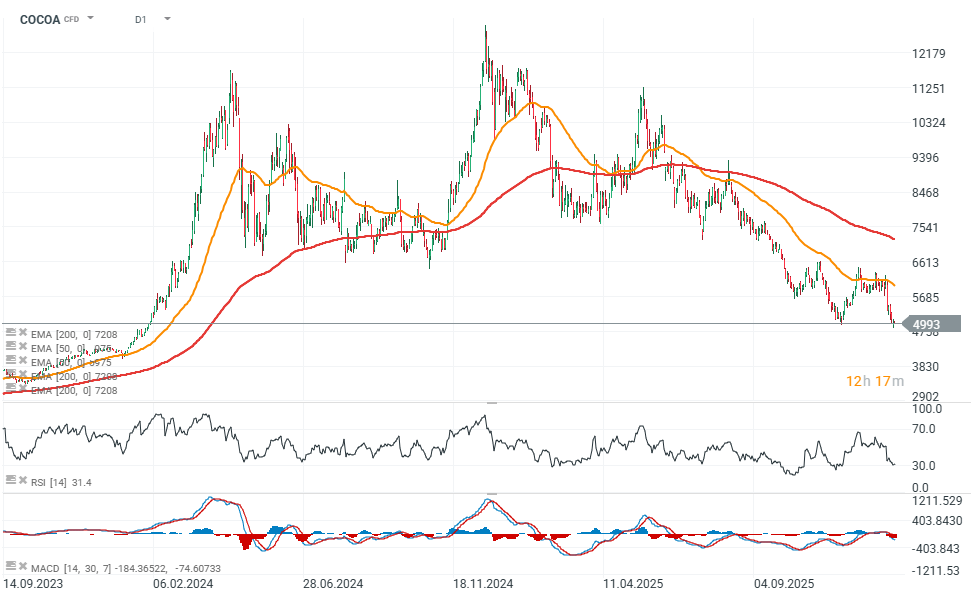
After the powerful rallies of 2024 and 2025, cocoa’s boom is now a distant memory, with the market stuck in a strong downtrend for months. Cocoa futures slipped below $5,000 per ton today, hitting their lowest level since November 26, pressured by weak demand signals and improving supply prospects in West Africa.
What’s driving cocoa lower?
- European grindings fell sharply in Q4 2025, down 8.3% y/y to 304,470 tons. This was the sixth consecutive decline and far worse than forecasts calling for a 2.9% drop. Europe remains the world’s largest cocoa market, making this a key barometer for global consumption.
- Asia’s Q4 grindings are expected to fall 12% y/y, to a 10-year low. Processing is under pressure globally, highlighting demand destruction and challenges in the chocolate market as purchases have slowed.
- A strong US dollar and exporters/producers using earlier price spikes to hedge supply via short positions are also weighing on futures demand.
- Favorable crop conditions in West Africa are adding downside pressure. Tropical General Investments Group said last Friday that supportive weather should lift cocoa output in February and March in Ivory Coast and Ghana. Farmers are reporting larger and healthier pods than a year ago.
- Mondelez noted that cocoa pod counts in West Africa are 7% above the five-year average and “materially higher” than last season. At the same time, the main crop harvest has started in Ivory Coast, with farmers optimistic about quality.
- Tight inventories had been a long-running bullish factor, but the picture has started to stabilize: ICE-monitored cocoa stocks in US ports fell on December 26 to a 9.75-month low of 1,626,105 bags, but have since rebounded to a four-week high of 1,660,515 bags.
- It’s also worth remembering that on November 26 the European Parliament confirmed a one-year delay to rules restricting imports of cocoa linked to deforestation risk. The EU’s EUDR is designed to curb deforestation tied to key commodities such as soy and cocoa, meaning that in 2026 imports will remain largely unrestricted in this area.
What could support prices?
- Cocoa is currently finding only limited support from signs of smaller shipments from Ivory Coast, the world’s largest producer. Farmers delivered 1.073 million tons (MMT) to ports this season (from Oct 1 to Jan 4), still down 3.3% from 1.11 MMT in the same period a year earlier.
- Peak Trading Research estimates that annual commodity index reweighting could trigger buying of roughly 37,000 cocoa futures contracts, equivalent to nearly 31% of total cocoa options open interest, potentially helping to underpin prices around current levels.
- Cocoa is also set to be added to the Bloomberg Commodity Index (BCOM) this month. According to Citigroup estimates, inclusion could attract up to $2 billion in buying of NY cocoa futures.
COCOA (D1)
Source: xStation5
The material on this page does not constitute financial advice and does not take into account your level of understanding, investment objectives, financial situation or any other specific needs. All information provided, including opinions, market research, mathematical results and technical analyzes published on the Website or transmitted To you by other means, it is provided for information purposes only and should in no way be construed as an offer or solicitation for a transaction in any financial instrument, nor should the information provided be construed as advice of a legal or financial nature on which any investment decisions you make should be based exclusively To your level of understanding, investment objectives, financial situation, or other specific needs, any decision to act on the information published on the Website or sent to you by other means is entirely at your own risk if you In doubt or unsure about your understanding of a particular product, instrument, service or transaction, you should seek professional or legal advice before trading. Investing in CFDs carries a high level of risk, as they are leveraged products and have small movements Often the market can result in much larger movements in the value of your investment, and this can work against you or in your favor. Please ensure you fully understand the risks involved, taking into account investments objectives and level of experience, before trading and, if necessary, seek independent advice.