Financial markets are still reeling from Donald Trump’s tariff threats to Europe for daring to try and protect the sovereignty of Greenland. However, so far on Monday, there has not been a lot of new information, as it is Martin Luther King Day in the US, and cash equity and Treasury markets are closed.
The continued weakness in the dollar suggests that there is a mild ‘sell America’ trade going on, but the main movements in European stock markets suggest that Trump’s tariff threat is bad news for luxury stocks, car manufacturers and European tech stocks like ASML who rely on US customers for their business. The winners are European defense stocks and gold.
We think that markets will be very sensitive to news flow in the coming days, and if Trump clarifies his position on Greenland or rolls back on tariffs, then the market reaction will be rapid.
Japan’s February election could expose fiscal weaknesses
However, it is easy to get distracted by the daily torrent of market-moving events at the White House, however, there are other things going on in the world right now, including in Japan. Japan’s Prime Minister Takaichi has called an early election for 8th February. She has promised a temporary cut to the sales tax on food if she wins. This is a costly pledge and could amount to $31bn a year.
Yields surge after costly election pledges announced
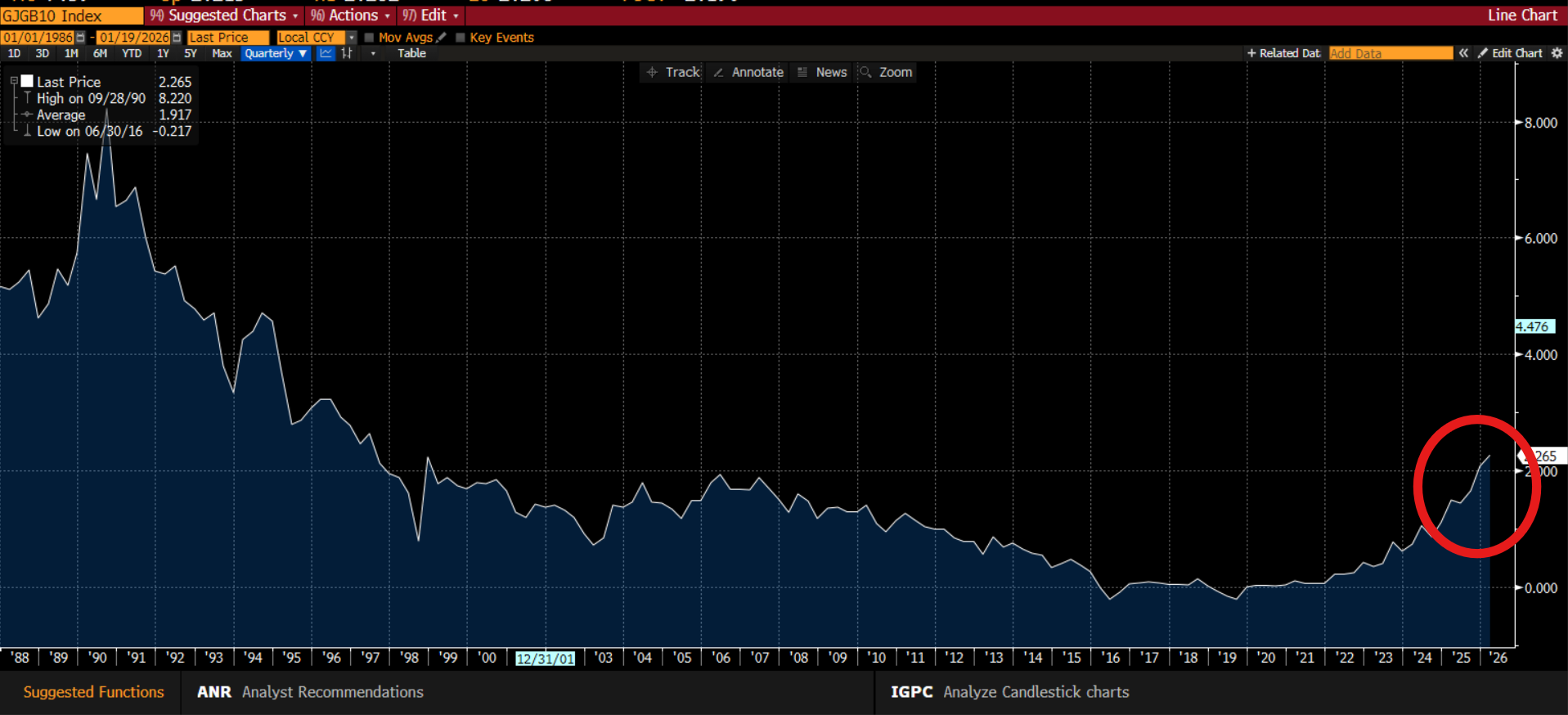
The prospect of a tax cut when Japan’s debt to GDP ratio stands at 247%, has weighed on Japanese bonds. Yields surged at the start of this week. The 30-year yield climbed to a fresh all time high, and the 10-year yield is at its highest level since the 1990s.
When bond yields rise from low levels they can break something. We saw it in the US in 2023 when Silicon Valley Bank collapsed, as the value of the Treasury bonds it held on its balance sheet collapsed as Treasury prices fell sharply. If Takaichi does win the election, then her expansionary fiscal policies could weigh on Japanese bonds even more.
Could Japan have its own Silicon Valley Bank moment?
At some point, a small Japanese bank or hedge fund could run into problems, especially since the run up in bond yields has been so acute in the past year, as you can see in the chart below. At the same time, since the start of 2025, the Japanese yen has been the weakest currency in the G10 FX space. When rising bond yields do not boost a currency, it can be a sign of fiscal stress.
Japanese stocks remain buoyant, for now
It is hard to predict which bank, or fund could be at risk, since Japanese stocks remain in fierce demand. Over the past 12 months, the Topix bank index has risen by 61%, as the BOJ ended its zero-interest rate policy, which boosted net interest income for the banking sector. In the past 12 months, Japanese stocks have been top global performers, and the Nikkei has risen by 37%, and demand for Japanese equities appears to be insatiable.
However, it is worth noting that US stocks had rallied strongly in the years leading up to Silicon Valley Bank’s collapse, so a strong equity market may not be a sign that Japan is immune to fiscal risks. Once the election is out of the way, Japan’s fiscal issues may come into focus, especially if sovereign bond yields keep rising.
Chart 1: Japanese 10-year bond yield
Source: XTB and Bloomberg
The material on this page does not constitute financial advice and does not take into account your level of understanding, investment objectives, financial situation or any other specific needs. All information provided, including opinions, market research, mathematical results and technical analyzes published on the Website or transmitted To you by other means, it is provided for information purposes only and should in no way be construed as an offer or solicitation for a transaction in any financial instrument, nor should the information provided be construed as advice of a legal or financial nature on which any investment decisions you make should be based exclusively To your level of understanding, investment objectives, financial situation, or other specific needs, any decision to act on the information published on the Website or sent to you by other means is entirely at your own risk if you In doubt or unsure about your understanding of a particular product, instrument, service or transaction, you should seek professional or legal advice before trading. Investing in CFDs carries a high level of risk, as they are leveraged products and have small movements Often the market can result in much larger movements in the value of your investment, and this can work against you or in your favor. Please ensure you fully understand the risks involved, taking into account investments objectives and level of experience, before trading and, if necessary, seek independent advice.