Pound Sterling attracts bids as UK inflation rises more than expected in December

- The Pound Sterling gains against its peers as UK CPI grew at a higher-than-expected pace in December to 3.4%.
- UK core inflation remained at 3.2% YoY in December, as markets expected.
- US-EU strained relations are keeping the US Dollar under pressure.
The Pound Sterling (GBP) gains against its major peers on Wednesday after the United Kingdom’s (UK) Office for National Statistics (ONS) has reported that inflation grew at a faster-than-projected pace in December.
UK headline inflation rose to 3.4% year-on-year, faster than estimates of 3.3% and the November reading of 3.2%. On a monthly basis, headline CPI grew at an expected pace of 0.4% after contracting by 0.2% in November.
The UK core CPI – which strips off volatile components such as food, energy, alcohol, and tobacco – rose at a steady pace of 3.2% year-on-year (YoY), as expected.
Meanwhile, inflation in the services sector, which is closely tracked by Bank of England (BoE) officials, accelerated to 4.5% YoY from the prior reading of 4.4%.
Signs of price pressures remaining sticky are expected to weigh on market expectations for interest rate cuts by the BoE in the near term. In the December policy meeting, the BoE guided that the monetary policy will remain on a “gradual downward” path.
Going forward, investors will focus on the UK Retail Sales data for December and the preliminary S&P Global Purchasing Managers’ Index (PMI) data for January. Both indicators will be releasedon Friday.
Daily Digest Market Movers: Investors await Trump’s speech at WEF in Davos
- The Pound Sterling trades marginally higher to near 1.3445 against the US Dollar (USD) during the European trading session on Wednesday. The GBP/USD pair trades broadly sideways as the US Dollar wobbles, while investors await United States (US) President Donald Trump’s speech at the World Economic Forum (WEF) in Davos.
- At the time of writing, the US Dollar Index (DXY), which tracks the Greenback’s value against six major currencies, trades flat around 98.55. Still, it is close to its two-week low of 98.20.
- The US Dollar is broadly under pressure amid disputes between the US and European Union (EU) members over Greenland’s future. Over the weekend, US President Trump threatened to impose 10% tariffs on several EU members and the UK for opposing Washington’s plans to acquire Greenland.
- In response, several EU members and officials across the globe have criticized Trump’s tariff threats, referring to them as ”blackmail” . European Central Bank (ECB) President Christine Lagarde stated in an interview with CNN on Tuesday at the WEF that Trump’s tariff threats have undermined relations between the US and the EU. Lagarde added that companies from both economies struggle to gauge the “potential impact of additional duties”.
- President Trump’s speech at Davos will be closely watched by investors for clues about which measures Washington can take to pressure EU members after opposing US control of Greenland.
- On the domestic front, investors await the announcement of the new Federal Reserve (Fed) Chairman, which is expected as early as next week, as stated by US Treasury Secretary Scott Bessent on Tuesday. “There are four candidates for the position presently,” Bessent added.
Technical Analysis: GBP/USD wobbles near 20-day EMA
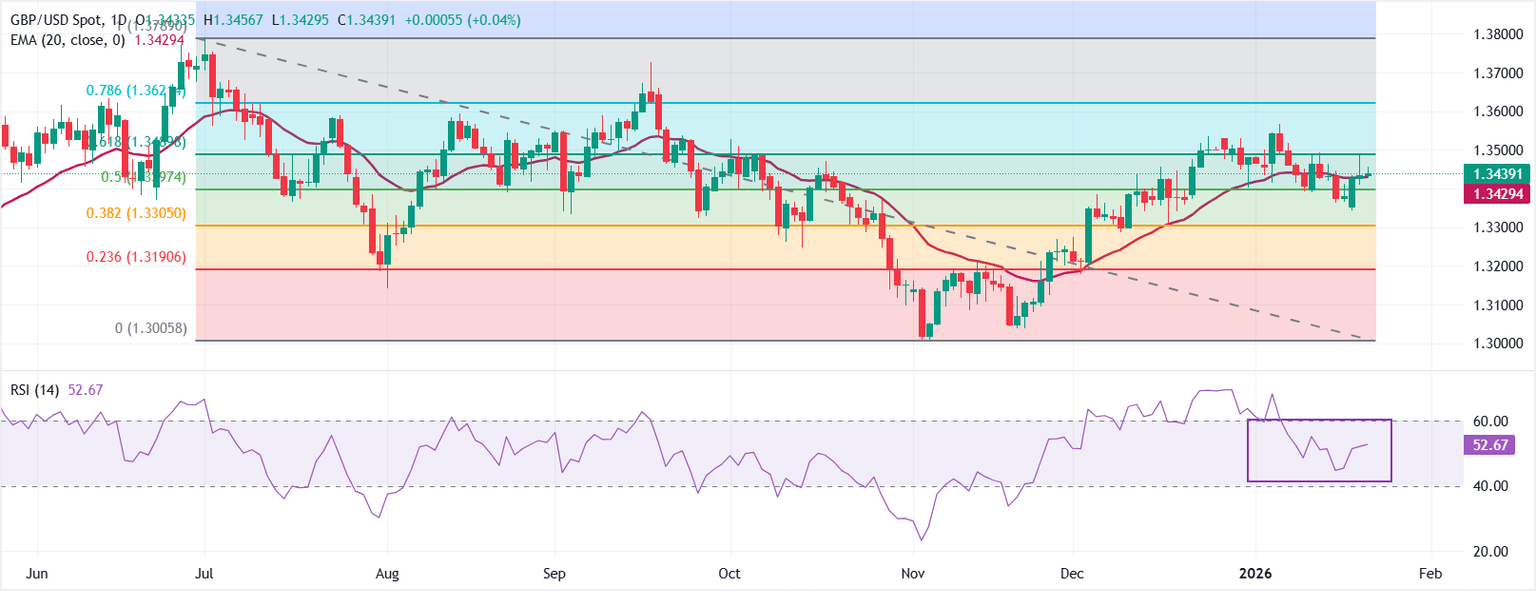
GBP/USD trades broadly sideways near 1.3440 at the time of writing. Price holds marginally above the 20-Exponential Moving Average (EMA) at 1.3429, which has flattened after a steady climb, signaling consolidation. A sustained close above the 20-day EMA would keep the near-term bias tilted to the upside.
The 14-day Relative Strength Index (RSI) at 53 (neutral) shows a slight improvement in momentum. Measured from the 1.3789 high to the 1.3006 low, any rebound would confront the 61.8% retracement at 1.3490, while the 50% retracement at 1.3397 is a pivotal threshold.
A push through 60 by the RSI would strengthen bullish traction, whereas a dip under 50 would reassert bearish pressure. A daily close above the retracement resistance would extend the rebound, while a break back under the 20 EMA could revive the broader pullback.