- USD/INR appreciates due to weak Asian risk sentiment and flow pressures.
- The Indian Rupee recorded a 92.51 low on Wednesday, pressured by NDF-related dollar buying.
- The INR faces added pressure from higher dollar demand linked to bullion imports and persistent equity outflows.
USD/INR rebounded after modest losses in the previous session, driven by weak Asian risk sentiment and flow pressures. Traders note the Reserve Bank of India (RBI) remains a key backstop against a move beyond the psychological 92.00 level.
The Indian Rupee (INR) hit a record of 92.51 against the US Dollar (USD) on Wednesday, weighed down by dollar buying linked to NDF maturities and a chronic demand–supply imbalance.
The INR faces additional pressure due to higher dollar demand tied to bullion imports, persistent equity outflows, and rising depreciation expectations, while slow exporter hedging continued to limit dollar supply.
Most economists polled by Reuters expect the Reserve Bank of India (RBI) to keep its key policy rate at 5.25% through 2026, as the central bank evaluates the economic impact of previous interest rate cuts.
US Dollar gains on a strong dollar policy
- The US Dollar Index (DXY), which measures the value of the US Dollar against six major currencies, has recovered its recent losses from the previous session and is trading around 96.50 at the time of writing.
- Bloomberg reported late Thursday that US President Donald Trump said that he will announce his choice to replace Jerome Powell as the chair of the Federal Reserve (Fed) on Friday morning. Trump said that his pick will do a “good job” and that he wants the US central bank to cut rates when there are signs of economic growth.
- The Greenback found support after Treasury Secretary Scott Bessent reaffirmed the US commitment to a “strong dollar policy,” pushing back against earlier comments from US President Donald Trump that suggested tolerance for a weaker currency. Bessent stressed that solid US fundamentals and sound policy settings should continue to draw capital inflows, rejecting speculation of any US intervention to sell dollars against the Japanese Yen (JPY).
- The US Federal Reserve (Fed) decided to keep interest rates unchanged at its January meeting on Wednesday, pointing to still-elevated inflation and resilient economic growth.
- Fed Chair Jerome Powell noted during the post-meeting press conference that job gains have moderated and the unemployment rate has shown signs of stabilization, adding that the Fed is “well positioned” to assess incoming data on a meeting-by-meeting basis and remains off a preset path for future rate decisions.
- Morgan Stanley analysts said in a note that further policy easing largely hinges on clear evidence of disinflation, which they expect to emerge later in 2026. As a result, they maintain their forecast for rate cuts in June and September.
- US President Donald Trump would soon announce his nominee to replace Fed Chair Jerome Powell, fueling speculation that the next chair could favor faster interest rate cuts.
- Indian Prime Minister Narendra Modi’s government has agreed to immediately cut duties on select vehicles priced above EUR 15,000, with rates set to gradually fall to 10%, easing market access for automakers such as Volkswagen, Mercedes-Benz, and BMW.
USD/INR hovers around 92.00 amid persistent bullish momentum
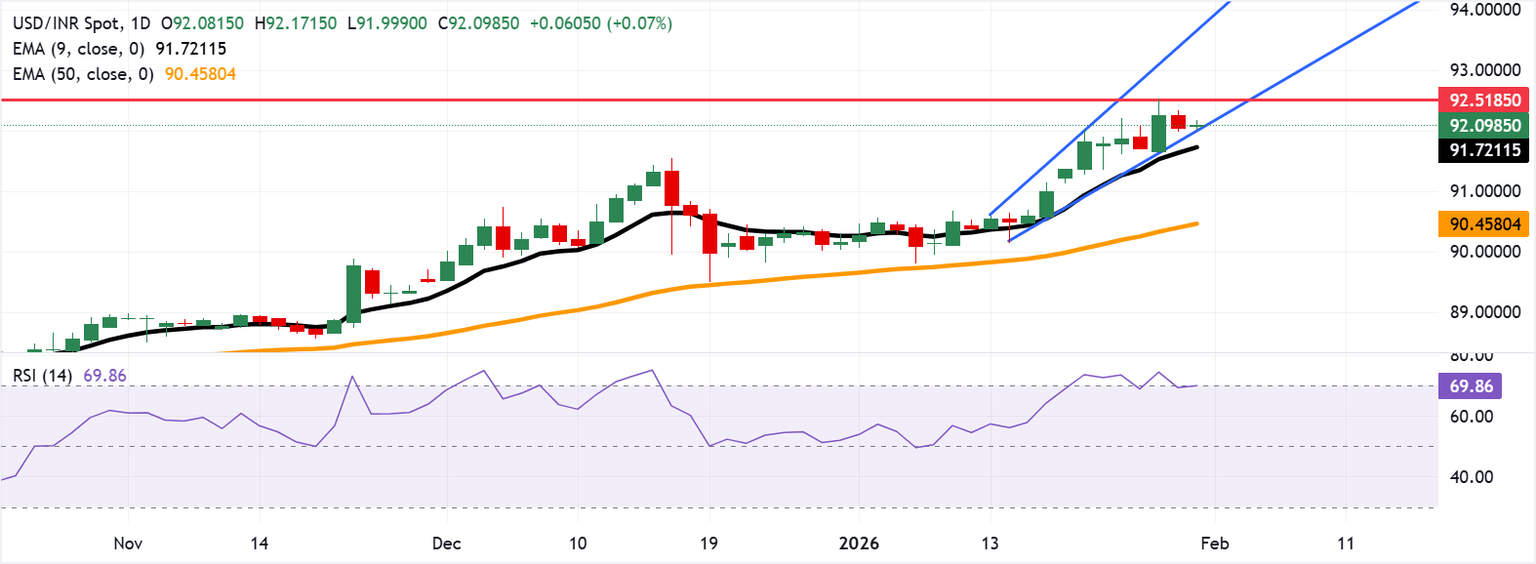
USD/INR is trading around 92.10 at the time of writing. Daily chart analysis points to a sustained bullish bias, with the pair remaining within an ascending channel pattern. However, the 14-day Relative Strength Index (RSI) at 69.72 sits just below the overbought threshold, confirming firm bullish momentum.
The nine-day Exponential Moving Average (EMA) stands above the 50-day EMA, with the short-term average rising and maintaining upside pressure. The expanding separation between them supports a continuation of the trend.
The initial resistance is seen at the January 28 all-time high of 92.51. A break above this level would support the USD/INR pair to approach the upper boundary of the ascending channel near 93.60. On the downside, the immediate support lies at the lower channel support around 92.00, followed by the nine-day Exponential Moving Average (EMA) at 91.71. Further declines would expose the 50-day EMA at 90.46.