S&P 500 — US Large Cap Index
 FTSE 100 — UK Blue Chips
 Euro Stoxx 50 — Eurozone Leaders
 DAX 40 — German Equities
 CAC 40 — French Market Index
 Nikkei 225 — Japan Benchmark
 Hang Seng — Hong Kong Index
 Shanghai Composite — China Mainland
 ASX 200 — Australian Market
 TSX Composite — Canada Index
 Nifty 50 — India Large Cap
 STI Index — Singapore Market
 KOSPI — South Korea Index
 Bovespa — Brazil Equities
 JSE Top 40 — South Africa Index
 IPC Index — Mexico Market

Alstom shares slump 25% in panic mode after the business guidance cut


Shares in rolling stock and signalling systems manufacturer Alstom (ALO.FR) are down around 25% on Monday, falling to approximately €11.50 following another sharp cut to the company’s financial outlook. The scale of the sell-off points to growing investor concerns about project profitability, the company’s cash position and the credibility of management’s turnaround plans. The most serious warning sign is the deterioration in the free cash flow outlook. Alstom now expects negative free cash flow of approximately €1.5 billion for the full financial year, having previously guided for positive cash flow. Such substantial cash requirements limit the company’s ability to reduce debt using internally generated funds. Shares in competing companies, including Siemens (the parent company of Siemens Mobility), Stadler and Spain’s CAF, have performed considerably better in recent quarters.
- The forecast for the adjusted profit margin has been cut from 6.5% to around 1%, a reduction of 5.5 percentage points. Such a low level of profitability leaves little room to absorb additional costs, while further problems with order execution could put even greater pressure on earnings.
- The company also expects slower revenue growth of 2–4% in the financial year ending in March, compared with approximately 5% previously. The much sharper revision to margins than to sales growth suggests that contract profitability and execution remain particularly challenging.
- The immediate trigger for the downgrade is delays affecting German projects involving Coradia Max trains. Alstom temporarily paused development work to carry out additional testing, which will delay deliveries across six contracts and result in contractual penalties. The problems therefore extend across several orders, increasing the scale of the financial impact.
- Management has also outlined a plan to reduce debt by €2 billion. With free cash flow expected to remain negative, achieving this target will be particularly demanding. The method and timing of debt reduction will become important factors in assessing the company’s financial position.
- This is the second downgrade since Martin Sion took over as chief executive in April. The first revision triggered a share price decline of around 30%. Another profit warning could further undermine confidence in the predictability of earnings and the new management team’s ability to bring operational problems under control quickly.
- The current difficulties reflect Alstom’s longstanding challenges with contract execution. The 2021 acquisition of Bombardier’s rail business left the company with a number of low-margin contracts, while repeated guidance cuts highlight the difficulty of translating the scale of its operations into stable profitability and positive cash flow.
- Sion aims to normalise performance from the next financial year. However, rebuilding investor confidence will depend primarily on timely deliveries, lower costs associated with delays and stronger cash generation. Upcoming reports will help investors assess whether the latest guidance reset provides a credible basis for improvement.
Alstom (ALO.FR) share price chart, D1 interval
Alstom shares are falling today to their lowest levels since 2023, testing a significant support zone around €10–12 per share. The stock is now trading almost 40% below its 200-day exponential moving average (EMA200, red line, around €18) and remains in a pronounced downtrend. The decline from its early-year highs of around €30 has reached approximately 61%. Initial resistance appears to lie near €12.50, while €15.30, the level from which the sharp gap down originated, represents a key longer-term resistance level.
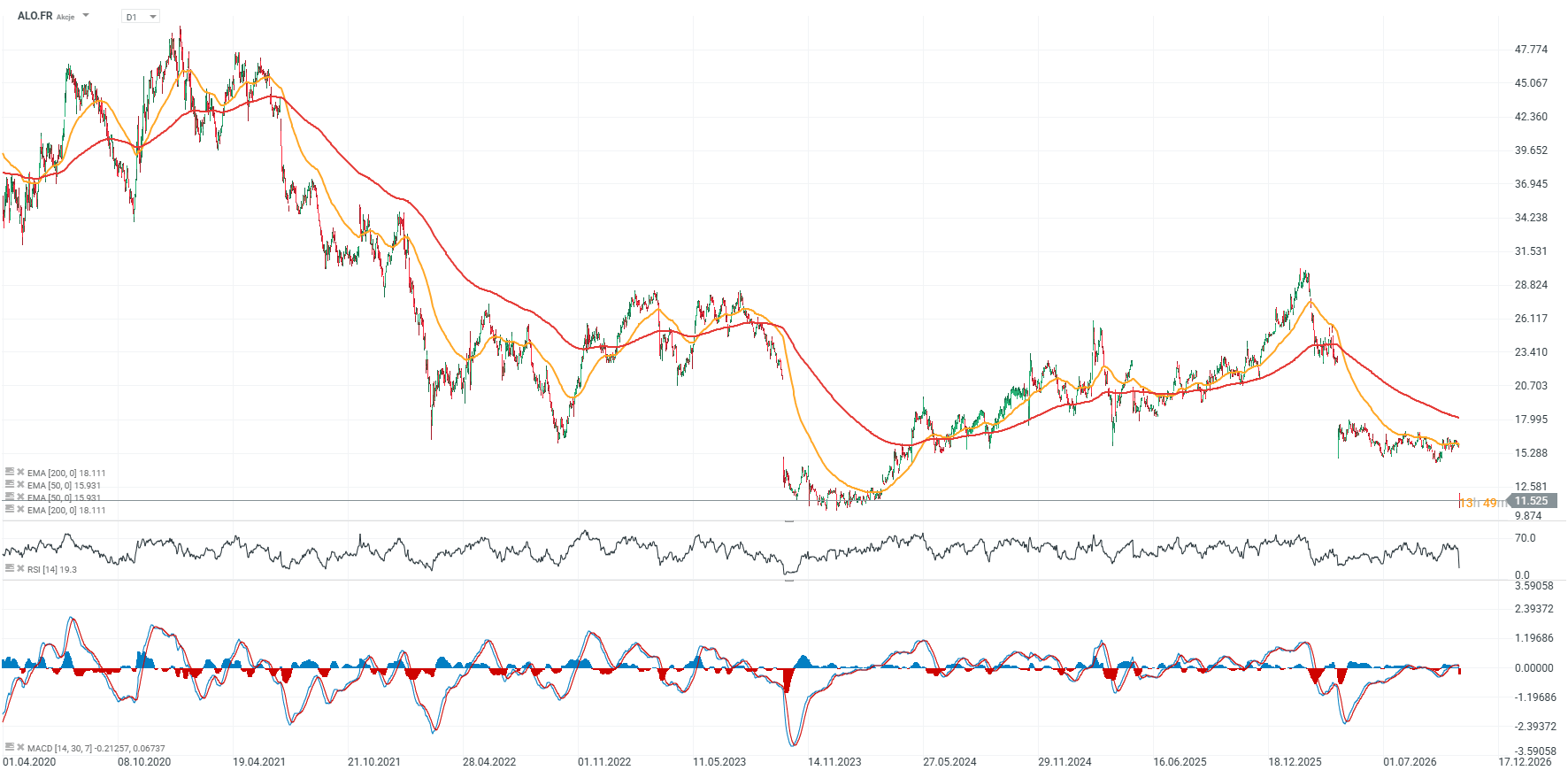
Source: xStation5