S&P 500 — US Large Cap Index
 FTSE 100 — UK Blue Chips
 Euro Stoxx 50 — Eurozone Leaders
 DAX 40 — German Equities
 CAC 40 — French Market Index
 Nikkei 225 — Japan Benchmark
 Hang Seng — Hong Kong Index
 Shanghai Composite — China Mainland
 ASX 200 — Australian Market
 TSX Composite — Canada Index
 Nifty 50 — India Large Cap
 STI Index — Singapore Market
 KOSPI — South Korea Index
 Bovespa — Brazil Equities
 JSE Top 40 — South Africa Index
 IPC Index — Mexico Market
- The Japanese Yen strengthens against the USD for the second straight day on Wednesday.
- The prospects for further policy normalization by the BoJ continue to underpin the JPY.
- Softer US CPI lifts bets for two Fed rate cuts in 2025, weighing on the USD and USD/JPY.
The Japanese Yen (JPY) remains on the front foot against its American counterpart for the second straight day on Wednesday and drags the USD/JPY pair to the 147.00 neighborhood during the Asian session. The Bank of Japan (BoJ) Deputy Governor Shinichi Uchida’s hawkish comments on Tuesday keep the door open for further policy normalization and assist the JPY to build on the previous day’s goodish recovery from over a one-month low.
In contrast, Tuesday’s softer US consumer inflation figures lifted bets that the Federal Reserve (Fed) will cut interest rates at least two times this year. This, in turn, keeps the US Dollar (USD) on the defensive below its highest level since April 10 and further benefits the lower-yielding JPY. However, the upbeat market mood, bolstered by the optimism over a US-China tariff truce for 90 days, might keep a lid on any further gains for the safe-haven JPY.
Japanese Yen remains supported by bets that the BoJ will hike rates again in 2025
- Data released this Wednesday showed that Japan’s Producer Price Index (PPI) rose 0.2% in April, and the yearly rate came in at 4%, down from 4.2% in the previous month. The Japanese Yen, however, moves little after the data and draws support from expectations for more rate hikes by the Bank of Japan.
- In fact, BoJ Deputy Governor Shinichi Uchida reiterated on Tuesday that the central bank will keep raising rates if the economy and prices improve as projected. Japan’s economic growth is expected to slow to around its potential before resuming moderate growth as overseas economies recover, Uchida added further.
- On the other hand, traders pared their bets for more aggressive policy easing by the Federal Reserve amid easing recession fears. Investors, however, are still pricing in 56 basis points of Fed rate cuts this year, and the bets were reaffirmed by softer US consumer inflation figures released on Tuesday.
- The US Bureau of Labor Statistics (BLS) reported that the headline Consumer Price Index (CPI) edged lower to the 2.3% YoY rate in April from 2.4% in the previous month. Meanwhile, the core CPI, which excludes volatile food and energy prices, rose 2.8% on a yearly basis, matching consensus estimates.
- This keeps the US Dollar depressed below its highest level since April 10 touched earlier this week, and exerts some downward pressure on the USD/JPY pair. However, the US-China trade deal optimism might hold back traders from placing aggressive bullish bets around the safe-haven JPY.
- US President Donald Trump said in a Fox News interview that the relationship with China is excellent. This comes on top of positive news from the US-China tariff negotiations over the weekend, where both countries agreed to pause the trade war for 90 days and bring down reciprocal duties.
USD/JPY could find decent support near the 23.6% Fibo., around the 146.60-146.55 area
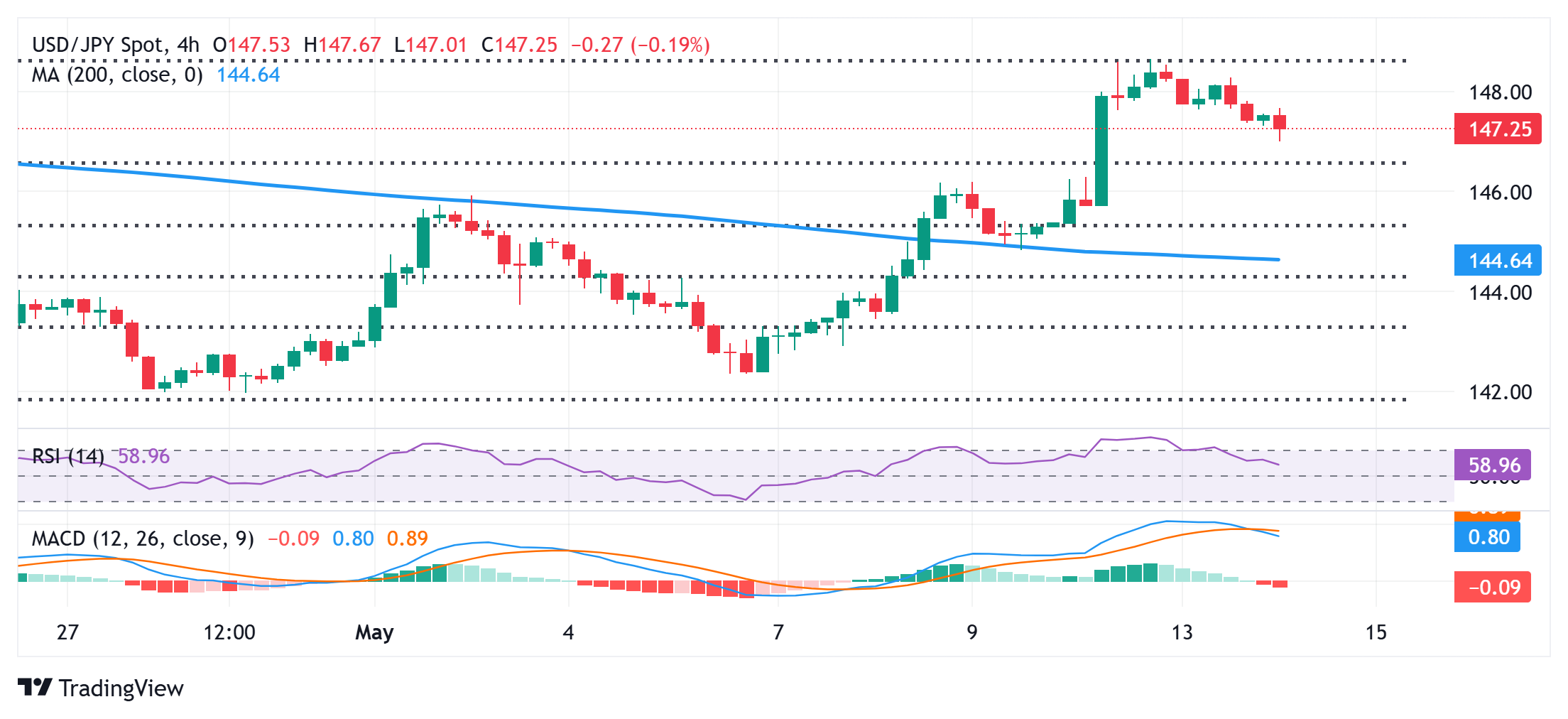
From a technical perspective, the recent breakout through the 200-period Simple Moving Average (SMA) on the 4-hour chart and positive oscillators on the daily chart favor bullish traders. Hence, any subsequent slide below the 147.00 mark might still be seen as a buying opportunity near the 146.60-146.55 area, representing the 23.6% Fibonacci retracement level of the strong recovery from the year-to-date low touched in April. A convincing break below, however, might prompt some technical selling and drag the USD/JPY pair to the 146.00 mark en route to the 145.40 region (38.2% Fibo. level) and the 145.00 psychological mark. This is closely followed by the 144.80-144.75 area, or the 200-period SMA on the 4-hour chart, which, if broken decisively, would negate the near-term positive bias.
On the flip side, the 147.65 zone now seems to act as an immediate hurdle, above which the USD/JPY pair could climb to the 148.00 round figure en route to the 148.25-148.30 region and over a one-month peak, around the 148.65 area touched on Monday. Some follow-through buying beyond the latter will be seen as a fresh trigger for bulls and lift spot prices beyond the 149.00 mark, towards the 149.65-149.70 area and eventually to the 150.00 psychological mark.