S&P 500 — US Large Cap Index
 FTSE 100 — UK Blue Chips
 Euro Stoxx 50 — Eurozone Leaders
 DAX 40 — German Equities
 CAC 40 — French Market Index
 Nikkei 225 — Japan Benchmark
 Hang Seng — Hong Kong Index
 Shanghai Composite — China Mainland
 ASX 200 — Australian Market
 TSX Composite — Canada Index
 Nifty 50 — India Large Cap
 STI Index — Singapore Market
 KOSPI — South Korea Index
 Bovespa — Brazil Equities
 JSE Top 40 — South Africa Index
 IPC Index — Mexico Market

Facts
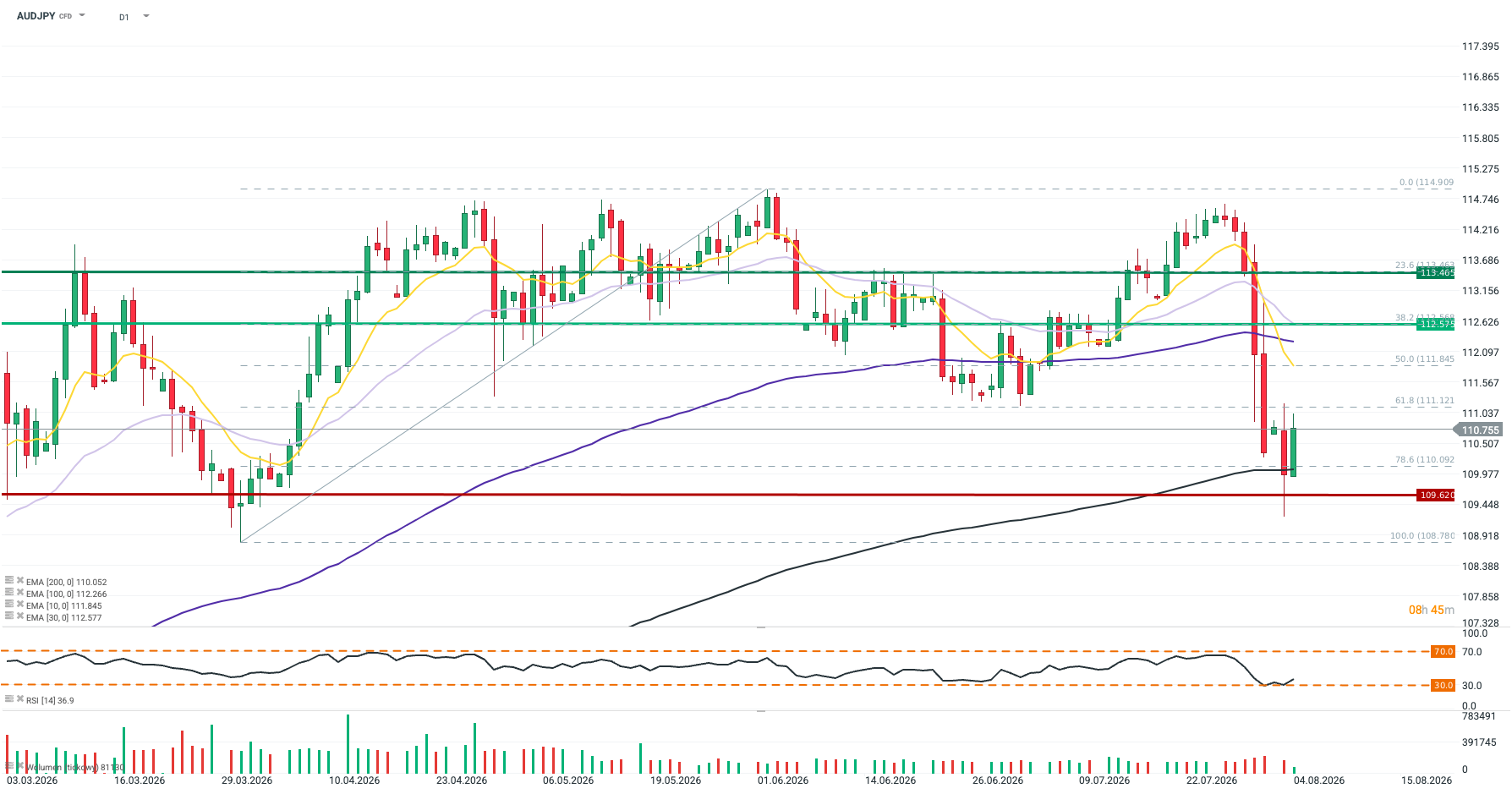
- AUDJPY returned today above the 200-day exponential moving average (EMA200; black).
- Daily RSI[14] fell over the past week from approx. 65 to approx. 34.
- Interest rates in Australia remain higher than in Japan (4.35% vs. 1.00%).
Recommendation
- Position: Long (BUY) on AUDJPY at market price
- Target Price (Take Profit; TP): 112.575 (TP1), 113.465 (TP2)
- Stop Loss (SL): 109.620
Source: xStation5
Opinion
Recent currency interventions on the yen and a unified narrative from Japanese and US authorities standing behind the Japanese currency (US Treasury Secretary Bessent today: “The United States will do everything in its power to support the yen”) led to a sharp sell-off in JPY-led pairs (AUDJPY: -3.5%, USDJPY: -3.9%, EURJPY: -2.6% change over the past week). The determination communicated by Tokyo and Washington should limit speculative selling of the yen; however, a sustained recovery in the Japanese currency will likely only be possible following stabilization in the bond market and a clear hawkish turn by the Bank of Japan. With current interest rates (Australia: 4.35%, Japan: 1.00%), the recent AUDJPY sell-off enhances the appeal of the carry trade, even in light of recent, fairly dovish remarks from the RBA. A rebound off the 200-day EMA (black), combined with a global increase in risk appetite (gains in risk assets, falling oil prices, de-escalation in the Middle East), should therefore motivate at least a local upward correction in AUDJPY. This is further supported by the fact that AUDUSD itself remains in an uptrend (trading above the EMA30 and EMA100 on the daily interval), bolstered by the recent decline in US rate hike expectations.
Methodology
This recommendation was prepared based on a technical analysis of the AUDJPY chart and a fundamental analysis of the respective economies (monetary policy in Japan, Australia, and the US). The directional bias was determined using moving averages and market expectations regarding central bank policies. Take Profit and Stop Loss levels were established using Fibonacci retracements and price action:
- TP1 is set at the 38.2% Fibonacci level.
- TP2 is set at the 23.6% Fibonacci level.
- SL is placed between the 100% and 78.6% Fibonacci levels, slightly below the EMA200.