S&P 500 — US Large Cap Index
 FTSE 100 — UK Blue Chips
 Euro Stoxx 50 — Eurozone Leaders
 DAX 40 — German Equities
 CAC 40 — French Market Index
 Nikkei 225 — Japan Benchmark
 Hang Seng — Hong Kong Index
 Shanghai Composite — China Mainland
 ASX 200 — Australian Market
 TSX Composite — Canada Index
 Nifty 50 — India Large Cap
 STI Index — Singapore Market
 KOSPI — South Korea Index
 Bovespa — Brazil Equities
 JSE Top 40 — South Africa Index
 IPC Index — Mexico Market
Will Palantir keep declining? Michael Burry weighs in.

Michael Burry, the investor known for correctly predicting the subprime crisis, has pointed to a further deterioration in Palantir’s situation. Burry has been an outspoken critic of the company’s valuation levels for quite some time. Palantir is one of the companies that, for now, are moving in line with the chief analyst’s forecasts. Since the beginning of the year, the company’s shares have already lost around 30%.
Technicals
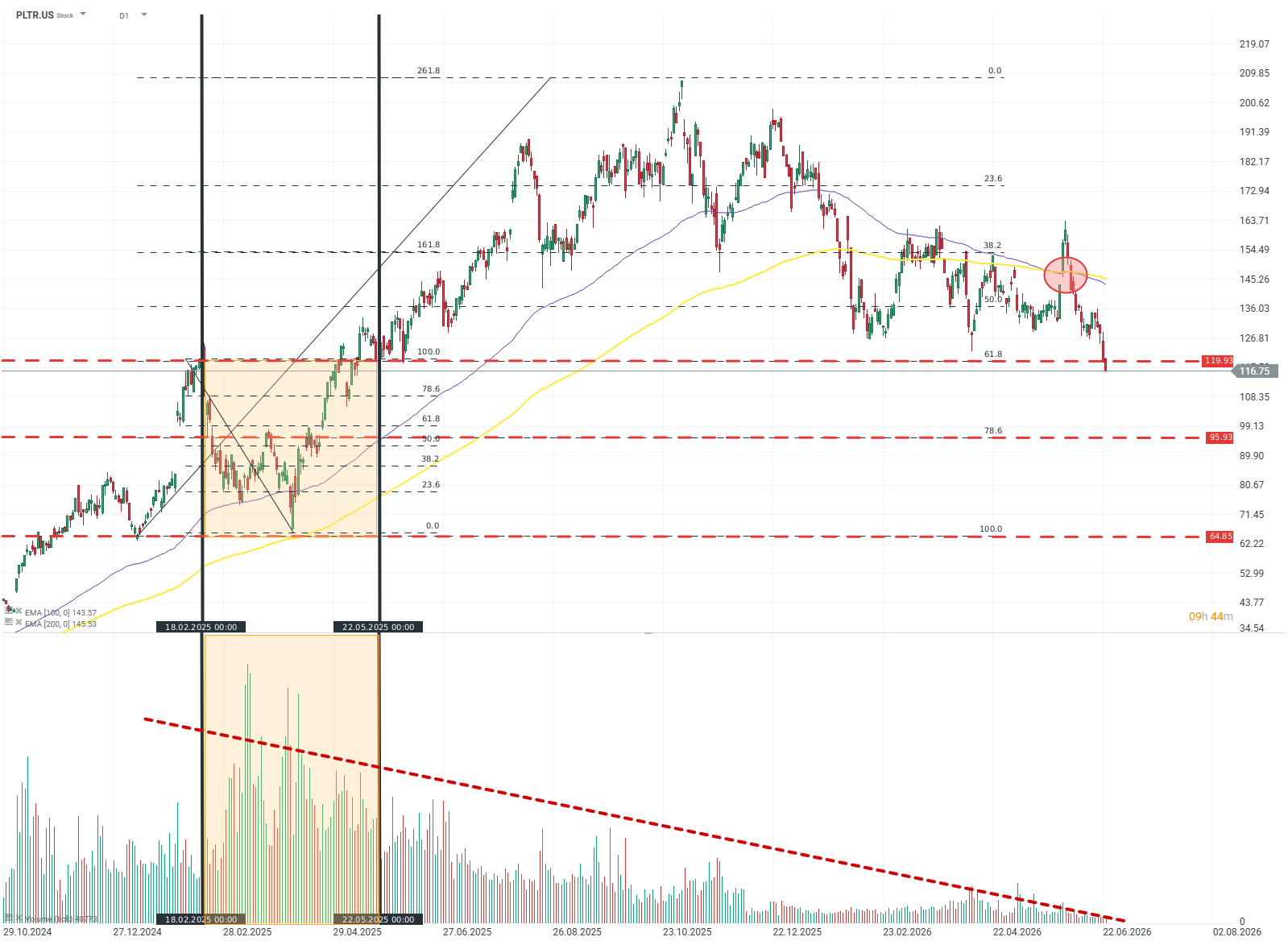
In his latest posts, he indicated what he believes is a worsening technical picture for the company. Are these allegations justified? Burry noted that most of the volume was recorded “near the highs,” and that a downtrend accompanied by declining volume supports the thesis that bearish momentum will persist.
Source: xStation5
This view is not entirely consistent with reality. Looking at the chart, one can observe that peak volume occurred across a (fairly wide) price range between USD 118 and 65. After the company’s shares had already fallen by more than 40%, the price merely returned to the main range of that move. Additionally, Burry tries to link weak volume with a “lack of interest” in the stock and further declines. This is an intuitive view, but from a technical-analysis perspective it is incorrect. A widely accepted theory in publications on this topic is that declining volume reduces, rather than increases, the “quality” and durability of price moves on a chart. Could this therefore signal an upcoming bullish correction? Not necessarily. A much more important signal than falling volume is the “death cross” formed by the 100- and 200-period EMAs. The previous time such a signal appeared on the company’s chart was at the end of 2021, after which the stock lost about 60% of its value.
Fundamentals
Michael Burry also pointed to a number of fundamental issues. He mainly highlighted the company’s relatively “shallow moat,” especially given that it is a SaaS-type business, even if the company’s leadership may suggest otherwise. Another problem is that Palantir is alleged to engage in “aggressive revenue recognition” to synthetically improve its results. These are interesting observations, but are they correct? The first argument is debatable. Burry presented no evidence of excessive reliance on third-party solutions. The company itself, meanwhile, offers a very unique set of services and has deep ties with governments and intelligence services around the world. If that kind of moat is shallow, then one has to ask how Burry defines its “depth.” The allegation about aggressive revenue recognition is, however, false. Under financial audit and accounting standards, such practices are characterized by revenue growing faster than, or outpacing, receivables—in Palantir’s case it is the opposite. That signals an issue for the company, but of a completely different nature.
What’s behind the declines?
Most of the downward move observed in the stock’s valuation is a consequence of its nature. Above all, Palantir is a company often referred to as “hyper-growth,” with profit growth rarely seen even in the tech sector and similarly high margins, giving it enormous operating leverage and, as a result, high valuation multiples. This means that even the smallest disappointment during earnings releases can trigger a painful sell-off. The second factor pressuring valuations is the SaaS segment the company belongs to. On the wave of the AI boom and the growing importance of agent/LLM-based solutions, the market has preemptively written off nearly all SaaS companies, without asking about the nature of or the real impact of the AI revolution on their business. Palantir is no exception. Given the broader market context, breaking out of the downtrend and returning to the highs would be a major challenge—however, the USD 120–70 range is wide and provides plenty of opportunities to move into consolidation while waiting for more favorable investor sentiment.