AUD/USD – Will The RBA be The Next Central Bank to Return to Rate Cuts

The Australian dollar (AUD) remains one of the stronger currencies following higher-than-expected inflation data. The latest CPI reading surprised to the upside in both headline and core inflation, reinforcing the view that price pressures remain too elevated for the Reserve Bank of Australia (RBA) to adopt a dovish — or even neutral — stance anytime soon.
Headline inflation accelerated to 3.8% y/y in December, while core inflation (trimmed mean) rose to around 3.4% y/y, clearly above the RBA’s 2–3% target and confirming that the disinflation process has stalled rather than progressed steadily. On a quarterly basis, core inflation came in at 0.9% q/q, which also does not support a smooth return to target.
Key inflation data
- Headline CPI: 3.8% y/y (from 3.4%)
- CPI trimmed mean: ~3.4% y/y, above expectations
- Core inflation: 0.9% q/q, maintaining strong momentum
- Services inflation accelerated to 4.1% y/y
- Housing costs remain the biggest driver: +5.5% y/y
The inflation mix is particularly uncomfortable for the RBA. Services inflation has re-accelerated, reflecting strong domestic demand, a tight labour market, and persistent pressure from rents and travel costs. At the same time, goods inflation has picked up again, partly due to a sharp rise in electricity prices. Combined with unemployment around 4% and solid economic growth, the data suggest inflation pressures are becoming increasingly entrenched across key sectors of the economy rather than driven by temporary or imported factors.
Main sources of price pressure
- Strong services inflation (rents, travel, market services)
- High housing costs weighing on households
- Rising energy prices boosting goods inflation
- Tight labour market sustaining wage pressures
In response to the data, Australia’s largest banks — including Westpac and ANZ — have begun to expect a 25 bp rate hike from the RBA at the 2–3 February meeting, arguing that inflation has effectively cast the “decisive vote” for tighter policy. Markets are now pricing in over a 70% probability of such a move. While most see it as a one-off hike rather than the start of a full tightening cycle, the RBA is expected to maintain a conditionally hawkish stance, with future decisions tied closely to incoming inflation data. The central bank has also made it clear that inflation above 3% remains “too high,” effectively ruling out near-term rate cuts.
RBA outlook after CPI
- February hike increasingly viewed as the base case
- Cash rate could rise to around 3.85%
- Possible pause thereafter, but with a hawkish bias
- Further tightening possible if inflation remains persistent
Market reaction
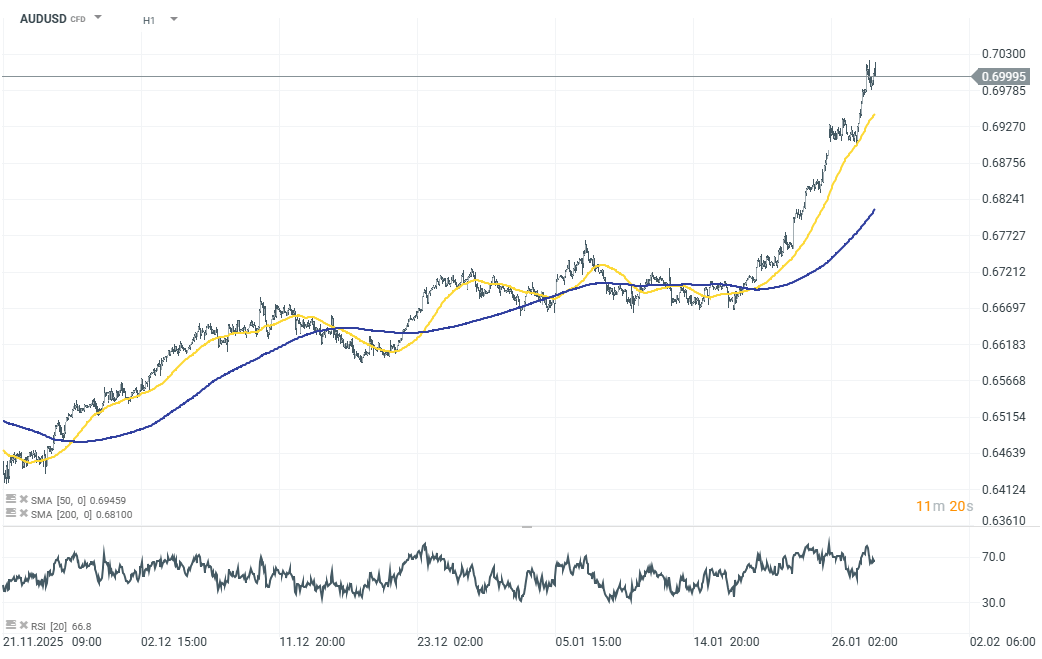
The Australian dollar surged sharply after the release — AUD reached its highest level since early 2023, and AUDUSD broke above 0.70, extending a strong start to the year. Investors have begun positioning for a more hawkish RBA relative to other major central banks. Recent gains in AUDUSD have also been supported by broad weakness in the US dollar.
The material on this page does not constitute financial advice and does not take into account your level of understanding, investment objectives, financial situation or any other specific needs. All information provided, including opinions, market research, mathematical results and technical analyzes published on the Website or transmitted To you by other means, it is provided for information purposes only and should in no way be construed as an offer or solicitation for a transaction in any financial instrument, nor should the information provided be construed as advice of a legal or financial nature on which any investment decisions you make should be based exclusively To your level of understanding, investment objectives, financial situation, or other specific needs, any decision to act on the information published on the Website or sent to you by other means is entirely at your own risk if you In doubt or unsure about your understanding of a particular product, instrument, service or transaction, you should seek professional or legal advice before trading. Investing in CFDs carries a high level of risk, as they are leveraged products and have small movements Often the market can result in much larger movements in the value of your investment, and this can work against you or in your favor. Please ensure you fully understand the risks involved, taking into account investments objectives and level of experience, before trading and, if necessary, seek independent advice.