S&P 500 — US Large Cap Index
 FTSE 100 — UK Blue Chips
 Euro Stoxx 50 — Eurozone Leaders
 DAX 40 — German Equities
 CAC 40 — French Market Index
 Nikkei 225 — Japan Benchmark
 Hang Seng — Hong Kong Index
 Shanghai Composite — China Mainland
 ASX 200 — Australian Market
 TSX Composite — Canada Index
 Nifty 50 — India Large Cap
 STI Index — Singapore Market
 KOSPI — South Korea Index
 Bovespa — Brazil Equities
 JSE Top 40 — South Africa Index
 IPC Index — Mexico Market
Australian Dollar Tests 0.7000 as Fed-RBA Rate Expectations Drive the Outlook


The Australian dollar is trading near 0.7010 against the US dollar as stronger US Treasury yields and increasingly hawkish Federal Reserve expectations keep pressure on AUD/USD. Attention is now turning toward the Reserve Bank of Australia’s upcoming interest-rate decision, which could provide an important counterweight to US monetary-policy expectations.
The currency remains caught between two opposing forces. A more restrictive Federal Reserve is supporting the US dollar, while rising expectations for further RBA tightening are providing underlying support for the Australian dollar.
The next direction for AUD/USD is therefore likely to depend on how aggressively both central banks are expected to respond to persistent inflation.
Market Snapshot
| Market Driver | Current Situation | Market Implication |
|---|---|---|
| AUD/USD | Around 0.7010 | Trading close to the 0.7000 level |
| US Treasury yields | Rising | Supporting the US dollar |
| Fed policy | Increasingly hawkish | Potential headwind for AUD/USD |
| Fed October hike expectations | Around 65.9% | Reinforcing USD rate support |
| RBA | Expected to tighten | Potential support for AUD |
| Expected RBA OCR | 4.60% after a 25 bp hike | Highest level since 2011 |
| Australian unemployment | 4.6% | Slightly above expectations |
| Australian participation | Increased | Suggests underlying labour conditions remain firm |
| AUD/USD 100-day SMA | Around 0.7070 | Initial technical resistance |
| Bollinger middle band | Around 0.7130 | Additional resistance |
| Bollinger lower band | Around 0.7000 | Important downside level |
| RSI | Around 33 | Near oversold territory |
Current AUD/USD Price Action
AUD/USD is hovering near 0.7010 after losing momentum as the US dollar strengthens.
The 0.7000 area has become an important near-term reference point. A sustained break below this level would indicate that selling pressure is gaining traction, while a recovery above the 100-day moving average around 0.7070 would begin to improve the near-term technical picture.
The market is also approaching the RBA decision with traders assessing whether Australian monetary policy can offset the renewed strength of the US dollar.
Federal Reserve Keeps a Restrictive Tone
Recent comments from Federal Reserve officials have reinforced expectations that US interest rates could remain elevated.
Fed officials have highlighted concerns that persistent inflation could become embedded in consumer and business expectations. The message remains that monetary policy may need to stay restrictive if progress toward the inflation target stalls.
Markets are currently pricing a significantly higher probability of another Fed rate increase in October than they were previously.
The rise in US Treasury yields has added another source of support for the dollar, increasing the pressure on AUD/USD.
RBA Rate Decision Comes Into Focus
The Reserve Bank of Australia is expected to raise its policy rate by 25 basis points, potentially taking the Official Cash Rate to 4.60%.
Such a move would place the Australian policy rate at its highest level since 2011.
However, the rate decision itself may not be the only catalyst for the Australian dollar. Governor Michele Bullock’s comments following the decision will be closely watched for indications of whether another increase could follow in November.
The market will therefore be assessing both the immediate decision and the potential path for Australian rates beyond September.
Australian Labour Market Sends a Mixed Signal
Australia’s latest labour-market data provides a mixed picture.
The unemployment rate increased to 4.6%, slightly above expectations and above the RBA’s year-end projection of 4.5%.
However, the increase in unemployment was accompanied by a higher participation rate. That means the headline rise in unemployment does not necessarily indicate a sharp deterioration in underlying labour-market conditions.
For the RBA, the combination of persistent inflation and relatively firm underlying employment conditions could keep additional tightening on the policy table.
Rate Differential Remains Central to AUD/USD
The relative outlook for the Federal Reserve and RBA remains one of the most important drivers of AUD/USD.
If the RBA signals further tightening while the Fed also maintains a restrictive stance, the difference between the two policy paths may remain relatively contained.
That could limit some of the pressure created by higher US yields.
Conversely, if the Fed becomes more hawkish while the RBA signals caution after its expected move, the interest-rate differential could shift in favour of the US dollar.
Commodity Exposure Provides Longer-Term Support
The Australian dollar also remains closely connected to global commodity demand.
Australia’s exposure to commodities associated with energy, AI infrastructure and defence provides a longer-term structural influence on the currency.
Strong commodity demand can support Australia’s external position and contribute to AUD resilience, although this factor can be outweighed in the short term by movements in US rates and the dollar.
Technical Picture: AUD/USD Nears an Important Support Level
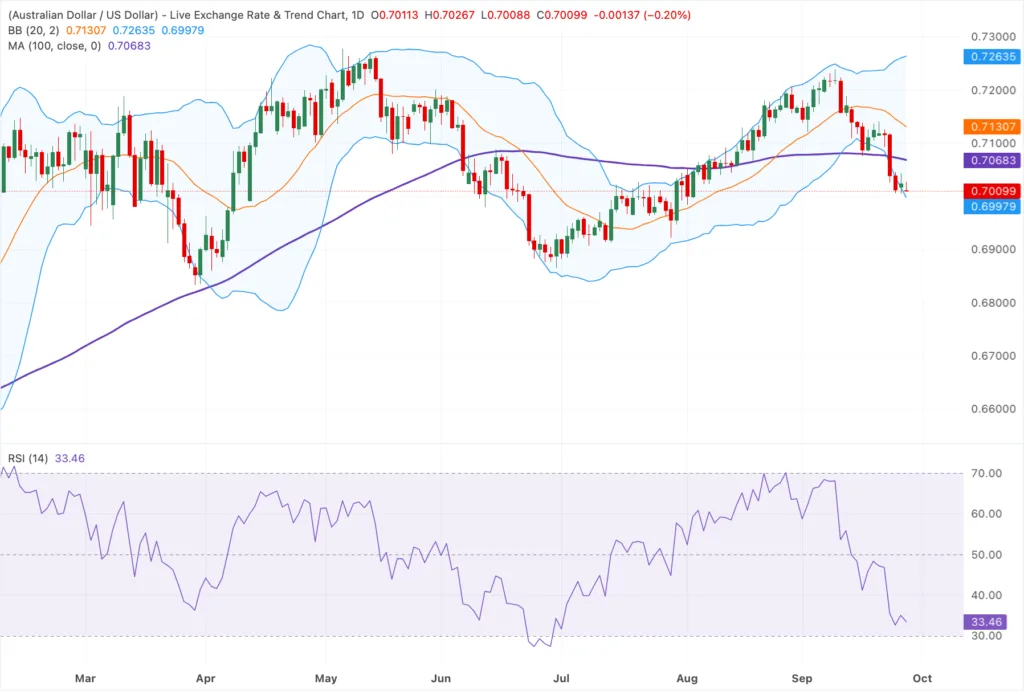
AUD/USD remains below its 100-day simple moving average and the Bollinger middle band, keeping the near-term technical structure under pressure.
The RSI is around 33, indicating that selling pressure is approaching oversold territory. This does not by itself confirm a reversal, but it suggests that the downside move could become increasingly stretched if selling accelerates.
The key levels are:
- 0.7000: Important downside support and Bollinger lower-band area.
- 0.7070: 100-day moving average and initial recovery resistance.
- 0.7130: Bollinger middle band.
- 0.7265: Upper Bollinger band.
A sustained move below 0.7000 would keep the downside structure in focus, while a recovery above 0.7070 would provide an initial indication that selling pressure is easing.
Bullish Sentiment
- Potential RBA tightening: A 25 bp increase to 4.60% could reinforce Australian dollar support.
- Further RBA hikes remain possible: A firm inflation outlook could encourage expectations for additional tightening.
- Underlying labour conditions remain relatively firm: Higher participation suggests the rise in unemployment needs to be interpreted carefully.
- Commodity exposure: Australia’s strategic exposure to energy, AI and defence-related commodities provides a longer-term source of potential currency support.
- Oversold conditions: An RSI near 33 means selling pressure is becoming stretched, leaving scope for a technical recovery if the market receives a supportive catalyst.
Bearish Sentiment
- Hawkish Federal Reserve: Expectations for additional US tightening continue to support the dollar.
- Higher Treasury yields: Rising US yields increase the relative attractiveness of US-dollar assets.
- AUD/USD below key averages: Trading below the 100-day SMA and Bollinger middle band keeps the near-term technical structure under pressure.
- 0.7000 support at risk: A clear break below this level could extend the current downside move.
- RBA caution risk: Even after a rate increase, cautious guidance could limit expectations for further Australian tightening.
Price Forecast: What Traders Are Watching
The next major catalyst is the RBA decision and, more importantly, the guidance surrounding the future path of Australian interest rates.
A clearly hawkish RBA message could provide the Australian dollar with a catalyst to recover above 0.7070, particularly if US Treasury yields stabilise.
A cautious RBA stance combined with continued hawkish Federal Reserve expectations would leave AUD/USD exposed to further pressure around the 0.7000 level.
The technical picture is therefore closely aligned with the monetary-policy outlook: 0.7000 on the downside and 0.7070 on the upside are the first levels traders are likely to monitor.
Supply Outlook
For a currency market, supply is primarily reflected through capital flows and the availability of Australian dollars against demand for US dollars.
Higher Australian interest rates can support demand for AUD-denominated assets, while stronger US yields can redirect capital toward US-dollar assets.
The relative policy paths of the RBA and Federal Reserve will therefore remain central to AUD/USD flows.
Demand Outlook
Demand for the Australian dollar remains linked to Australian interest rates, commodity conditions and global risk appetite.
A stronger domestic rate outlook could support AUD demand, while renewed US-dollar strength and higher Treasury yields could keep demand tilted toward the dollar.
Commodity-market performance will also remain relevant because of Australia’s significant exposure to global raw-material demand.
Market Outlook for the Coming Sessions
AUD/USD enters the coming sessions with the 0.7000 level firmly in focus.
The RBA decision will determine whether Australian monetary policy can provide a stronger counterweight to the Federal Reserve’s restrictive stance. Beyond the rate decision, Governor Bullock’s guidance will be particularly important for determining whether markets continue to price further RBA tightening.
At the same time, US Treasury yields and expectations for another Federal Reserve rate increase will remain major drivers of the US dollar.
The coming sessions could therefore produce significant AUD/USD volatility as traders reassess the balance between Australian and US monetary policy.
Currency Hedger View
The Australian dollar illustrates why currency markets cannot be viewed in isolation.
Interest rates, inflation, employment, commodity prices, central-bank policy and global risk sentiment can all influence the cost of exchanging Australian dollars into US dollars and other currencies.
For businesses with Australian suppliers, customers or international payment requirements, understanding these forces can help put currency movements into a broader market context.
Analysis Louis Roche – Today Markets
AUD/USD is approaching an important decision point as the RBA prepares to address persistent inflation while the Federal Reserve maintains a restrictive policy stance.
The Australian dollar has underlying support from expectations of further RBA tightening and Australia’s commodity exposure, but the US dollar continues to benefit from higher Treasury yields and renewed expectations for Federal Reserve rate increases.
The RBA decision, Governor Bullock’s guidance, US yield movements and the 0.7000 technical level will be central to the currency’s next phase.
Louis Roche – Today Markets