Geopolitics has dominated financial markets since the beginning of 2026. Donald Trump, leading the United States, is currently the central figure in this unfolding drama, though the primary catalyst for risk did not originate with the American president himself. The largest anti-government protests in Iran in decades have been brutally suppressed by authorities, leading to over 30,000 deaths. Although Trump initially refrained from military intervention after the first wave of protests, all “red lines” he established have now been crossed. Trump is sending a clear signal: either an agreement is reached to ensure zero nuclear weapons and an end to the killing of innocent citizens, or the United States will respond with overwhelming force. How is this situation impacting the oil market?
Geopolitics vs. Massive Oversupply
All forecasts for 2026 pointed toward a massive oversupply in the oil market. The United States is producing at a record rate of over 13 million barrels per day (bpd), OPEC+ is restoring a large portion of production following years of cuts, and output continues to expand in South America. This is occurring alongside a potential “demand peak,” or “peak oil.” While crude remains irreplaceable in many respects, it is possible that demand has reached near-maximum levels. The International Energy Agency (IEA) indicates that oversupply this year could average 3.7 million bpd. The US EIA has slightly more conservative estimates, pointing to a surplus of 2 million bpd. Regardless of the forecast, the market is currently in one of its longest periods of oversupply, a trend that began in 2022. Under similar fundamentals in 2014–2016, we saw prices collapse from $100 per barrel to just $40. Today, however, geopolitics is preventing prices from settling at levels dictated solely by the balance of supply and demand.
Investors Dislike Uncertainty
No investor wants to be in a situation where they do not know what awaits them—not in a year or a month, but in the next hour. Donald Trump has accustomed markets to the fact that his decisions have an extremely rapid and violent impact on financial assets. One need only look at gold or silver, which have seen record-breaking price surges almost overnight due to this uncertainty. Because Trump’s current focus involves major oil-producing nations, crude is experiencing immense volatility.
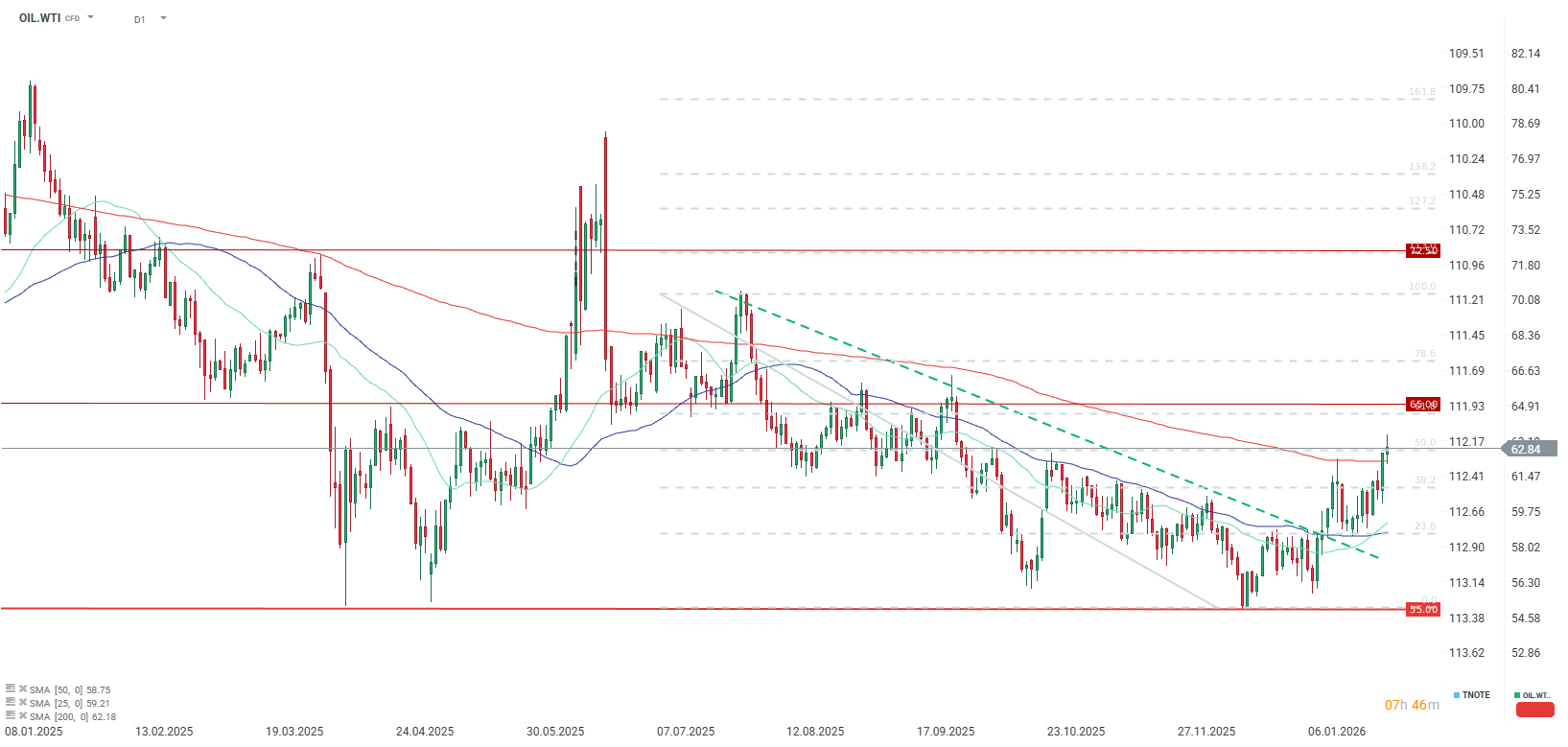
Since mid-December, WTI crude has risen from below $60 per barrel to $67, a gain of over 10%. The initial driver was the escalation regarding Venezuela, followed by uncertainty over a potential strike on Iran. Trump intends to prevent Iran from resuming nuclear weapons research and certainly wants an end to civilian bloodshed. Trump himself has suggested that a potential strike would be more powerful than the 2025 operation targeting nuclear infrastructure. Experts speculate that US actions could lead to the collapse of the regime but also threaten the current “fragile” global order.
Iran’s Market Share is Modest, but it Controls the Strait of Hormuz
Iran currently produces 3.3 million bpd and, until recently, exported nearly 2 million bpd to China. Due to the risk of sanctions, Chinese private refineries have recently slashed imports from Iran to approximately 1.3 million bpd. However, Iran’s global significance lies in its geography—specifically its control over the Strait of Hormuz, through which over 20 million barrels of oil pass daily. Iran did not block the strait following US and Israeli strikes in 2025, but it may do so now. As the US threatens a more decisive strike, Iran is conducting exercises at the Jask base, positioned to target any vessels passing through the strait. An attempted blockade could lead to a massive short-term price spike. Why short-term? Such a move would harm the interests of the entire Persian Gulf, the US, and even China, making a permanent blockade impossible as it would trigger a combined international retaliation. Nevertheless, in June of last year, oil prices jumped over 20% within days following strikes on Iran. Bloomberg indicates that in a blockade scenario, prices could exceed $100 per barrel.
Is the Market Ready for This Scenario?
Oil prices have climbed to their highest levels since late September 2025. A US strike could trigger a jump in WTI above $70 per barrel, while a blockade of the Strait of Hormuz could nearly double current prices. The options market is beginning to price in a bullish scenario, suggesting a high probability of prices rising to the $70–$80 range in the coming weeks. The volatility index (fear gauge) for WTI has approached 50, which translates to potential price swings of up to 10% within a 30-day period.
Will Trump Back Down Again?
The most desired scenario remains a de-escalation of the situation within Iran and a cooling of US military rhetoric. Conversely, without US intervention, the collapse of the regime remains unlikely. Iran has indicated that its response to any new attack will be significantly more forceful this time. However, the United States appears prepared. Numerous aircraft are stationed in nearby bases, and the regional fleet has been bolstered by the USS Abraham Lincoln carrier strike group. Given Trump’s actions toward Venezuela, the probability of a strike may grow daily unless Iran makes clear concessions. Historically, Trump’s most significant moves often occur over weekends; therefore, the end of January may bring even more volatility to key financial markets.
The material on this page does not constitute financial advice and does not take into account your level of understanding, investment objectives, financial situation or any other specific needs. All information provided, including opinions, market research, mathematical results and technical analyzes published on the Website or transmitted To you by other means, it is provided for information purposes only and should in no way be construed as an offer or solicitation for a transaction in any financial instrument, nor should the information provided be construed as advice of a legal or financial nature on which any investment decisions you make should be based exclusively To your level of understanding, investment objectives, financial situation, or other specific needs, any decision to act on the information published on the Website or sent to you by other means is entirely at your own risk if you In doubt or unsure about your understanding of a particular product, instrument, service or transaction, you should seek professional or legal advice before trading. Investing in CFDs carries a high level of risk, as they are leveraged products and have small movements Often the market can result in much larger movements in the value of your investment, and this can work against you or in your favor. Please ensure you fully understand the risks involved, taking into account investments objectives and level of experience, before trading and, if necessary, seek independent advice.