S&P 500 — US Large Cap Index
 FTSE 100 — UK Blue Chips
 Euro Stoxx 50 — Eurozone Leaders
 DAX 40 — German Equities
 CAC 40 — French Market Index
 Nikkei 225 — Japan Benchmark
 Hang Seng — Hong Kong Index
 Shanghai Composite — China Mainland
 ASX 200 — Australian Market
 TSX Composite — Canada Index
 Nifty 50 — India Large Cap
 STI Index — Singapore Market
 KOSPI — South Korea Index
 Bovespa — Brazil Equities
 JSE Top 40 — South Africa Index
 IPC Index — Mexico Market
Cocoa Prices Slide as Ivory Coast Supplies Rise and Inventories Reach Multi-Year High

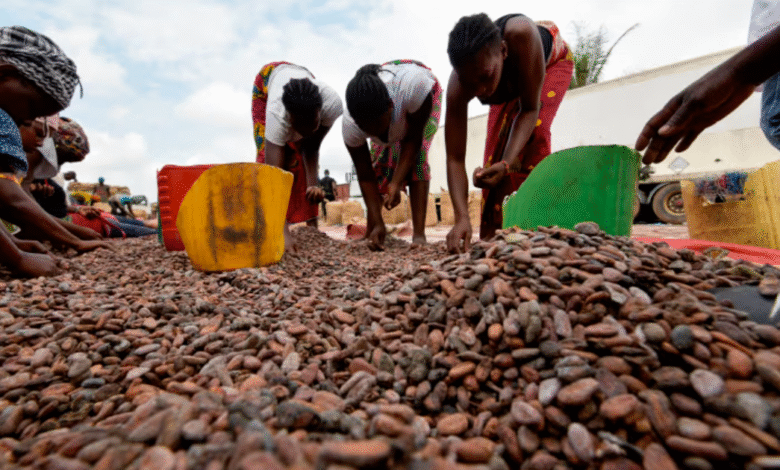
Cocoa prices are under renewed pressure as expanding supplies from Ivory Coast and rising exchange inventories outweigh concerns about the next West African crop. New York and London cocoa have both retreated sharply, with the market also facing additional selling pressure from a stronger US dollar.
The latest Ivory Coast shipment figures point to significantly stronger availability during the current international marketing period. Farmers have shipped approximately 2.18 million tonnes to ports since October 2025, an increase of nearly 20% from the comparable period a year earlier.
At the same time, ICE cocoa inventories have climbed to their highest level in more than two years. These developments are creating a more comfortable near-term supply picture, even as concerns over crop quality, disease and the 2026/27 harvest provide medium-term support.
Market Snapshot
| Factor | Current Situation | Potential Market Impact |
|---|---|---|
| New York Cocoa | December futures have fallen sharply and remain under pressure | Keeps near-term momentum bearish |
| London Cocoa | December futures have also declined sharply | Confirms broad selling pressure |
| Ivory Coast Shipments | 2.18 MMT shipped during the international marketing period, up 19.8% y/y | Signals strong current availability |
| ICE Inventories | 3.45 million bags, a 2.25-year high | Negative for nearby prices |
| Ivory Coast Crop | 2025/26 harvest estimated at 2.06 MMT, up 30% y/y | Confirms stronger current production |
| 2026/27 Ivory Coast Crop | Early estimates point to around 1.8 MMT | Provides medium-term supply support |
| Ghana | 2026/27 production outlook has been reduced | Adds longer-term supply risk |
| Global Balance | Several forecasts point toward a much smaller surplus | Limits downside over the medium term |
| Demand | European grindings weakened, while North American and Asian demand improved | Creates a mixed demand outlook |
| Weather | El Niño could increase West African production risks | Potential bullish catalyst |
Current Cocoa Price Action
Cocoa prices remain under pressure after falling to two-month lows as traders respond to stronger evidence of current-season supply.
The latest decline has also been amplified by US dollar strength. A stronger dollar generally increases the cost of dollar-denominated commodities for buyers using other currencies and can encourage liquidation from speculative positions.
The market is therefore dealing with two separate forces: abundant nearby supply is weighing on prices, while concerns over the next West African crop are preventing the longer-term outlook from becoming decisively bearish.
Ivory Coast Shipments Point to Strong Current Supply
Ivory Coast remains the most important factor in the immediate cocoa supply picture.
Government data indicate that farmers have shipped approximately 2.18 million tonnes of cocoa to ports during the current international marketing period, representing an increase of 19.8% from the comparable period.
The increase indicates that physical availability from the world’s largest cocoa producer remains strong.
However, there is an important timing distinction. Ivory Coast has changed its domestic marketing-year start to September 1, while international cocoa statistics continue to use an October 1 starting point. This means shipment comparisons need to be interpreted carefully when assessing the early stages of the new crop.
ICE Inventories Reach a 2.25-Year High
Exchange stocks are adding another bearish signal.
ICE cocoa inventories have increased to approximately 3.45 million bags, the highest level in around 2.25 years.
Rising exchange stocks indicate that cocoa is becoming more readily available within the futures-market delivery system. If inventories continue to rise, the market could face additional pressure as traders reassess the immediate balance between physical supply and demand.
The inventory increase is particularly significant because it contrasts with the longer-term concern that the next West African crop could be considerably smaller.
Ivory Coast Current Crop Shows Strong Production
The current production cycle has delivered substantially more cocoa from Ivory Coast.
The country’s cocoa regulator reported that approximately 2.06 million tonnes were harvested between June 2025 and June 2026, up around 30% from the previous year’s 1.58 million tonnes.
The stronger crop helps explain why current inventories and shipments have improved.
However, production conditions are now shifting toward the 2026/27 season, where early crop assessments are considerably less encouraging.
2026/27 Ivory Coast Crop Faces Early Concerns
Early assessments of the new Ivory Coast crop are raising concerns about pod development.
Cherelle formation has reportedly been below average, while early estimates place the coming season’s crop around 1.8 million tonnes. That would represent a decline of roughly 18% from approximately 2.2 million tonnes in 2025/26.
This creates an important distinction for cocoa traders: current supply is strong, but the next crop may be considerably weaker.
If later crop assessments confirm poor pod development, the market could begin placing greater value on future supply risks.
Ghana Production Outlook Deteriorates
Ghana provides another potential source of medium-term supply pressure.
The country’s cocoa regulator expects 2026/27 production to decline from the previous season, with estimates ranging between 450,000 and 550,000 tonnes compared with approximately 750,000 tonnes previously projected.
Swollen shoot disease, aging farms and potential adverse weather are among the factors affecting the outlook.
At the same time, Ghana’s current season has been strong, with approximately 750,000 tonnes harvested for 2025/26, up 25.6% from the previous season.
As with Ivory Coast, the market is therefore transitioning from a strong current crop toward a potentially weaker next season.
Global Cocoa Surplus Is Expected to Narrow
The medium-term global balance is becoming less comfortable.
StoneX has reduced its projected 2026/27 global cocoa surplus to approximately 25,000 tonnes from 149,000 tonnes previously. Transgraph Consulting has also forecast a significantly smaller surplus of around 80,000 tonnes for 2026/27, compared with 415,000 tonnes in 2025/26.
The reduction reflects expectations for lower West African production and increasing weather risks.
A much smaller surplus leaves the market more vulnerable to supply disruptions. Even if current inventories remain high, a weak 2026/27 harvest could rapidly change the balance later in the season.
El Niño Remains a Medium-Term Risk
Weather remains one of the largest variables for cocoa prices.
El Niño conditions can bring warmer and drier weather to West Africa, potentially reducing soil moisture and stressing cocoa trees during critical development periods.
If the current weather pattern becomes more persistent or intense, production estimates for Ivory Coast and Ghana could be revised lower.
That risk provides an important counterweight to the current supply surplus.
Cocoa Demand Remains Mixed
Demand indicators are providing a divided signal.
European cocoa grindings fell 4.6% year over year in the second quarter, reaching their lowest level for the period in six years. This points to weaker processing demand in one of the world’s major cocoa-consuming regions.
North American demand moved in the opposite direction, with cocoa grindings increasing 7.7% year over year. Asian grindings also rose sharply, increasing 25% year over year.
The contrasting regional data make it difficult to identify a uniform global demand trend.
If European weakness spreads to other markets, the current supply surplus could remain comfortable. If North American and Asian processing demand continues to strengthen, the market’s supply cushion could narrow more rapidly.
Bullish Sentiment
- The next Ivory Coast crop may be smaller: Early estimates point to a significant decline in 2026/27 production.
- Ghana faces a substantial production reduction: Disease, aging farms and weather risks are threatening the next crop.
- Global surplus estimates are shrinking: Several analysts now expect only a small surplus in 2026/27.
- El Niño creates additional production risk: Warmer and drier conditions could reduce West African yields.
- Asian and North American demand remains strong: Improving grindings in these regions provide evidence that global consumption has not weakened uniformly.
Bearish Sentiment
- Ivory Coast shipments remain strong: Current deliveries are substantially above the comparable period last year.
- ICE inventories are at a multi-year high: Rising exchange stocks indicate abundant nearby availability.
- The current Ivory Coast crop was significantly larger: Production increased by around 30% during the 2025/26 season.
- European cocoa grindings are weakening: Lower European processing activity signals demand pressure.
- The US dollar is strengthening: A stronger dollar can create additional pressure on dollar-denominated cocoa prices and encourage speculative liquidation.
Price Forecast: What Traders Are Watching
The immediate cocoa outlook remains focused on whether strong current supplies can continue to outweigh concerns about the next crop.
A continuation of rising ICE inventories and strong Ivory Coast shipments would keep pressure on nearby futures and could encourage further liquidation.
However, the market’s medium-term risk profile is different. If early estimates of weaker Ivory Coast and Ghana production are confirmed, the current surplus could narrow substantially.
Traders are therefore watching the transition between the strong 2025/26 crop and the potentially weaker 2026/27 crop.
Supply Outlook
Nearby supply remains comfortable, with Ivory Coast shipments and ICE inventories both pointing toward strong availability.
The outlook further ahead is less certain. Early evidence of weaker pod formation in Ivory Coast, declining Ghana production expectations and potential El Niño weather disruption all suggest that supply conditions could tighten during the next crop cycle.
The critical question is whether current inventories are large enough to absorb any reduction in the next West African harvest.
Demand Outlook
Demand remains mixed by region.
European processing has weakened, while North American and Asian grindings have strengthened. This divergence means that global demand cannot currently be described by a single trend.
A recovery in European processing combined with continued strength in Asia and North America would improve the demand outlook and provide greater support to prices.
Conversely, persistent European weakness would leave the current supply surplus more difficult for the market to absorb.
Market Outlook for the Coming Sessions
Cocoa is entering a period where the market must balance strong current availability against increasingly uncertain future production.
The near-term bias remains sensitive to Ivory Coast shipments, ICE inventories and the US dollar. Continued inventory growth or further evidence of strong West African supply could keep prices under pressure.
Beyond the immediate supply picture, however, the focus is likely to shift increasingly toward the 2026/27 crop. Weak pod development in Ivory Coast, lower Ghana production estimates and the potential impact of El Niño could become increasingly important as the season progresses.
The central question for cocoa traders is therefore whether strong current supply can continue to dominate the market before concerns over the next crop become more significant.
Currency Hedger View
Currency movements remain an important factor for cocoa producers, exporters, processors and international buyers because cocoa futures and much of the physical trade are priced in US dollars.
The recent rise in the dollar has added pressure to cocoa by increasing the effective cost of dollar-denominated purchases for buyers using other currencies. For producers in West Africa, exchange-rate movements can also influence the domestic value of export revenues and the economics of selling cocoa into international markets.
The current environment therefore creates two distinct currency considerations. A stronger dollar can weigh on international demand and commodity prices in the short term, while currency movements in producing countries can influence producer selling behaviour.
For businesses with cocoa-related international payments, monitoring the relationship between the US dollar, local currencies and cocoa prices can help distinguish movements driven by the underlying commodity market from those driven by foreign-exchange conditions.
Currency Hedger helps businesses and individuals manage international currency requirements while understanding the wider market forces influencing exchange rates.
Analysis Louis Roche – Today Markets
Cocoa prices are facing strong near-term supply pressure as Ivory Coast shipments remain elevated and ICE inventories reach a multi-year high. These factors provide a clear contrast with the concerns emerging around the next West African crop.
The market is increasingly split between abundant current-season supply and a potentially tighter 2026/27 balance. Ivory Coast and Ghana production estimates, weather conditions and global processing demand will determine which side of that equation becomes more influential.
For now, the strongest market signals are coming from current inventories and shipments. But as the new crop develops, traders are likely to place increasing emphasis on pod formation, weather and the potential impact of El Niño on West African production.
Louis Roche – Today Markets