S&P 500 — US Large Cap Index
 FTSE 100 — UK Blue Chips
 Euro Stoxx 50 — Eurozone Leaders
 DAX 40 — German Equities
 CAC 40 — French Market Index
 Nikkei 225 — Japan Benchmark
 Hang Seng — Hong Kong Index
 Shanghai Composite — China Mainland
 ASX 200 — Australian Market
 TSX Composite — Canada Index
 Nifty 50 — India Large Cap
 STI Index — Singapore Market
 KOSPI — South Korea Index
 Bovespa — Brazil Equities
 JSE Top 40 — South Africa Index
 IPC Index — Mexico Market


- EUR/JPY may test the immediate support at the nine-day EMA of 176.33.
- The 14-day Relative Strength Index is at 42.64, indicating weak upside momentum.
- The primary barrier lies at the descending channel’s upper boundary near 178.00.
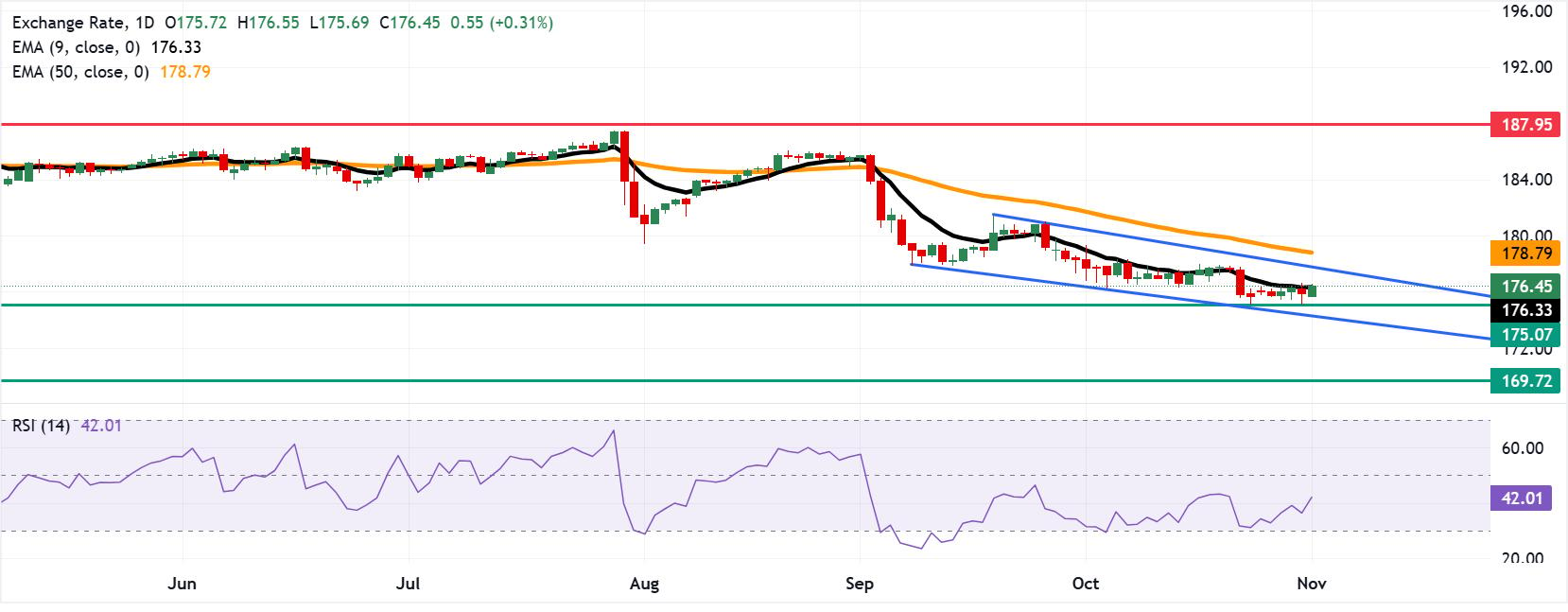
EUR/JPY gains ground after recovering recent losses from the previous trading day, hovering around 176.40 during Asian hours on Monday. Based on the technical analysis of the daily chart’s descending channel pattern, the currency cross maintains a clear bearish bias.
The EUR/JPY cross is maintaining a bearish near-term bias as it holds below the 50-day Exponential Moving Average (EMA). The cross is showing only modest stabilization, with price trading just above the nine-day EMA, while the 14-day Relative Strength Index (RSI) at 42.64 remains below the neutral 50 line and hints at subdued upside momentum rather than a decisive recovery.
The EUR/JPY cross may test the immediate support at the nine-day EMA of 176.33, followed by the 12-month low of 175.07, reached on October 30. Further support lies at the lower boundary of its descending channel around 174.40. A break below the channel would open the door for the currency cross to navigate the region around the 15-month low at 169.72.
On the upside, the EUR/JPY cross may rise toward the upper boundary of the descending channel near 178.00, followed by the 50-day EMA of 178.79. A successful break above the medium-term price average would cause a bullish reversal, supporting the EUR/JPY cross to explore the area around the all-time high of 187.95, reached on April 17.
Dollar stays on the back foot as tech rout collides with Fed hawkishness
Brown Brothers Harriman’s Elias Haddad argues that the ongoing tech sell-off is likely to keep the Dollar under pressure in the near term, with “the USD index (DXY) likely to test support at 101.00.” However, he stresses that “strong US economic activity and rising price pressures reinforce the Fed’s hawkish bias, keeping rate differentials supportive of USD,” suggesting that any downside in the Dollar may be tempered by underlying macro and policy support.