S&P 500 — US Large Cap Index
 FTSE 100 — UK Blue Chips
 Euro Stoxx 50 — Eurozone Leaders
 DAX 40 — German Equities
 CAC 40 — French Market Index
 Nikkei 225 — Japan Benchmark
 Hang Seng — Hong Kong Index
 Shanghai Composite — China Mainland
 ASX 200 — Australian Market
 TSX Composite — Canada Index
 Nifty 50 — India Large Cap
 STI Index — Singapore Market
 KOSPI — South Korea Index
 Bovespa — Brazil Equities
 JSE Top 40 — South Africa Index
 IPC Index — Mexico Market
Donald Trump has once again announced negotiations with Iran and an almost inevitable “deal.” The oil market reacted very sharply again, but stock market moves proved much shallower than in previous, similar episodes. What are representatives of both countries declaring, what are markets pricing in, and what is probably happening?
Between inflation and elections
Many market participants are unable to understand and explain many of Donald Trump’s actions and statements and often over-interpret limited information or see phenomena that are not actually occurring. The biggest misunderstanding would be to attribute desperation to the US president because of the politically lethal combination of high fuel prices and the midterm elections. In the US context, fuel prices really are crucial, but the story is not as simple as looking at the average gasoline price in the United States, especially when it comes to gasoline.
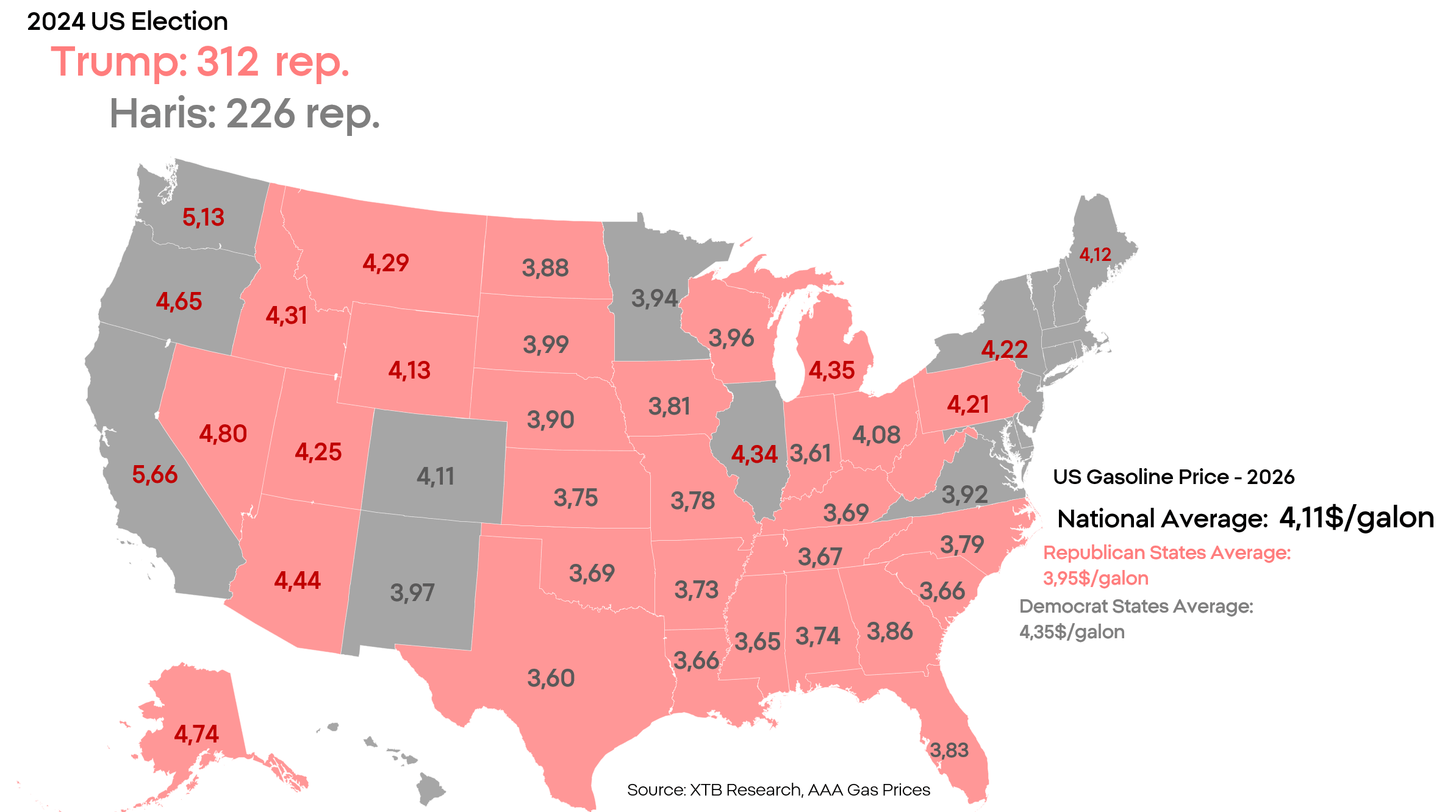
Overlaying the electoral map on the fuel price map reveals a very important pattern. “Republican” (red) states have much cheaper fuel than “Democratic” (blue) states. There are several reasons, including:
- Emissions standards
- Logistics
- Tax rates
- Local supply and demand balance
What is crucial to understand, however, is that despite real inflation pressure and the real problem of rising fuel prices, the situation is not as bad for Donald Trump’s voters and the Republican Party. It is also worth briefly describing the mechanism of the midterm elections facing the US. Midterms concern the House of Representatives and the Senate. Currently, even relatively optimistic forecasts for Democrats indicate that Republicans will keep the Senate, and the margin in the House will be razor-thin (around 5 to 10 members out of 435). Other indicators of the condition of the American economy, while leaving room for improvement in places, remain acceptable. Consumer spending and GDP are rising despite slower momentum. Inflation and unemployment have slowed their growth to almost zero. From a military perspective:
- The situation looks similar. US military assets in the Middle East region account for only 5 to 10% (depending on how they are counted) of the total.
- The ammunition situation is also not as “critical” as even some Pentagon representatives warn.The real and urgent problem is stocks of the most advanced interceptor missiles, mainly the PAC-3 (the so-called Patriot).Current stocks of these missiles can be estimated at a few weeks of intensive fighting.
- The real and urgent problem is stocks of the most advanced interceptor missiles, mainly the PAC-3 (the so-called Patriot).
- Current stocks of these missiles can be estimated at a few weeks of intensive fighting.
- As for offensive ammunition, certain shortages can be observed among tactical missiles (mainly Tomahawks and JASSM).However, this is not universal ammunition, these missiles are intended for precise long-range strikes.
- However, this is not universal ammunition, these missiles are intended for precise long-range strikes.
The US does not have to limit the scale of attacks, stocks of simpler and cheaper ammunition are still sufficient for many years of fighting.
Siege
Many opinion-forming centers attribute not only initiative but often an advantage to the Islamic Republic of Iran. This is far from the truth.
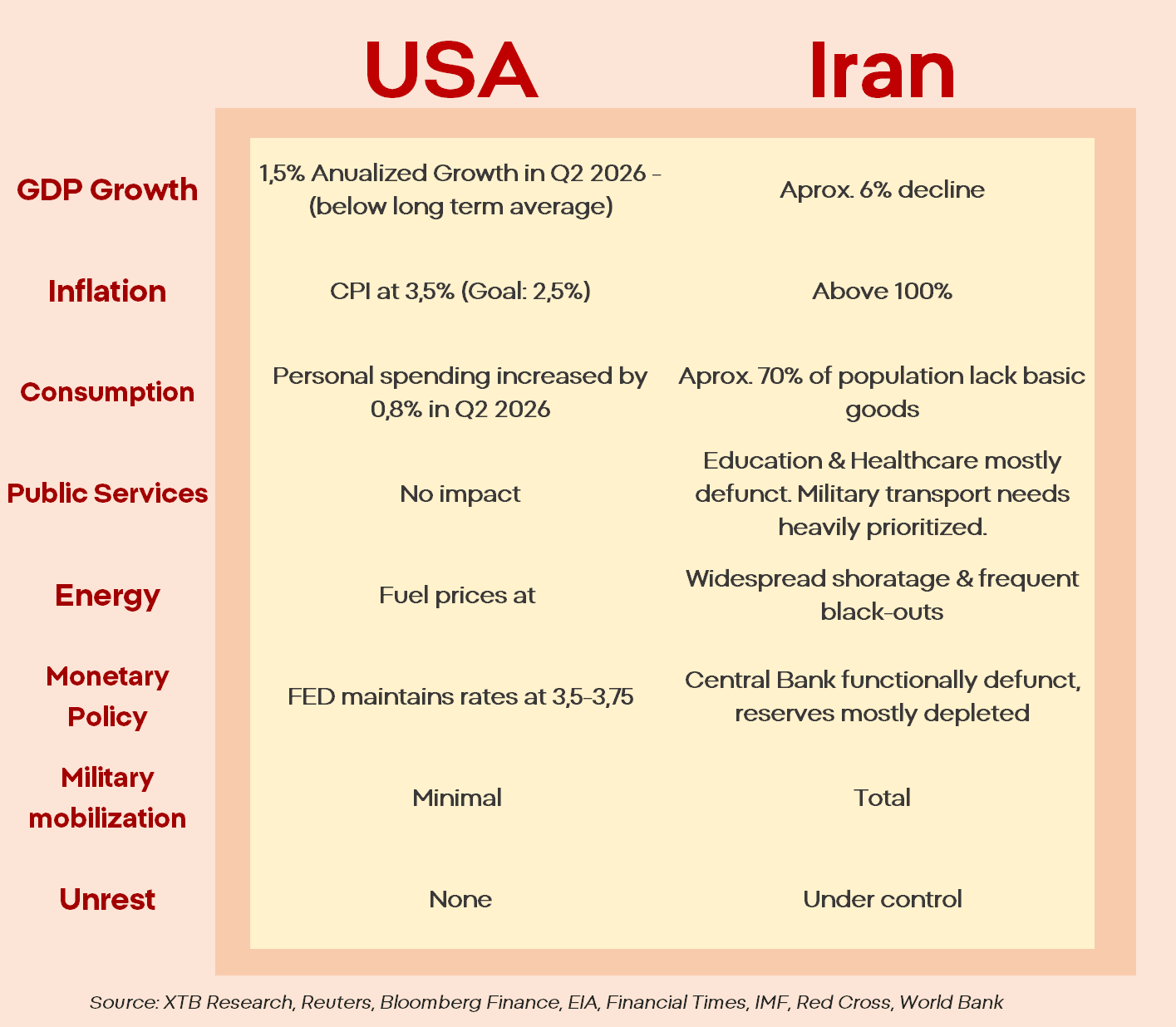
Iran’s economic situation is not a case of declining growth, a slowdown, or a recession, but a severe and serious humanitarian crisis that will only worsen.
- The minimum wage in Iran, about $85 per month, has already lost about 20% of its average real value after being raised by 60% this year. This is an average figure, because inflation in food products reaches hundreds of percent.In Iran, 70% of the minimum wage must be spent on food to ensure a level slightly above biological subsistence, making Iran one of the poorest countries on earth.
- In Iran, 70% of the minimum wage must be spent on food to ensure a level slightly above biological subsistence, making Iran one of the poorest countries on earth.
- Even worse is unemployment. An average unemployment rate of 9% plus about 25% unemployment among the young would be disastrous on its own.However, the seriousness of the situation becomes clear only when confronted with the estimated labor force participation rate, about 35%, a little more than half the values observed in developed countries.
- However, the seriousness of the situation becomes clear only when confronted with the estimated labor force participation rate, about 35%, a little more than half the values observed in developed countries.
- Despite large oil reserves, fuel and energy shortages in Iran are widespread.The fuel deficit is about 20% and the power deficit in the electricity grid already exceeds 30% today.
- The fuel deficit is about 20% and the power deficit in the electricity grid already exceeds 30% today.
Despite episodic shelling of ships in the Strait of Hormuz and facilities on the Persian Gulf coast, Iran’s military situation today is no better than its economic one.
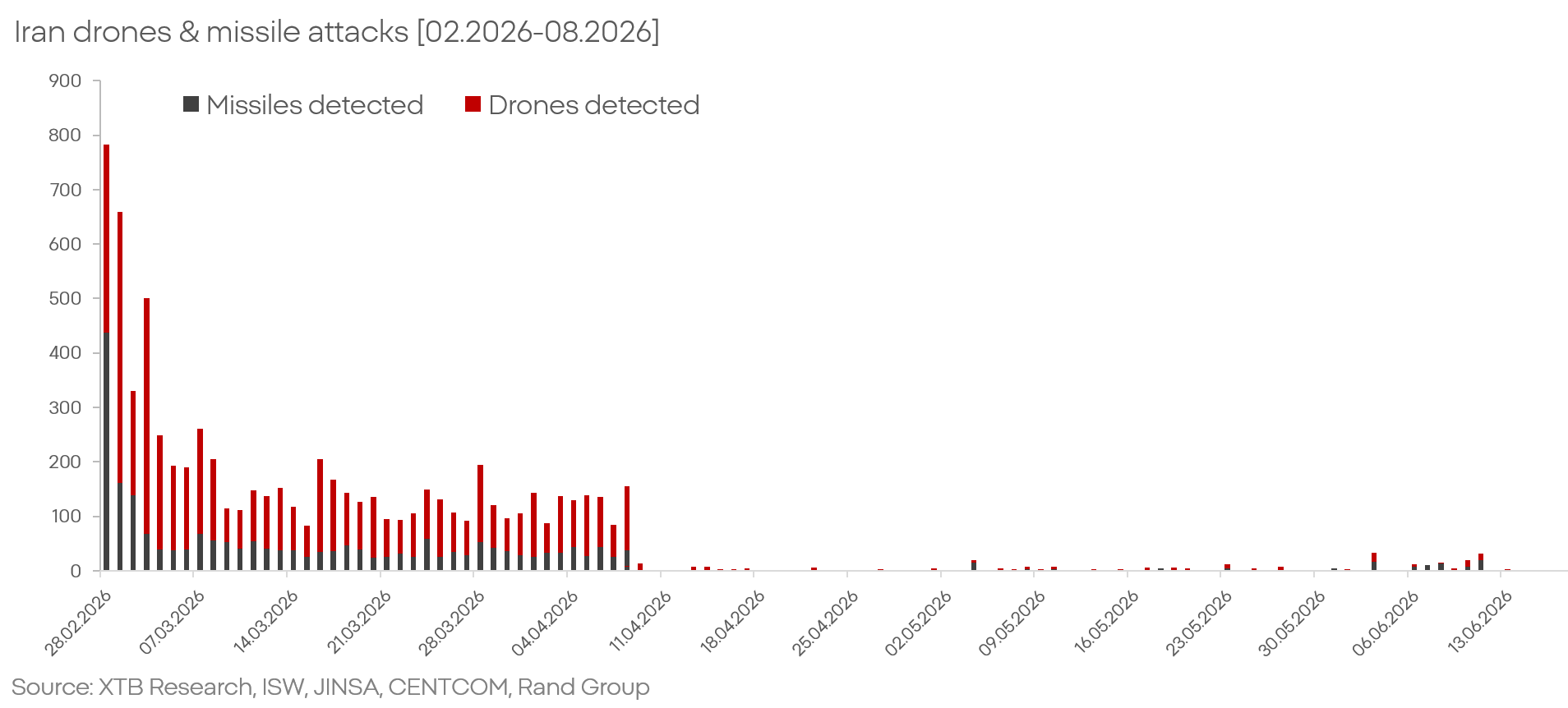
- Most of Iran’s proxies have been eliminated or neutralized, ports remain blocked, and the intensity of Iran’s missile attacks has fallen by about 90% compared with the beginning of the conflict.
- While Iran’s drone and missile stocks may (but do not have to) be very large, its ability to launch them is limited. Most mobile launchers have already been destroyed.
Base scenario
The midterm elections are not as important to Donald Trump as some might think, especially in the context of fuel prices and war, but it cannot be said that the US president does not care about his party’s fate. Therefore, to partially and/or temporarily reduce fuel prices, Trump may decide on temporary and potentially significant concessions toward the Republic of Iran. This will be aimed solely at lowering fuel costs. The core of the conflict, Iran’s nuclear program, remains unaddressed and is probably impossible to resolve through diplomacy. If Trump feels that the Republicans’ position in the Senate (key to impeaching a president) is secure, then hostilities in Iran will probably resume. After the elections, the president will be much less constrained by public opinion and may decide on escalation or even a limited ground invasion. Doubts about the feasibility of such an operation are also exaggerated. Iran is not a fortress but a prison. The IRGC and the Iranian military are capable of maintaining the current власти, but there can be no talk of a victorious confrontation with US forces.
What will markets do?
Such a course of events for oil outlines a fairly specific price range for oil, the dollar, and gold.
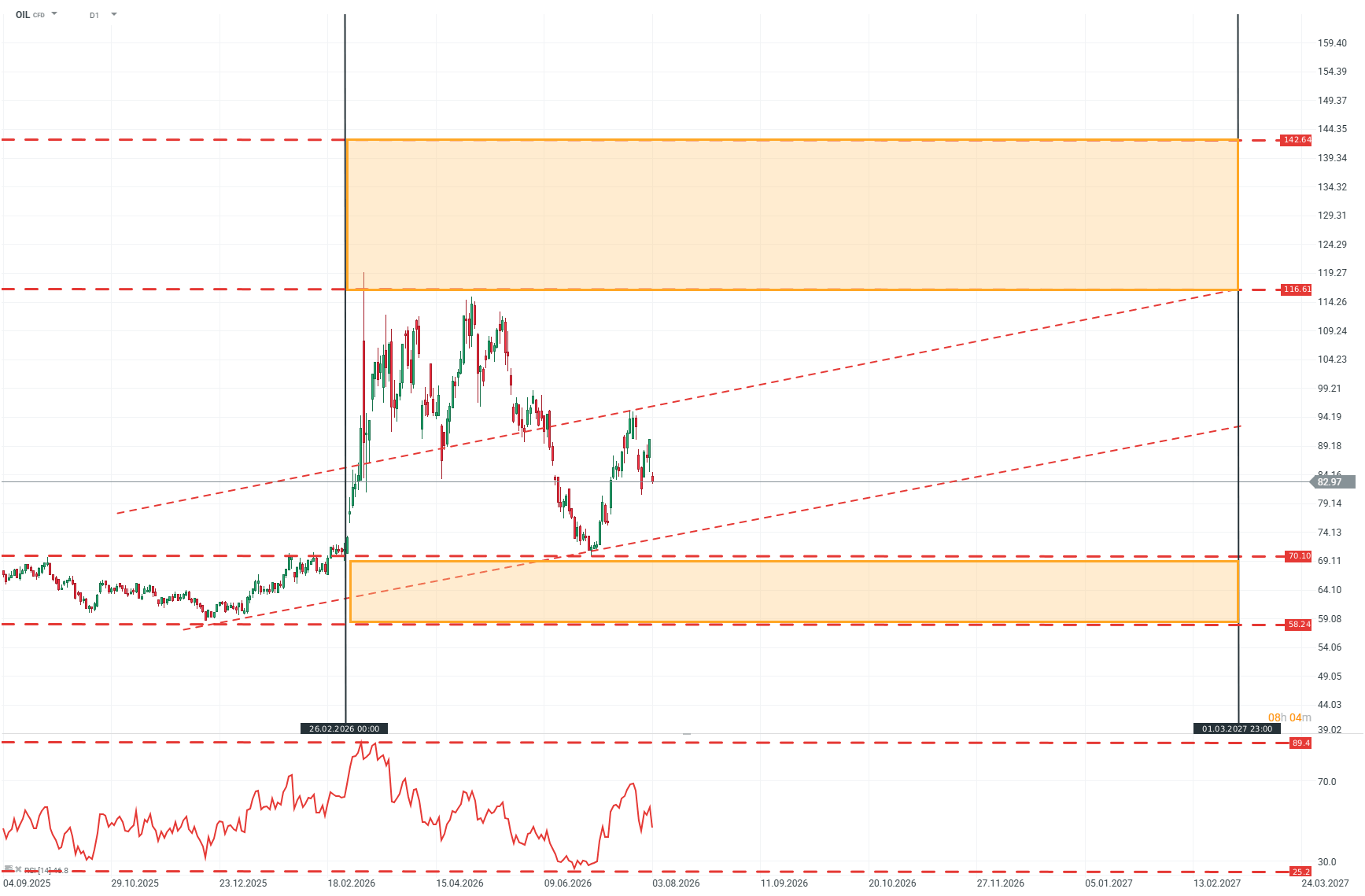
The episodic and unpredictable nature of the conflict and its pauses will keep oil in a wide consolidation range between $70 and $90 per barrel. Escalation of the conflict will probably push oil prices above $100, perhaps even toward $120 per barrel, but levels significantly above that threshold are unlikely. Gold and the dollar will react to expectations regarding the Fed. Rising oil prices will mean a gradual increase in inflation expectations:
- If the Fed chooses inaction, gold could gain significantly on fears of a loss of purchasing power in the currency. At the same time, the dollar would weaken, possibly materially.
- If the Fed decides to raise rates, gold would face another wave of declines, the dollar would strengthen significantly, and indices could experience a deep correction.
Taking into account the broader context and the Fed’s behavior in recent weeks, variant #2 currently has a slight edge.