S&P 500 — US Large Cap Index
 FTSE 100 — UK Blue Chips
 Euro Stoxx 50 — Eurozone Leaders
 DAX 40 — German Equities
 CAC 40 — French Market Index
 Nikkei 225 — Japan Benchmark
 Hang Seng — Hong Kong Index
 Shanghai Composite — China Mainland
 ASX 200 — Australian Market
 TSX Composite — Canada Index
 Nifty 50 — India Large Cap
 STI Index — Singapore Market
 KOSPI — South Korea Index
 Bovespa — Brazil Equities
 JSE Top 40 — South Africa Index
 IPC Index — Mexico Market
Gold trades flat as stronger US Dollar offsets easing Fed rate-hike bets


- Gold holds modest gains as weak US economic data lowers the chance of an October Fed rate hike.
- Persistent inflation risks keep the broader Fed policy outlook tilted towards further tightening.
- Buyers need to reclaim $4,200 to regain near-term bullish momentum.
Gold (XAU/USD) trades little changed on Monday after giving back most of its early gains. The metal remains caught between easing Federal Reserve (Fed) interest-rate hike bets and a stronger US Dollar (USD), while US Treasury yields also remain elevated near multi-year highs. At the time of writing, XAU/USD trades around $4,142.
The latest US business surveys offered little fresh direction for Gold. The S&P Global Services Purchasing Managers’ Index (PMI) was revised marginally higher to 58.8 in September from the preliminary reading of 58.7, while the Composite PMI held at 58.4. In contrast, the ISM Services PMI slipped to 54.9 from 55.4, narrowly missing the 55.0 forecast.
The data followed Friday’s weaker-than-expected employment report, which showed that Nonfarm Payrolls (NFP) increased by only 29K in September, well below the 90K forecast. Employment gains for the previous two months were revised down by a combined 60K, while the Unemployment Rate edged up to 4.2%. Annual wage growth slowed to 3.0%.
Earlier, August’s Personal Consumption Expenditures (PCE) inflation report also fell short of expectations, while previous readings were revised lower. Together, the softer employment and inflation figures have weakened the case for another Fed rate hike at the October 27-28 meeting.
According to the CME FedWatch Tool, traders now price in only around a 20% chance of a rate hike in October, down from nearly 70% last week. The dovish repricing lends some support to the non-yielding metal. However, the broader policy outlook remains tilted towards further tightening as policymakers remain concerned about inflation running above the 2% target, while Middle East tensions keep energy-driven inflation risks alive. This caps Gold’s upside while keeping the US Dollar and Treasury yields supported.
Economists at Deutsche Bank argue that “although the headline payroll number was disappointing, the wider labour-market picture remains relatively resilient, particularly alongside recent ADP and jobless-claims readings,” and on that basis “our economists continue to expect two further 25bp Fed hikes over the next couple of quarters.” They add that “since the meeting, Fed communication has broadly reinforced the quarterly pace of rate hikes implied by the September SEP,” leaving their view of the Fed’s trajectory broadly unchanged despite the softer payroll print.
The US Dollar also draws support from a sharp decline in the Euro (EUR) amid growing political and fiscal concerns in France. The US Dollar Index (DXY), which tracks the Greenback’s value against a basket of six major currencies, trades around 102.36 after touching an intraday high of 102.53, its highest level since April 2025.
Meanwhile, the benchmark 10-year US Treasury yield holds near 5.30%, after touching 5.34% last week, its highest level since 2002. A stronger US Dollar makes Gold more expensive for overseas buyers, while elevated yields increase the opportunity cost of holding the non-yielding metal.
Looking ahead, the US economic docket features the ISM Services Purchasing Managers’ Index (PMI) on Monday, followed by the September Federal Open Market Committee (FOMC) meeting minutes on Wednesday and Initial Jobless Claims on Thursday. The preliminary University of Michigan Consumer Sentiment Index and inflation expectations will be released on Friday.
Technical analysis: Buyers struggle to reclaim $4,200
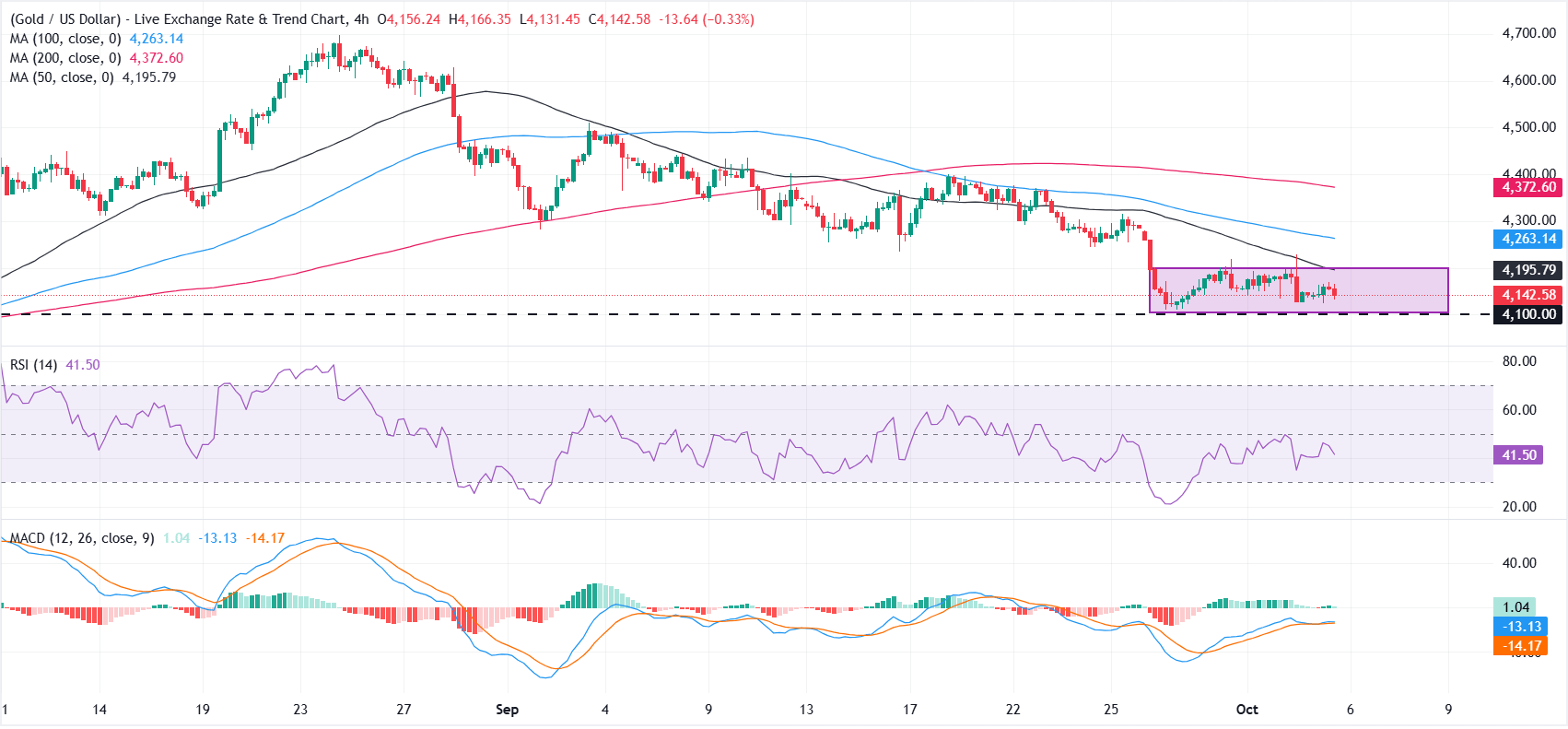
The 4-hour chart shows XAU/USD consolidating below its major moving averages, keeping the near-term bias tilted to the downside. Buyers are struggling to sustain gains above the $4,200 psychological mark, which closely aligns with the 50-period Simple Moving Average (SMA) at $4,198 and acts as the first resistance.
A sustained break above this area could expose the 100-period SMA at $4,265, followed by the 200-period SMA near $4,374. A decisive move above these moving averages would be needed to strengthen the bullish outlook. The Relative Strength Index (RSI) hovers near 46, reflecting neutral-to-soft momentum, while the Moving Average Convergence Divergence (MACD) remains slightly above zero, pointing to a modest recovery attempt.
On the downside, the $4,100 psychological mark offers immediate support. A clear break below this level could intensify selling pressure and expose the $4,000-$3,950 support zone.