S&P 500 — US Large Cap Index
 FTSE 100 — UK Blue Chips
 Euro Stoxx 50 — Eurozone Leaders
 DAX 40 — German Equities
 CAC 40 — French Market Index
 Nikkei 225 — Japan Benchmark
 Hang Seng — Hong Kong Index
 Shanghai Composite — China Mainland
 ASX 200 — Australian Market
 TSX Composite — Canada Index
 Nifty 50 — India Large Cap
 STI Index — Singapore Market
 KOSPI — South Korea Index
 Bovespa — Brazil Equities
 JSE Top 40 — South Africa Index
 IPC Index — Mexico Market

Indian Rupee weakens as higher oil prices keep elevating US Dollar’s demand


- The Indian Rupee trades lower against the US Dollar amid strong demand for US Dollars.
- Oil prices retreat as fears of widening internal Middle East conflicts ease.
- The RBI is expected to intervene at around 95.30, traders say.
The Indian Rupee (INR) weakens again versus the US Dollar (USD) as demand for US Dollars remains significant due to elevated oil prices. In the opening trade on Tuesday, the USD/INR pair is slightly up to near 95.22.
As of writing, the MCX Crude Oil contract expiring on November 19 is down 1.24% to near Rs. 9,600, but is close to its recent highs of Rs. 9,828.
Currencies from economies, such as India, which rely heavily on oil imports to meet its energy demands, tend to underperform in a high oil-price environment.
Oil prices correct, outlook remains firm
Oil prices have retreated from recent highs as fears of broadening Middle East conflicts have eased, following reports that Iran, Saudi Arabia, Pakistan, and Turkey have agreed to continue security discussions and enhance regional cooperation.
On Monday, the Islamic Republic of Iran Broadcasting (IRIB) reported that high-level talks held in Tehran joined by Saudi Arabia, Pakistan, and Turkey aimed at representing the Mecca Joint Defence Agreement. The agreement stated that the four countries had agreed to maintain dialogue and consultations, particularly on regional peace, security and stability.
Meanwhile, fears that the United States (US) and Israel could resume attacks on Iran after their respective elections continue to favor a bullish oil price outlook.
Analysts at MUFG/BTMU warn that political rhetoric from Washington is adding to the region’s vulnerability to higher energy costs. They highlight that with US President Trump “hinting at renewed military action against Iran after the US midterm elections,” any “renewed escalation that pushes crude materially higher would amplify the adverse terms-of-trade and inflation shock for the region’s net energy importers and those with current account deficits.” This leaves Asian economies particularly exposed to a further spike in oil prices driven by Middle East risk.
Investors expect RBI to intervene soon
With the Indian currency facing one-way depreciation against the US Dollar in the past few days, financial markets expect the Reserve Bank of India (RBI) to intervene soon.
According to a Reuters report, traders see 95.30 as a key level to watch, given the RBI’s more aggressive intervention around that level. A sustained break could expose the rupee to a deeper decline toward 96 per dollar, they said.
Fed’s policy in focus
This week, the major trigger for global markets will be the Federal Reserve’s (Fed) monetary policy announcement on Wednesday.
Economists at Deutsche Bank expect the upcoming Fed decision to be uneventful in terms of the formal communiqué, noting that “the statement itself [is] to contain only limited changes, although dissents to a hold are possible.” In their view, “the interest will therefore be in Chair Warsh’s press conference and how the Fed balances still-elevated inflation and solid growth against the recent tightening in financial conditions,” with markets likely to scrutinize his remarks for any shift in the policy narrative.
USD/INR Technical Analysis
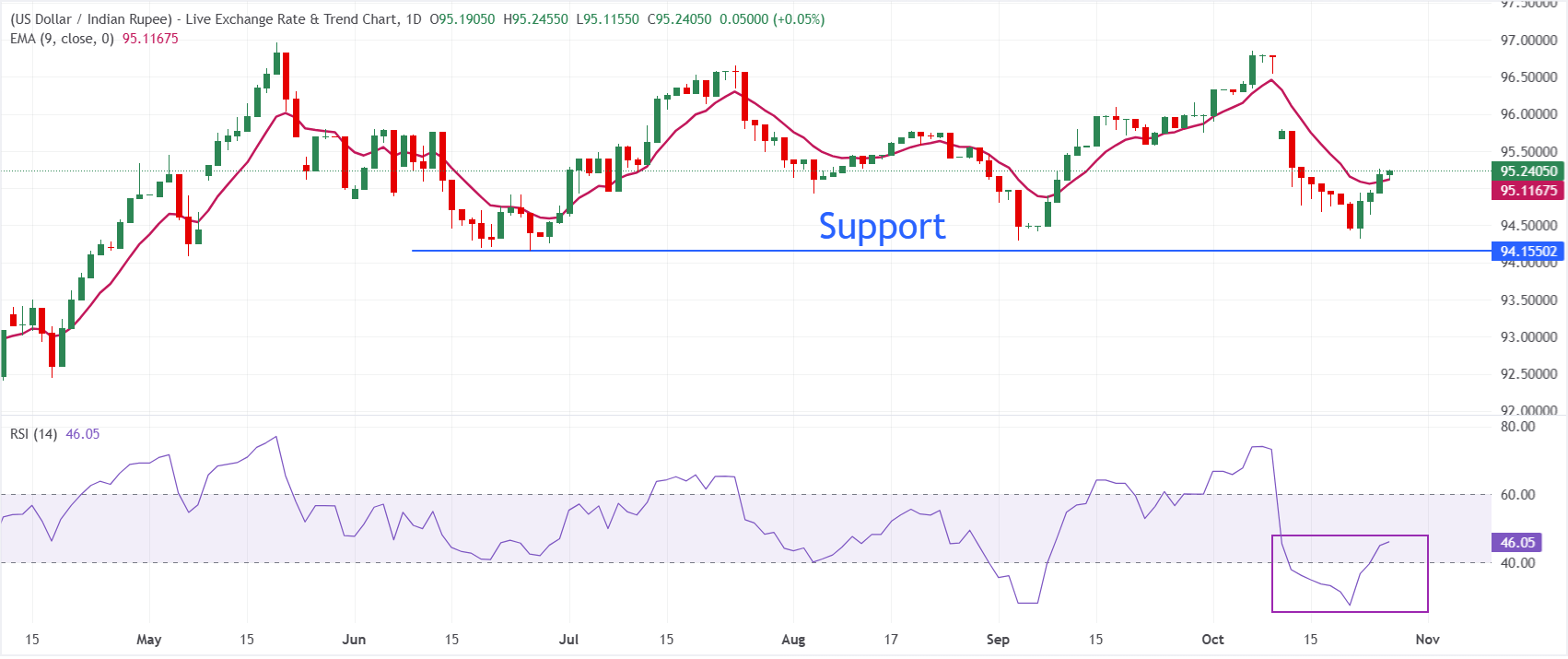
In the daily chart, USD/INR trades at 95.2405, holding just above the 9-period exponential moving average (EMA) at 95.1168, which offers immediate short-term support. The pair has retreated from the mid-96s seen earlier in the month, and the Relative Strength Index (RSI) at 46.05 sits below the 50 line, hinting at waning bullish pressure and a consolidative to mildly corrective bias rather than a strong directional move.
On the downside, the 9-period EMA at 95.12 is the initial support level traders will watch; a sustained break below this floor would open the door for deeper losses toward the June 25 low at 94.16. On the topside, the October 12 high at 95.80 appears as key key hurdle.