S&P 500 — US Large Cap Index
 FTSE 100 — UK Blue Chips
 Euro Stoxx 50 — Eurozone Leaders
 DAX 40 — German Equities
 CAC 40 — French Market Index
 Nikkei 225 — Japan Benchmark
 Hang Seng — Hong Kong Index
 Shanghai Composite — China Mainland
 ASX 200 — Australian Market
 TSX Composite — Canada Index
 Nifty 50 — India Large Cap
 STI Index — Singapore Market
 KOSPI — South Korea Index
 Bovespa — Brazil Equities
 JSE Top 40 — South Africa Index
 IPC Index — Mexico Market
- The Japanese Yen attracts strong follow-through buyers for the second successive day.
- Firming BoJ rate hike expectations and the risk-off mood benefit the safe-haven JPY.
- Recession fears weigh on the USD, which further exerts downward pressure on USD/JPY.
The Japanese Yen (JPY) strengthens against its American counterpart for the second consecutive day on Monday and hits a one-week high during the Asian session on Monday. The global risk sentiment continues to be weighed down by concerns about US President Donald Trump’s so-called reciprocal tariffs on April 2 and geopolitical risks, which turn out to be key factors driving flows towards the safe-haven JPY.
Meanwhile, Friday’s strong consumer inflation figures from Tokyo – Japan’s capital city – reaffirmed bets that the Bank of Japan (BoJ) could raise interest rates in May. This marks a big divergence in comparison to the growing market acceptance that the Federal Reserve (Fed) will resume its rate-cutting cycle soon amid a tariff-driven US economic slowdown and provide an additional boost to the lower-yielding JPY.
Japanese Yen benefits from global flight to safety amid rising trade tensions and BoJ rate hike bets
- US President Donald Trump rattled markets last week by imposing a 25% tariff on all non-American cars. Moreover, a report over the weekend said that Trump will consider higher tariffs against a broader range of countries, which will take effect from April 2. This comes on top of worries about slowing economic growth and continues to weigh on investors’ sentiment, driving safe-haven flows toward the Japanese Yen.
- Trump said on Sunday that he was pissed off at Russian President Vladimir Putin and would impose secondary tariffs of 25% to 50% on buyers of Russian oil if he feels Moscow is blocking his efforts to end the war in Ukraine. Adding to this, Trump warned that Ukrainian President Volodymyr Zelenskiy would face big problems as he is trying to back out of the critical rare earth minerals deal.
- Data released on Friday showed that consumer inflation in Tokyo – Japan’s capital city – remained above the Bank of Japan’s 2% annual target and backs the case for further interest rate hikes. Adding to this, BoJ’s Summary of Opinions from the March meeting revealed a consensus to continue raising rates if the economy and prices move in line with the forecast, keeping hopes alive for more interest rate hikes this year.
- From the US, the Commerce Department reported that the Personal Consumption Expenditures (PCE) Price Index rose 0.3% in February and 2.5% from a year ago, both in line with market expectations. However, the core gauge, which excludes volatile food and energy prices, showed a 0.4% increase for the month – marking the biggest monthly gain since January 2024 and pushing the 12-month inflation rate at 2.8%.
- Additional details revealed that Consumer Spending accelerated 0.4% following a downwardly revised 0.3% fall in January, while Personal Income posted a 0.8% rise during the reported month. Separately, a survey from the University of Michigan showed that consumers’ 12-month inflation expectations soared to the highest level in nearly 2-1/2 years in March, stocking stagflation fears and undermining the US Dollar.
- The markets reacted little to the official data released by the National Bureau of Statistics (NBS), which showed that China’s Manufacturing Purchasing Managers’ Index (PMI) edged higher to 50.5 in March from 50.2 previous. Furthermore, the NBS Non-Manufacturing PMI jumped to 50.8 in March versus February’s 50.4 reading.
- Japanese Finance Minister Katsunobu Kato said this Monday that they agree with the US that excessive moves on forex are undesirable. This, however, does little to dent a strong bullish sentiment surrounding the JPY or hinder the USD/JPY pair’s fall to the 149.00 mark. Traders now look to this week’s US macro data scheduled at the start of a new month, including the Nonfarm Payrolls (NFP) report, for a fresh impetus.
USD/JPY decline could accelerate once the 149.00 confluence support is broken decisively
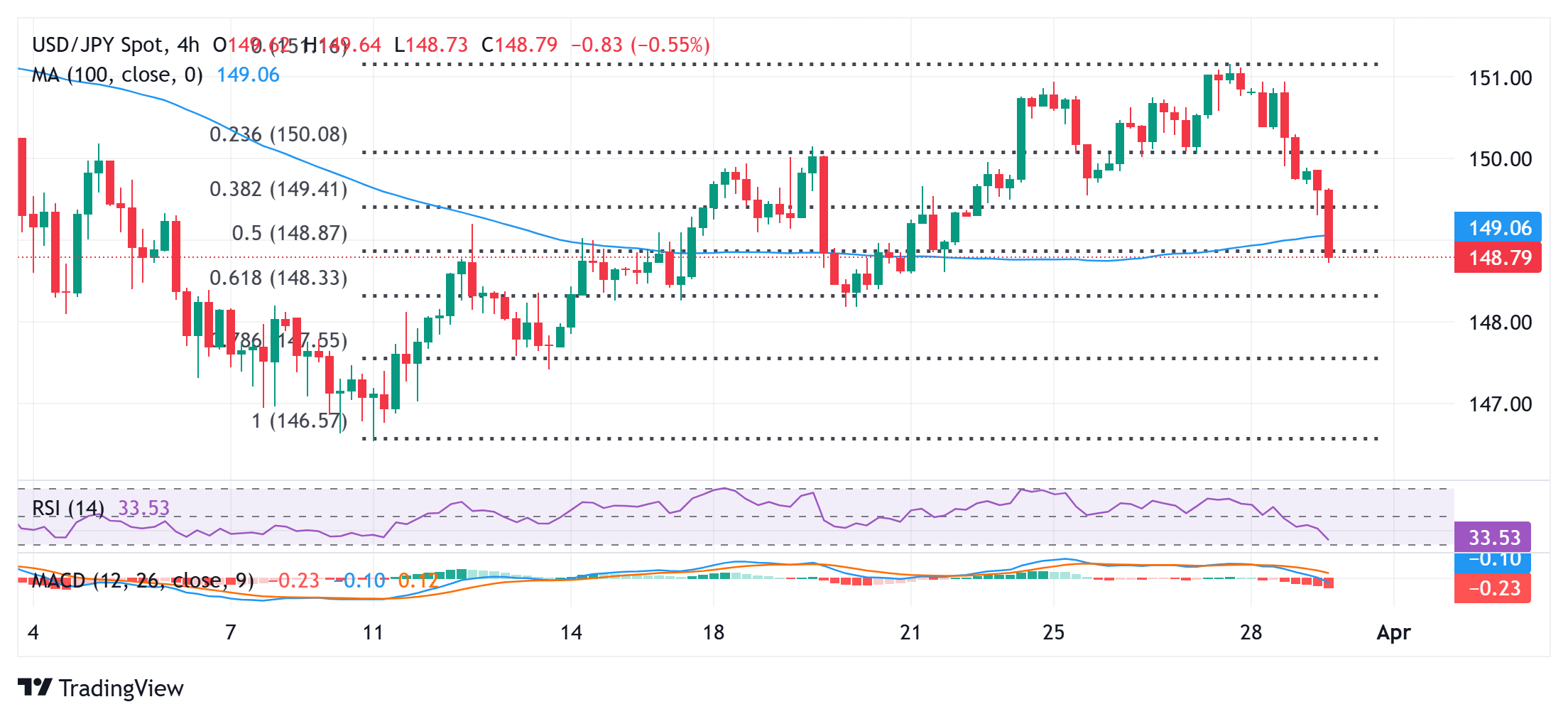
From a technical perspective, the 149.00 round figure represents the 100-day Simple Moving Average (SMA) on the 4-hour chart and nears the 50% retracement level of the recent move up from the multi-month low. Given that oscillators on hourly/daily charts are holding in negative territory, a convincing break below will be seen as a fresh trigger for bearish traders and pave the way for deeper losses. The USD/JPY pair might then accelerate the downfall towards the 61.8% Fibonacci retracement level, around the 148.35 region, before dropping to the 148.00 mark en route to the next relevant support near the 147.70 area.
On the flip side, the 38.2% Fibo., around the 149.45 region, now seems to act as an immediate hurdle, above which a bout of a short-covering could allow the USD/JPY pair to reclaim the 150.00 psychological mark. A sustained strength beyond the latter will suggest that the corrective pullback from a multi-week high touched on Friday has run its course and pave the way for further gains. Spot prices might then surpass the 150.60-150.65 intermediate hurdle and climb to the 151.00 mark before aiming to retest the monthly swing high, around the 151.30 region.