S&P 500 — US Large Cap Index
 FTSE 100 — UK Blue Chips
 Euro Stoxx 50 — Eurozone Leaders
 DAX 40 — German Equities
 CAC 40 — French Market Index
 Nikkei 225 — Japan Benchmark
 Hang Seng — Hong Kong Index
 Shanghai Composite — China Mainland
 ASX 200 — Australian Market
 TSX Composite — Canada Index
 Nifty 50 — India Large Cap
 STI Index — Singapore Market
 KOSPI — South Korea Index
 Bovespa — Brazil Equities
 JSE Top 40 — South Africa Index
 IPC Index — Mexico Market
Michael Burry is shorting Micron – Is this the end of the semiconductor bubble?


Michael Burry, the investor known for his successful bet against the U.S. housing market ahead of the 2008 crisis, is said to have opened a short position in Micron Technology shares. Burry argued that the latest surge was driven more by FOMO and the “greater fool theory” (a stock market speculation strategy) than by cool-headed fundamental analysis. In his view, Micron remains a deeply cyclical business, and HBM, despite its role in AI infrastructure, does not completely change the nature of the memory market. The news comes at a time when Micron shares have just experienced one of the strongest rallies in the company’s history, followed by a meaningful correction. Negative sentiment was also reinforced by insider selling.
Lynn A. Dugle, a member of Micron’s board of directors, sold shares worth about USD 1.50 million on June 30. On the same day, she also donated 700 shares. Fundamentally, however, Micron’s situation still looks exceptionally strong. In the third quarter of fiscal year 2026, the company reported USD 41.46 billion in revenue versus USD 9.30 billion a year earlier, and non-GAAP gross margin rose to 84%. Micron forecasts USD 50 billion in revenue for the next quarter and about 86% gross margin, highlighting the scale of memory makers’ current pricing power. The company also emphasized that HBM4 is already shipping in high volume to a major customer, and HBM4E is expected to enter volume production in 2027.
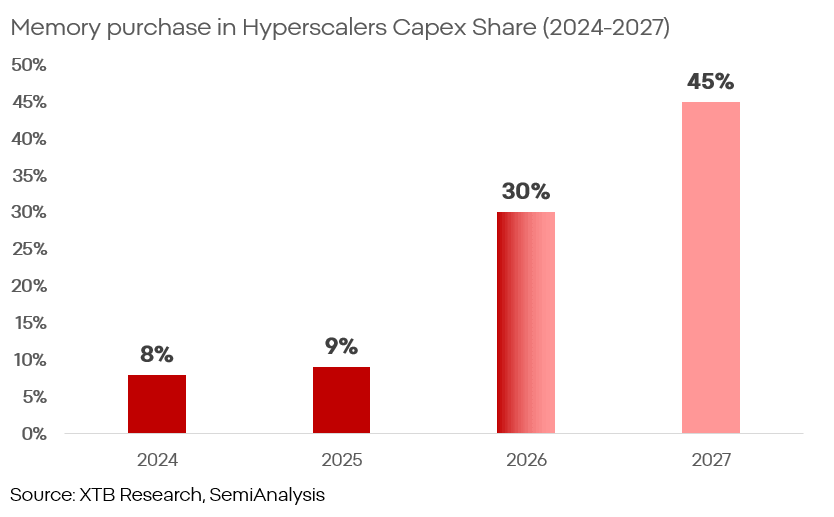
The question is whether the extraordinary profits of companies selling memory will “strangle in the cradle” the AI boom to which they owe their current position. More and more analyses indicate that demand from AI data centers is pulling memory supply away from other segments, and rising prices are making data center capital expenditures less efficient. This is happening at a time when the market is already seriously worried about whether these unprecedented investments will pay off.
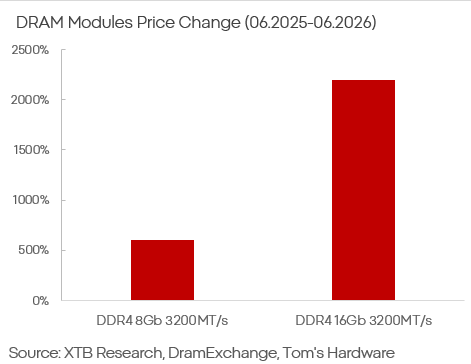
Bloomberg reported comments from the head of SK Group that the global memory shortage could last several more years because wafer supply remains more than 20% below demand, and additional capacity requires multi-year investments. This means Burry’s bet is not a simple wager against Micron’s current results. Those are record-breaking. Rather, it is a bet against the market’s belief that today’s margins, valuations, and memory shortages can be sustained for many years without a classic supply response. Burry suggests that investors are treating HBM as a permanent break from the industry’s cyclicality, whereas in his view it is just another iteration of the old pattern: shortage, euphoria, overinvestment, and then price pressure.
For the semiconductor market, the issue is broader than Micron alone. It should not be forgotten that China has its own memory manufacturers, whose production is set by the central committee rather than the market or shareholders. Chinese producers could, on orders from the CCP, flood the memory market, push margins to the bottom, and at the same time make a fortune on it. Burry himself expects that investments in capacity expansion by Micron, SK hynix, and Samsung will prove much larger and faster than the market currently needs. His short thesis is based on that second possibility.
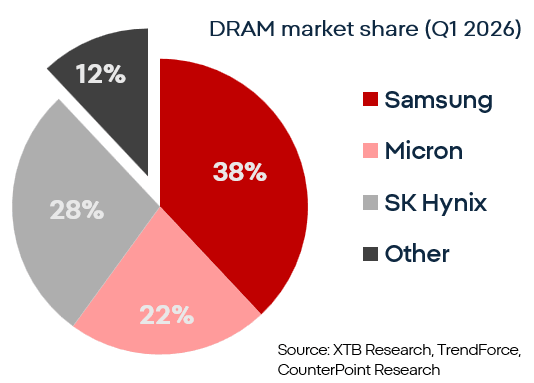
For now, the market has not received a clear signal of deteriorating fundamentals so much as a warning that the narrative around the AI memory trade has become very crowded. Reports of HBM shortages support the short-term bullish case for Micron, but questions about whether the current pace can be sustained are increasingly common.
MU.US (D1)
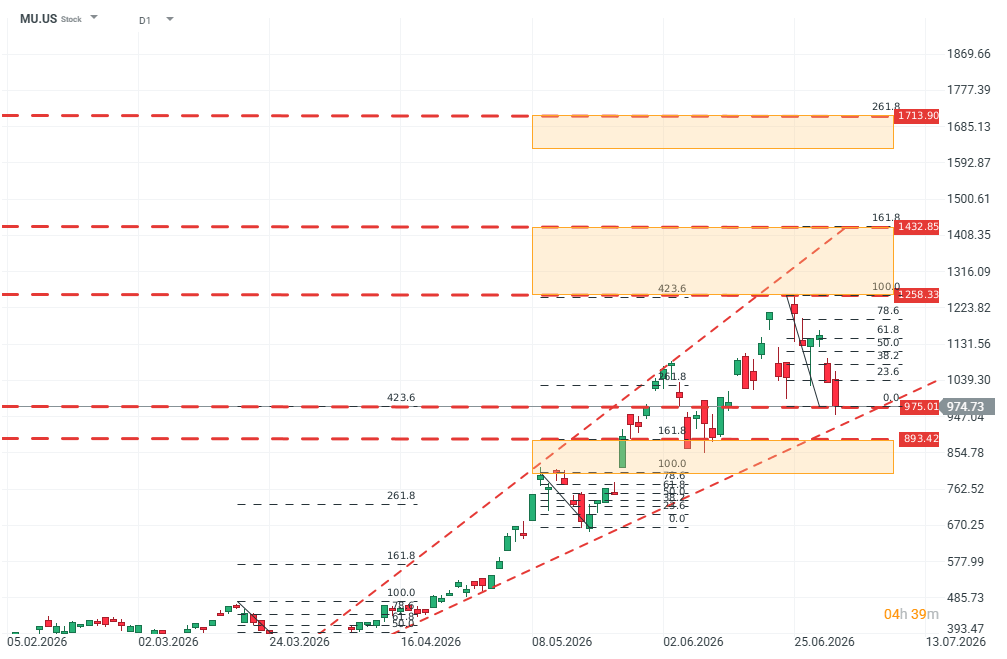
In recent sessions, sellers have taken the initiative, and according to FIBO ranges, the resistance zone around USD 1,000 to 900 has proven too strong during the current correction. If selling makes another successful attempt to break through that resistance, the next support awaits around USD 850. If buyers defend the resistance zone and return to gains, the next target will be USD 1,400 to 1,500. Source: xStation5.