S&P 500 — US Large Cap Index
 FTSE 100 — UK Blue Chips
 Euro Stoxx 50 — Eurozone Leaders
 DAX 40 — German Equities
 CAC 40 — French Market Index
 Nikkei 225 — Japan Benchmark
 Hang Seng — Hong Kong Index
 Shanghai Composite — China Mainland
 ASX 200 — Australian Market
 TSX Composite — Canada Index
 Nifty 50 — India Large Cap
 STI Index — Singapore Market
 KOSPI — South Korea Index
 Bovespa — Brazil Equities
 JSE Top 40 — South Africa Index
 IPC Index — Mexico Market
Nestlé Stock Outlook: Russia Asset Seizure Sends Shares Lower as Geopolitical Risk Returns to Focus

Nestlé shares fell nearly 3% after Russia placed the Swiss food giant’s Russian assets under temporary external administration, highlighting the continuing geopolitical and ownership risks facing Western companies that retain operations inside the Russian Federation.
The move, which also affects French retail groups Auchan and Lemana Pro, formerly Leroy Merlin, places the companies’ Russian operations under the control of an entity called L.E.V. Management.
For investors, the immediate issue is the potential loss of control over Nestlé’s Russian assets, including local production and supply-chain operations. The longer-term question is how much value the company could ultimately lose if temporary administration develops into a permanent transfer of ownership.
The news has therefore created both a fundamental corporate risk and a clear technical deterioration in Nestlé’s share price.
Market Snapshot
| Market Indicator | Latest Development | Market Signal |
|---|---|---|
| Nestlé Share Price | Shares fell nearly 3% following the Russia announcement | Bearish |
| Russian Assets | Placed under temporary external administration | Bearish Risk |
| L.E.V. Management | Taking control of affected Russian operations | Bearish Risk |
| Nestlé Production | Russian facilities include Nescafé and KitKat production | Negative |
| Geopolitical Risk | Western corporate assets remain exposed in Russia | Bearish Risk |
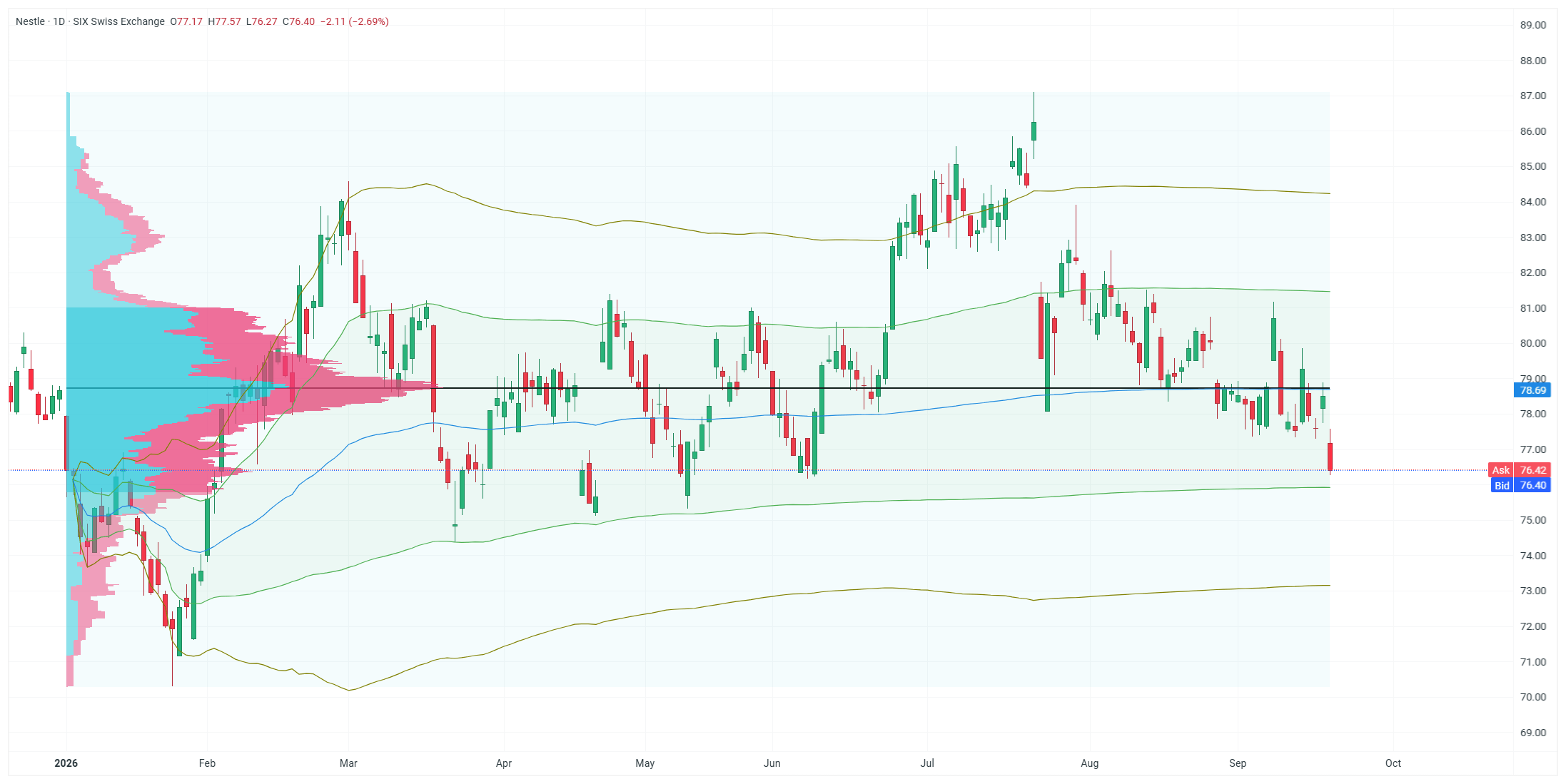
| Technical Support | Multi-month consolidation range has broken | Bearish |
| Point of Control | 78.69 CHF has been lost | Bearish |
| Key Recovery Zone | 77.00–78.70 CHF | Resistance / Confirmation Zone |
Russia Asset Seizure Puts Nestlé Investors on Alert
The Russian government’s decision represents a significant escalation in the risks surrounding Western corporate assets operating in the country.
Under the presidential decree, the Russian operations of the affected companies are being placed under temporary external administration through L.E.V. Management.
The Kremlin has described the arrangement as temporary external management. However, similar mechanisms have previously been used in cases involving Western-owned assets in Russia, creating uncertainty over whether companies will ultimately regain full control.
For Nestlé shareholders, that uncertainty is particularly important because the company has maintained a presence in Russia despite substantially limiting its operations there.
The potential consequence is not simply the loss of a revenue stream.
Nestlé could also lose control over factories, supply-chain infrastructure and physical assets located within Russia.
Nestlé’s Russian Operations Face Increasing Uncertainty
Nestlé’s Russian business includes local production associated with major products such as Nescafé coffee and KitKat.
The company’s exposure therefore goes beyond a straightforward financial investment.
Physical manufacturing facilities and distribution networks can be considerably more difficult to recover once effective control has been transferred.
The immediate financial impact remains dependent on the ultimate treatment of the assets and the degree to which Nestlé is able to retain or recover their economic value.
Investors will therefore be watching closely for any assessment from Nestlé concerning the potential effect on its balance sheet, revenue and future earnings expectations.
The Broader Geopolitical Risk for Western Companies
The Nestlé development also highlights a broader issue for multinational companies maintaining Russian operations.
Switzerland historically maintained a policy of neutrality, but it adopted many European Union sanctions following Russia’s full-scale invasion of Ukraine in 2022.
Moscow has subsequently rejected Switzerland’s traditional neutrality in its dealings with Russia.
For Swiss companies operating in Russia, this creates an additional layer of geopolitical exposure.
The latest action against Nestlé also comes alongside measures affecting Auchan and Lemana Pro, demonstrating that continued commercial operations inside Russia do not necessarily eliminate the risk of government intervention.
The experience of other Western companies, including Carlsberg, Danone and Fortum, provides additional context for investors assessing the potential consequences of state intervention.
Why the Nestlé Stock Reaction Matters
The nearly 3% decline in Nestlé shares represents an immediate repricing of the risk associated with the company’s Russian exposure.
Investors are effectively having to consider whether the economic value previously assigned to those assets can still be realised.
This is particularly relevant when a company owns physical infrastructure inside a jurisdiction where the government has established mechanisms for taking control of foreign-owned assets.
The market response therefore reflects more than the potential loss of Russian revenue.
It also reflects uncertainty over asset ownership, recoverability, future cash flows and valuation.
Technical Analysis: Nestlé Breaks Below Key Consolidation
The fundamental news has coincided with an important technical deterioration in Nestlé shares.
According to the technical analysis provided by XTB, the stock has broken below a multi-month consolidation range while simultaneously losing its Point of Control at 78.69 CHF.
The timing of the technical breakdown is significant because the Russian asset announcement appears to have provided the catalyst for increased selling pressure.
The loss of the previous consolidation structure indicates that sellers have gained greater control of the short-term price action.
The 77.00–78.70 CHF region now becomes particularly important.
Until Nestlé can recover this range, the technical setup remains exposed to continued supply-side pressure.
Bullish Sentiment
1. Russia Represents Only Part of Nestlé’s Global Business
The impact of losing or reducing exposure to Russia needs to be considered in the context of Nestlé’s much broader international operations.
The company is not dependent exclusively on the Russian market, meaning the fundamental impact could ultimately be contained relative to its overall global business.
2. A Recovery Above 78.70 CHF Would Improve the Technical Picture
A sustained move back above the 77.00–78.70 CHF area would provide an important technical signal that sellers are losing control.
A recovery above the 78.69 CHF Point of Control would also weaken the immediate bearish interpretation of the breakdown.
3. Further Corporate Guidance Could Reduce Uncertainty
Investors are awaiting more precise information from Nestlé concerning the value and financial significance of its Russian assets.
Greater clarity around the potential balance-sheet and earnings impact could reduce some of the uncertainty currently incorporated into the share price.
Bearish Sentiment
1. Potential Loss of Control Over Physical Assets
The biggest fundamental concern is that Nestlé may no longer have effective control over its Russian factories, distribution infrastructure and related operations.
The longer such uncertainty persists, the more difficult it becomes for investors to assign a reliable valuation to those assets.
2. Russian Government Intervention Creates Additional Risk
The use of temporary external administration introduces uncertainty over whether foreign companies can ultimately recover control of their Russian businesses.
Previous cases involving Western-owned assets demonstrate why investors are closely monitoring the development.
3. Technical Breakdown Reinforces the Fundamental Shock
The loss of the multi-month consolidation range and the 78.69 CHF Point of Control adds a technical dimension to the fundamental selling pressure.
If the stock remains below the 77.00–78.70 CHF zone, the current supply-side advantage could remain intact.
4. Geopolitical Risk May Require a Higher Risk Premium
The Nestlé case demonstrates that companies maintaining physical assets in Russia can face risks that are difficult to quantify using traditional earnings forecasts alone.
Investors may therefore assign a greater geopolitical risk premium to Western companies with remaining Russian exposure.
What Traders Are Watching Next
The next developments for Nestlé shares are likely to centre on both the company’s response and the technical structure of the stock.
Key areas to monitor include:
- Nestlé management’s assessment of the Russian assets
- Potential balance-sheet impact
- Effect on annual revenue and earnings expectations
- Whether control of the Russian operations remains temporary
- Developments involving L.E.V. Management
- The 77.00–78.70 CHF technical zone
- The 78.69 CHF Point of Control
- Whether the stock can reclaim its previous consolidation range
- Further geopolitical actions affecting Western-owned assets in Russia
The interaction between fundamental news and technical price action will be particularly important.
Today Markets View
The Nestlé situation demonstrates how geopolitical risk can quickly become a direct equity-market issue.
The immediate nearly 3% decline in the shares reflects investor concern over the potential loss of control and economic value associated with Nestlé’s Russian operations.
However, the longer-term impact remains dependent on how the Russian authorities ultimately treat the assets and how Nestlé accounts for the situation.
Technically, the picture has also deteriorated.
The break below the multi-month consolidation range and the loss of the 78.69 CHF Point of Control have strengthened the bearish technical setup. The 77.00–78.70 CHF region is now a key area for investors to monitor.
A sustained recovery above that zone would change the immediate technical structure, while continued trading below it would leave the shares exposed to further selling pressure.
For global investors, the broader lesson is that geopolitical exposure can represent a material component of corporate valuation when a company maintains physical assets in a jurisdiction where government intervention can alter ownership or operational control.
The market will now focus on how Nestlé quantifies the financial consequences and whether the company can provide greater clarity over the future of its Russian business.
Louis Roche, Analyst, Today Markets