S&P 500 — US Large Cap Index
 FTSE 100 — UK Blue Chips
 Euro Stoxx 50 — Eurozone Leaders
 DAX 40 — German Equities
 CAC 40 — French Market Index
 Nikkei 225 — Japan Benchmark
 Hang Seng — Hong Kong Index
 Shanghai Composite — China Mainland
 ASX 200 — Australian Market
 TSX Composite — Canada Index
 Nifty 50 — India Large Cap
 STI Index — Singapore Market
 KOSPI — South Korea Index
 Bovespa — Brazil Equities
 JSE Top 40 — South Africa Index
 IPC Index — Mexico Market

Nvidia Earnings Preview: Record Growth Faces Leadership Uncertainty as Investors Await Q3 Results

Nvidia heads into its third-quarter fiscal 2027 earnings announcement at a pivotal moment. The world’s leading AI chipmaker is facing exceptionally high financial expectations alongside an unexpected leadership transition following the resignation of founder and CEO Jensen Huang.
The company confirmed on 12 November that Huang had resigned as president, chief executive officer and board member, effective immediately. Chief Financial Officer Colette Kress has been appointed interim CEO while the board searches for a permanent successor. The announcement has introduced a new layer of uncertainty for investors already questioning the sustainability of the AI investment boom and the valuations of major technology companies.
Nvidia is scheduled to release its results after the close of Wall Street trading on Tuesday, 17 November. The figures will provide an important assessment of demand for AI infrastructure, particularly its Data Center business, while management’s comments will be closely scrutinised for reassurance that the leadership transition will not disrupt operations, customer relationships or product development.
The earnings report could therefore become more than a test of financial performance. It will also be an early opportunity for Kress to demonstrate continuity in Nvidia’s strategy and reassure investors that the company can maintain its position without its long-standing founder at the helm.
Nvidia Earnings Snapshot
| Market Expectation | Q3 Fiscal 2027 |
|---|---|
| Expected Revenue | $109.1 billion |
| Adjusted Earnings per Share | $2.47 |
| Data Center Revenue | $101.8 billion |
| Expected Revenue Growth | Approximately 90% year-on-year |
| Non-GAAP Gross Margin | Approximately 74% |
| Expected Q4 Revenue | $124.8 billion |
| Expected Q4 Adjusted EPS | $2.76 |
These estimates underline the scale of expectations surrounding Nvidia. The Data Center division is expected to generate the overwhelming majority of quarterly revenue, reflecting continued investment in AI accelerators, advanced computing systems and the infrastructure required to train and operate increasingly sophisticated AI models.
Investors will also be looking for confirmation that Blackwell demand remains strong and that the next-generation Vera Rubin platform is progressing according to schedule.
Jensen Huang’s Departure Creates a New Leadership Challenge
Jensen Huang’s departure represents a significant change for Nvidia. Over more than three decades, he helped build the company into one of the most influential businesses in the global semiconductor and artificial intelligence industries.
Huang was closely associated with Nvidia’s long-term strategy, product development, major customer relationships and public identity. His leadership helped establish the company’s position at the centre of the AI infrastructure expansion.
The circumstances surrounding his departure have attracted considerable attention, with reports concerning his private life and potential national security implications contributing to the controversy. However, Nvidia’s formal announcement confirmed the resignation without setting out a detailed explanation of the circumstances.
Colette Kress has taken over as interim CEO while retaining her position as CFO. She joined Nvidia in 2013 and has been closely involved in its financial development during a period of extraordinary growth.
The board has begun searching for a permanent chief executive and will consider both internal and external candidates. Its immediate challenge is to maintain confidence in the company’s leadership while demonstrating that the existing management structure can continue executing its strategy.
Speculation about a possible return by Huang has also emerged, but investors should distinguish such discussion from confirmed corporate developments. Nvidia has not announced any reversal of its leadership decision.
Data Center Revenue Remains the Main Earnings Driver
Nvidia’s Data Center division remains the most important part of its financial performance. Analysts expect the segment to generate approximately $101.8 billion in the third quarter, supported by demand for AI accelerators, Blackwell systems and related computing infrastructure.
The scale of investment by major cloud and technology companies will remain central to the outlook. Microsoft, Amazon, Alphabet and Meta are among the largest participants in the AI infrastructure expansion, and their spending plans are important indicators of future demand for Nvidia’s products.
Investors will want reassurance that customer commitments remain intact following Huang’s departure. Any indication that major projects, procurement schedules or product deployments have been delayed could create concerns about future revenue visibility.
Blackwell demand is another important consideration. Nvidia needs to demonstrate that the latest generation of AI systems is continuing to attract strong orders and that customers are preparing for further deployments.
The transition towards the Vera Rubin platform will also attract attention. Progress on development, production schedules and customer readiness could help investors assess whether Nvidia’s technology roadmap remains on track.
Gross Margins and Profitability Under Scrutiny
Revenue growth alone may not be sufficient to satisfy investors. Nvidia is expected to report a non-GAAP gross margin of approximately 74%, making profitability a major part of the earnings discussion.
The company has benefited from strong demand and its position in the AI accelerator market, but maintaining margins as operations expand and systems become increasingly complex will be important.
Investors will examine whether higher sales volumes are translating into sustained earnings growth, and whether production costs, supply-chain requirements and the development of increasingly advanced computing platforms are affecting profitability.
The outlook for the fourth fiscal quarter will be equally important. Market expectations point to revenue of approximately $124.8 billion and adjusted earnings per share of $2.76.
Any guidance that exceeds those expectations could support the share price. Conversely, even strong quarterly results could disappoint if management signals slower growth, margin pressure or weaker visibility beyond the current reporting period.
AI Investment Concerns Continue to Weigh on Technology Stocks
Nvidia’s earnings arrive during a period of growing caution across the technology sector.
Investors are increasingly questioning whether the enormous sums being committed to AI infrastructure will generate sufficient long-term returns. The expansion of data centres, procurement of advanced chips and investment in computing capacity require substantial capital expenditure.
The concern is not necessarily that demand for AI technology is disappearing. Rather, investors want clearer evidence that the investment cycle can translate into sustainable productivity gains, revenue growth and profitability.
Nvidia sits at the centre of this debate because its performance is closely linked to the spending decisions of the world’s largest technology companies.
A strong earnings report could provide reassurance that demand for advanced computing remains robust. However, weaker guidance or signs of slowing customer investment could intensify pressure across semiconductor manufacturers and other AI-related businesses.
Leadership Continuity and Customer Relationships
One of the most important questions surrounding the earnings announcement is whether Nvidia can maintain its commercial momentum under interim leadership.
The company has an experienced management team, and Kress has been involved in its financial operations for more than a decade. Nevertheless, Huang’s influence extended beyond conventional executive responsibilities.
Investors will be looking for confirmation that customer relationships, product commitments and strategic partnerships remain unaffected.
The board has stated that it expects operations, customer commitments and the product roadmap to continue without interruption. Management’s ability to demonstrate this during the earnings call will be important in determining whether investors begin to separate the company’s operating performance from the uncertainty surrounding its former CEO.
Bullish Sentiment
- Strong Data Center demand: Expected revenue of approximately $101.8 billion would reinforce the strength of Nvidia’s central growth business.
- Blackwell adoption: Continued demand for Blackwell systems could support revenue visibility and reinforce Nvidia’s competitive position.
- High earnings expectations: Consensus estimates point to approximately $109.1 billion in revenue and adjusted EPS of $2.47, reflecting strong anticipated business performance.
- AI infrastructure expansion: Continued investment by major cloud providers and technology companies could sustain demand for Nvidia’s advanced computing products.
- Management continuity: Confirmation that customer commitments and product development remain on schedule could help reduce concerns about the leadership transition.
- Positive forward guidance: Revenue guidance above the expected $124.8 billion for the fourth quarter could provide a fresh catalyst for the share price.
Bearish Sentiment
- Leadership uncertainty: Huang’s sudden resignation creates questions about long-term strategic direction and the appointment of a permanent CEO.
- High market expectations: Even strong financial results could disappoint if revenue, earnings or guidance fail to exceed demanding forecasts.
- AI spending concerns: Questions over the returns generated by massive infrastructure investments could weigh on demand expectations across the sector.
- Margin pressure: Investors may react negatively if profitability weakens as Nvidia expands production and delivers increasingly complex systems.
- Customer concentration: A substantial proportion of demand is linked to a relatively small group of major technology companies, making their investment plans particularly important.
- Competitive pressure: Rival semiconductor businesses and alternative AI computing solutions could challenge Nvidia’s ability to maintain its current market position.
Source – Todaymarkets.com
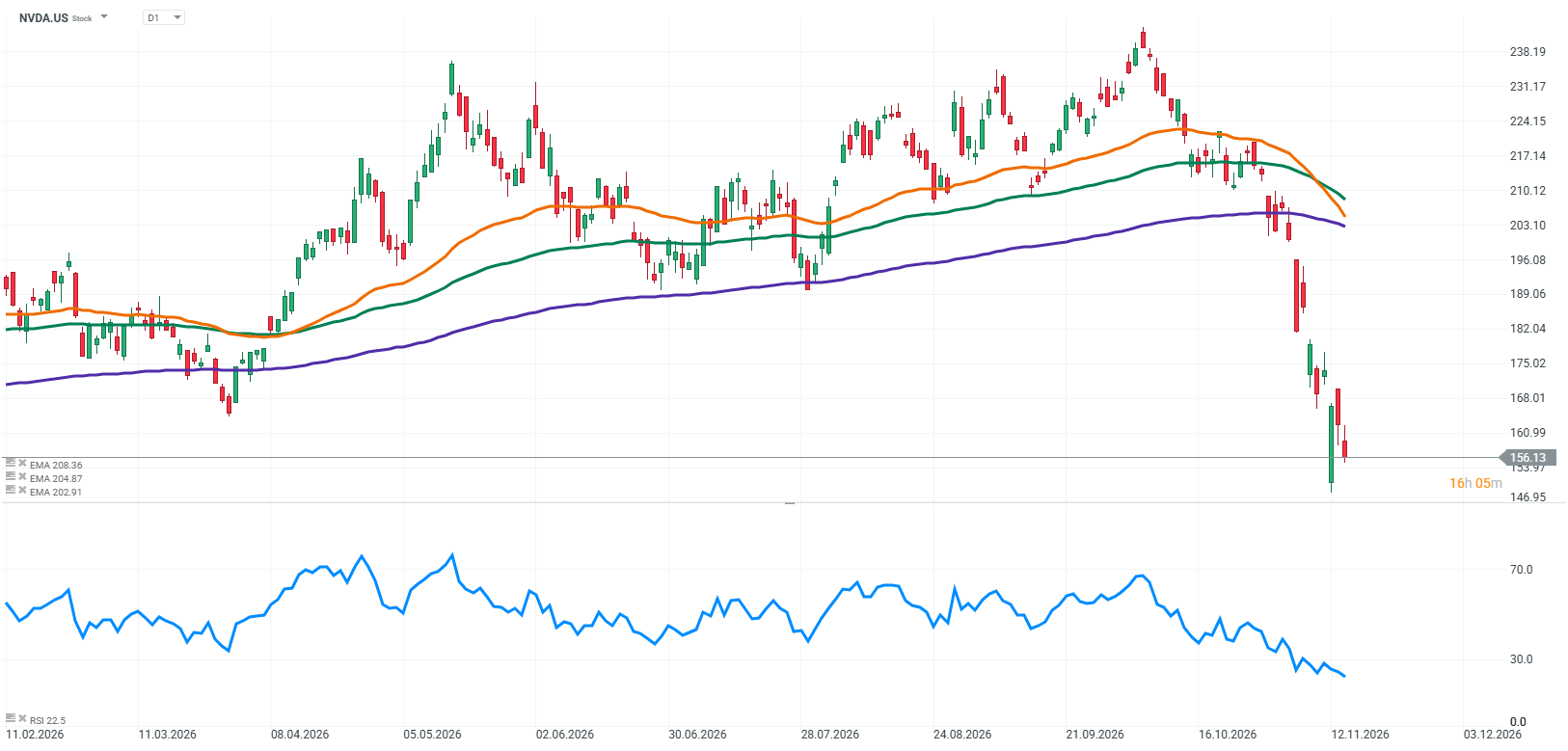
Nvidia Share Price Forecast – What Traders Are Watching
The immediate focus will be on the earnings figures and management’s guidance for the fourth fiscal quarter. Revenue, adjusted earnings per share and Data Center performance will provide the first indication of whether Nvidia is maintaining the growth trajectory anticipated by the market.
However, the earnings call may be just as important as the headline numbers. Investors will be listening for detailed commentary from Kress on the leadership transition, customer relationships, Blackwell demand and the development schedule for Vera Rubin.
The market will also be looking for clarity on the board’s succession process and whether the company can maintain its strategic direction while a permanent CEO is selected.
A strong earnings beat accompanied by confident guidance could help stabilise sentiment and encourage investors to refocus on Nvidia’s operating performance. A weaker outlook, however, could amplify existing concerns about AI spending and leadership uncertainty.
Market Outlook for the Coming Sessions
Nvidia’s third-quarter fiscal 2027 results could become an important catalyst for the wider technology sector.
The company enters the announcement with substantial revenue expectations and continued demand for AI computing infrastructure, but the resignation of Jensen Huang has introduced an additional risk that investors must now evaluate.
Strong results, resilient gross margins and positive fourth-quarter guidance could provide support for Nvidia shares and potentially improve sentiment across semiconductor and AI-related stocks.
Nevertheless, the longer-term outlook will depend on more than another strong quarterly performance. Nvidia must demonstrate that its management team can maintain customer confidence, execute its technology roadmap and preserve its competitive position during a period of leadership change.
For traders, the key distinction will be between financial performance and management confidence. A strong set of results may support the share price in the immediate aftermath, but a sustained recovery in investor sentiment will depend on the company’s ability to demonstrate stability beyond the earnings announcement.
Currency Hedger – Market Contributor
Currency Hedger provides international payment solutions, multi-currency accounts and foreign exchange risk management services for businesses exposed to currency movements.
Disclaimer: This article is provided for market information and educational purposes only. It does not constitute investment advice, a recommendation or an offer to buy or sell any financial instrument. Shares and other financial instruments involve risk, and prices can rise or fall. Traders and investors should conduct their own research and consider their financial circumstances before making investment decisions.