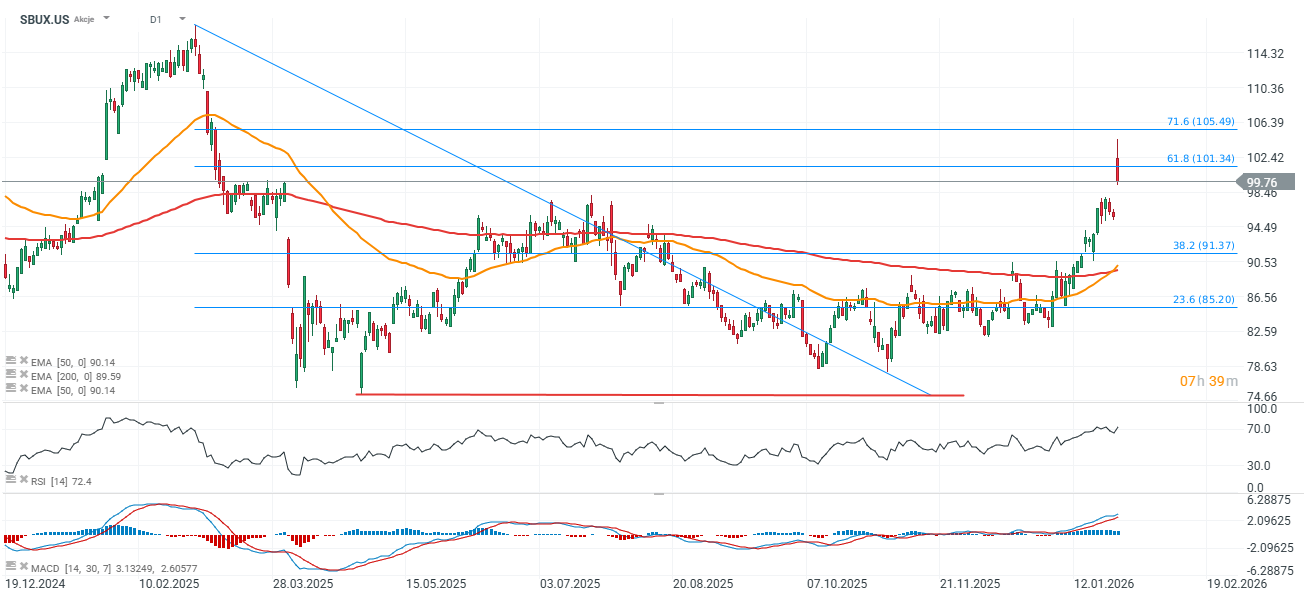
Starbucks (SBUX.US) is signaling a revival of its U.S. business, even though margins remain under pressure. Shares are rising after the earnings release, and the market reaction is hopeful, as the company has finally broken the negative streak of slowdown in its most important market — the United States.
This is the first quarter in a long time in which the numbers don’t just “look better on paper,” but genuinely suggest that the turnaround strategy under CEO Brian Niccol is taking hold faster than some investors expected. One thing should be emphasized, however: Starbucks is delivering a sales rebound, but it is paying for it through weaker profitability. In other words, the company is starting to win customers back, yet its operating foundations still require investment.
Since the start of the year, the stock is up nearly 15%, and it is gaining more than 3.5% following the report. This release contains what Starbucks has been missing: a reversal in the U.S. trend and growth driven by transactions. At the same time, margins are under pressure, coffee input costs remain high, and technology, logistics, and the execution of the turnaround plan require spending.
Starbucks results (Q4 2025)
- Global comparable sales (y/y): +4% vs expectations of about +2.25%
- North America comparable sales: +4%
- First U.S. sales growth in two years; transaction-driven growth for the first time in eight quarters
- U.S.: average ticket +1%, driven by espresso drinks, tea-based beverages, and the growing popularity of cold-foam add-ons
- Margins contracted by 290 bps (2.9 pp) in the quarter
- Management pointed to the impact of tariffs, cost pressure, and operational investments
- Global comps expected to rise by more than 3% this year (the market was looking for around +2.94%)
- Adjusted EPS expected at $2.15–$2.40 (midpoint below consensus of roughly $2.35)
- The company expects tariff pressure to start easing in the second half of the year
- China sales: +7% y/y in Q4 (vs +2% y/y in the prior quarter)
The most “market-relevant” takeaway is straightforward: Starbucks is growing again in the U.S., which is exactly where it needed a breakthrough most. The nature of the improvement matters as well — this is not just a price-driven story, but a sign that customers are returning to stores. Basket growth can be “pushed” through price increases, but rising transactions typically signal that the product and in-store experience are working.
Brian Niccol is reshaping the company from the inside out. In practice, the plan rests on several very tangible changes:
- Menu simplification: less workload for baristas, faster order execution, and fewer mistakes during peak hours.
- Back to quality and the “coffeehouse” feel: freshly baked food, a stronger focus on the in-store atmosphere, and more product personalization.
- Shorter service times: the target is to get below four minutes, though the company admits it still falls short at times.
Starbucks also has a key advantage that is difficult to replicate: it can sell “add-ons” in a way that makes customers feel they are upgrading quality rather than merely paying extra. In the U.S., the +1% increase in average ticket was mainly supported by espresso drinks, tea-based beverages, and the popularity of cold foam.
One of the initiatives aimed at bringing customers back is the rollout of new protein-infused drinks. This may be a bigger move than it appears at first glance, as the beverage market continues to shift toward more “functional” offerings: health-oriented products, solutions for active consumers, and drinks that are not just a dessert.
Still, Starbucks is improving sales while facing profitability headwinds, as margins have declined. What’s behind it? Higher raw material and import costs (including tariff effects), costs that are now embedded in the run-rate, and investments to improve operations. The questions Wall Street is likely to keep asking boil down to a few core points:
- Will U.S. growth persist over the next few quarters?
- Will protein-infused drinks become a permanent part of the core offering?
- Will margins begin to recover in the second half of the year, as management expects?
- What concrete details will come out of Niccol’s first Investor Day?
 Source: xStation5
The material on this page does not constitute financial advice and does not take into account your level of understanding, investment objectives, financial situation or any other specific needs. All information provided, including opinions, market research, mathematical results and technical analyzes published on the Website or transmitted To you by other means, it is provided for information purposes only and should in no way be construed as an offer or solicitation for a transaction in any financial instrument, nor should the information provided be construed as advice of a legal or financial nature on which any investment decisions you make should be based exclusively To your level of understanding, investment objectives, financial situation, or other specific needs, any decision to act on the information published on the Website or sent to you by other means is entirely at your own risk if you In doubt or unsure about your understanding of a particular product, instrument, service or transaction, you should seek professional or legal advice before trading. Investing in CFDs carries a high level of risk, as they are leveraged products and have small movements Often the market can result in much larger movements in the value of your investment, and this can work against you or in your favor. Please ensure you fully understand the risks involved, taking into account investments objectives and level of experience, before trading and, if necessary, seek independent advice.