S&P 500 — US Large Cap Index
 FTSE 100 — UK Blue Chips
 Euro Stoxx 50 — Eurozone Leaders
 DAX 40 — German Equities
 CAC 40 — French Market Index
 Nikkei 225 — Japan Benchmark
 Hang Seng — Hong Kong Index
 Shanghai Composite — China Mainland
 ASX 200 — Australian Market
 TSX Composite — Canada Index
 Nifty 50 — India Large Cap
 STI Index — Singapore Market
 KOSPI — South Korea Index
 Bovespa — Brazil Equities
 JSE Top 40 — South Africa Index
 IPC Index — Mexico Market
The American e-commerce giant is increasingly less associated with an online store and more often viewed in a one-dimensional way through the lens of its new label as part of the so-called “hyperscalers.”
Doubts about both the company’s AI-driven growth strategy and the quality of its implementation have been discussed for a long time. This is being covered more and more loudly in industry media: both Reuters and the Financial Times report that the company’s AI-based programming tools and methodology are performing not better and better, but worse and worse.
Only recently has this started to show up in valuations. In the first half of February, the shares fell by as much as 15%. What changed shareholders’ sentiment? The market realized that the “hyper” in “hyperscalers” also means “hyper-CAPEX,” which requires “hyper-FCF”, cash flow the company doesn’t have and won’t have if current trends persist.
But this is the beginning, not the end, of the company’s problems. Financially, the company is still doing well: despite certain over-interpretations and inconsistencies, its profits and margins look great. However, it is only in less “official” indicators that one can see the investment thesis—built on the supposedly transformative impact of AI on the company, starting to wobble.
Headcount reduction or offshoring?
Beyond e-commerce and AI, Amazon is also successfully positioning itself as a leader in layoffs, claiming this is driven by productivity gains delivered by AI implementation across the organization. The data, however, says otherwise. From the company’s SEC 10-K filings, global headcount was 1,576,000 employees. That represents an increase of 20,000 versus the prior year. It is also hard to find signs of declines in the financial statements: in 3 out of 4 operating cost categories, costs rose in 2025—some of them significantly.
What casts Amazon in a particularly unfavourable light is an analysis of the geographic distribution of hiring conducted by the Bloomberry team.
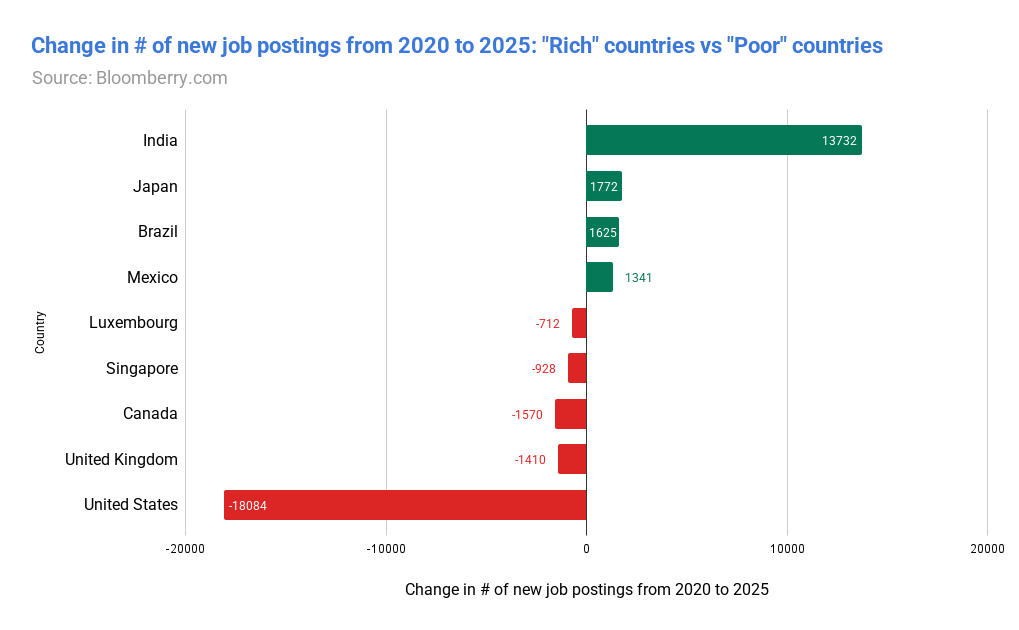
Source: Bloomberry
The number of Amazon job postings in “low-cost” countries has increased by 154% since 2020. The leaders in this growth are India, Mexico, Brazil, and Japan. Despite the declared tens of thousands of layoffs in the US, headcount and costs increased. The employees didn’t disappear, only their address changed.
New outages, a new normal?

AI implementation is leaving its mark not only on employees but also on customers. Amazon’s flywheel—AWS—is starting to stall more and more often, in a way that appears strongly correlated with the degree of AI integration within the organization.
Analysing the frequency and duration of AWS outages, one can clearly see the situation worsening. Financial reports show phenomenal margins and growth in this segment, which forms the backbone of the company’s valuation narrative. But how long can it sustain this with declining service quality and reliability?
The material on this page does not constitute financial advice and does not take into account your level of understanding, investment objectives, financial situation or any other specific needs. All information provided, including opinions, market research, mathematical results and technical analyzes published on the Website or transmitted To you by other means, it is provided for information purposes only and should in no way be construed as an offer or solicitation for a transaction in any financial instrument, nor should the information provided be construed as advice of a legal or financial nature on which any investment decisions you make should be based exclusively To your level of understanding, investment objectives, financial situation, or other specific needs, any decision to act on the information published on the Website or sent to you by other means is entirely at your own risk if you In doubt or unsure about your understanding of a particular product, instrument, service or transaction, you should seek professional or legal advice before trading. Investing in CFDs carries a high level of risk, as they are leveraged products and have small movements Often the market can result in much larger movements in the value of your investment, and this can work against you or in your favor. Please ensure you fully understand the risks involved, taking into account investments objectives and level of experience, before trading and, if necessary, seek independent advice.