S&P 500 — US Large Cap Index
 FTSE 100 — UK Blue Chips
 Euro Stoxx 50 — Eurozone Leaders
 DAX 40 — German Equities
 CAC 40 — French Market Index
 Nikkei 225 — Japan Benchmark
 Hang Seng — Hong Kong Index
 Shanghai Composite — China Mainland
 ASX 200 — Australian Market
 TSX Composite — Canada Index
 Nifty 50 — India Large Cap
 STI Index — Singapore Market
 KOSPI — South Korea Index
 Bovespa — Brazil Equities
 JSE Top 40 — South Africa Index
 IPC Index — Mexico Market
The private credit and private equity markets are not new, but what is relatively new is how they are perceived and how visible they have become to the broader market. Today’s issues in this segment stem partly from that shift.
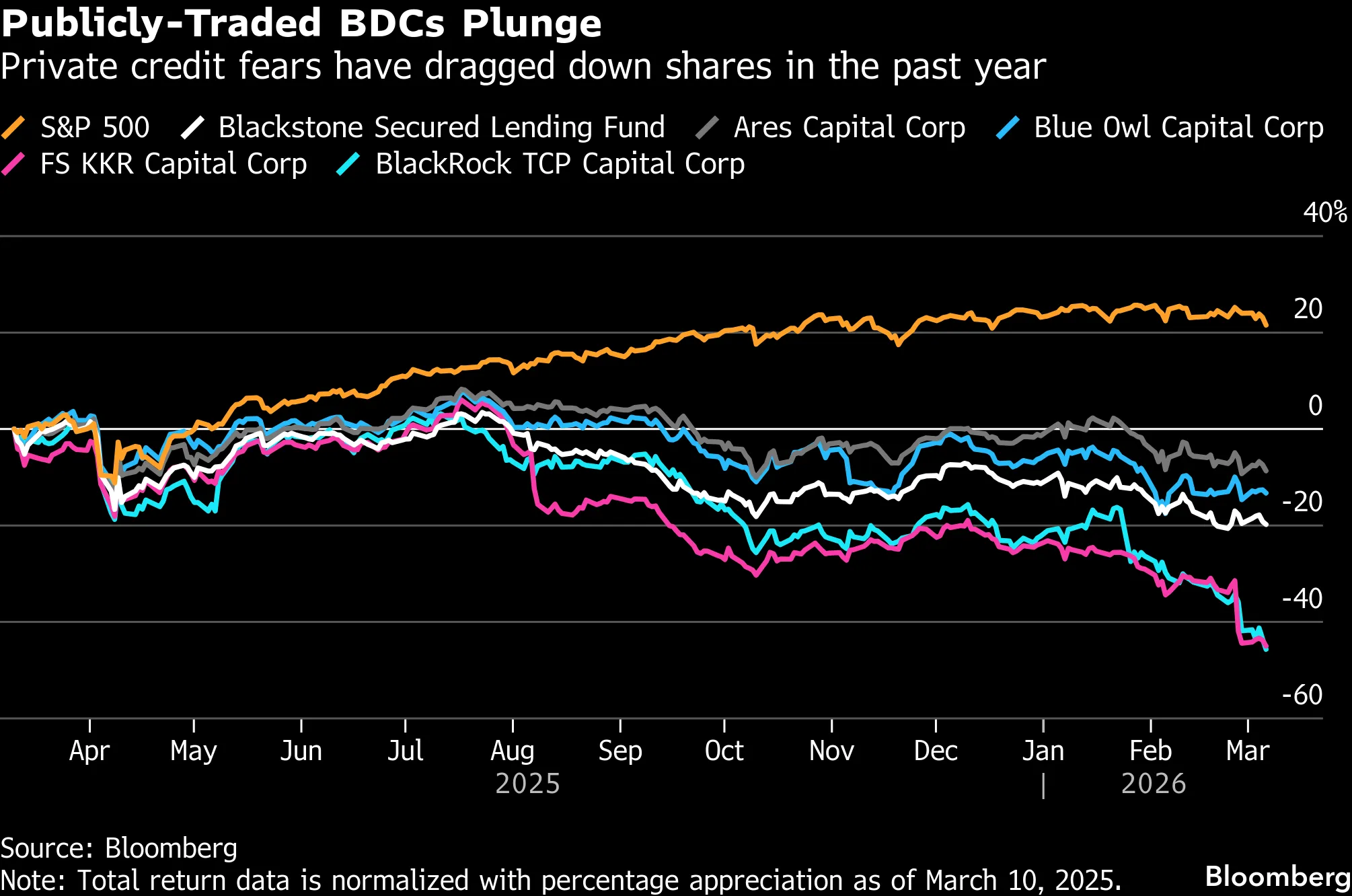
Private credit/private equity firms have seen significant declines in recent months. BlackRock, the world’s largest asset manager, has already lost over 20% of its valuation over the last two months. This is not an isolated case, but a clearly sector-wide trend.
Source: Bloomberg Finance LP
Where are the declines and rumors coming from?
Private equity and private credit firms are known for several things. Among their key characteristics are a lack of transparency and oversight comparable to what is required of other institutions, as well as an above-average tolerance for risk. Risk combined with weaker oversight is, more often than not, a mix that can be disastrous for valuations.
At this stage, however, one should not expect an inevitable financial crisis, as a large part of the market seems to do. The decline in valuations is primarily a reassessment of a business model that had come to rely on assumptions that cannot hold, combined with a meaningful degree of overinterpretation by some market participants.
A series of events, such as limiting redemptions from funds by companies like BlackRock or Blue Owl, or occasional markdowns of assets held in funds, has fuelled concerns about liquidity and asset quality.
The point is that this is a correction in perception, not necessarily in the underlying assets themselves.
The private credit/private assets market and its investors tried to pretend this was a capital allocation method “like any other”: without meaningful risk or constraints, but with higher returns. Unfortunately, that’s not how markets work. Private credit and private assets are now showing their true nature: the market is illiquid by design, and the holdings on these funds’ balance sheets are often there for a reason.
Source: Bloomberg Finance LP
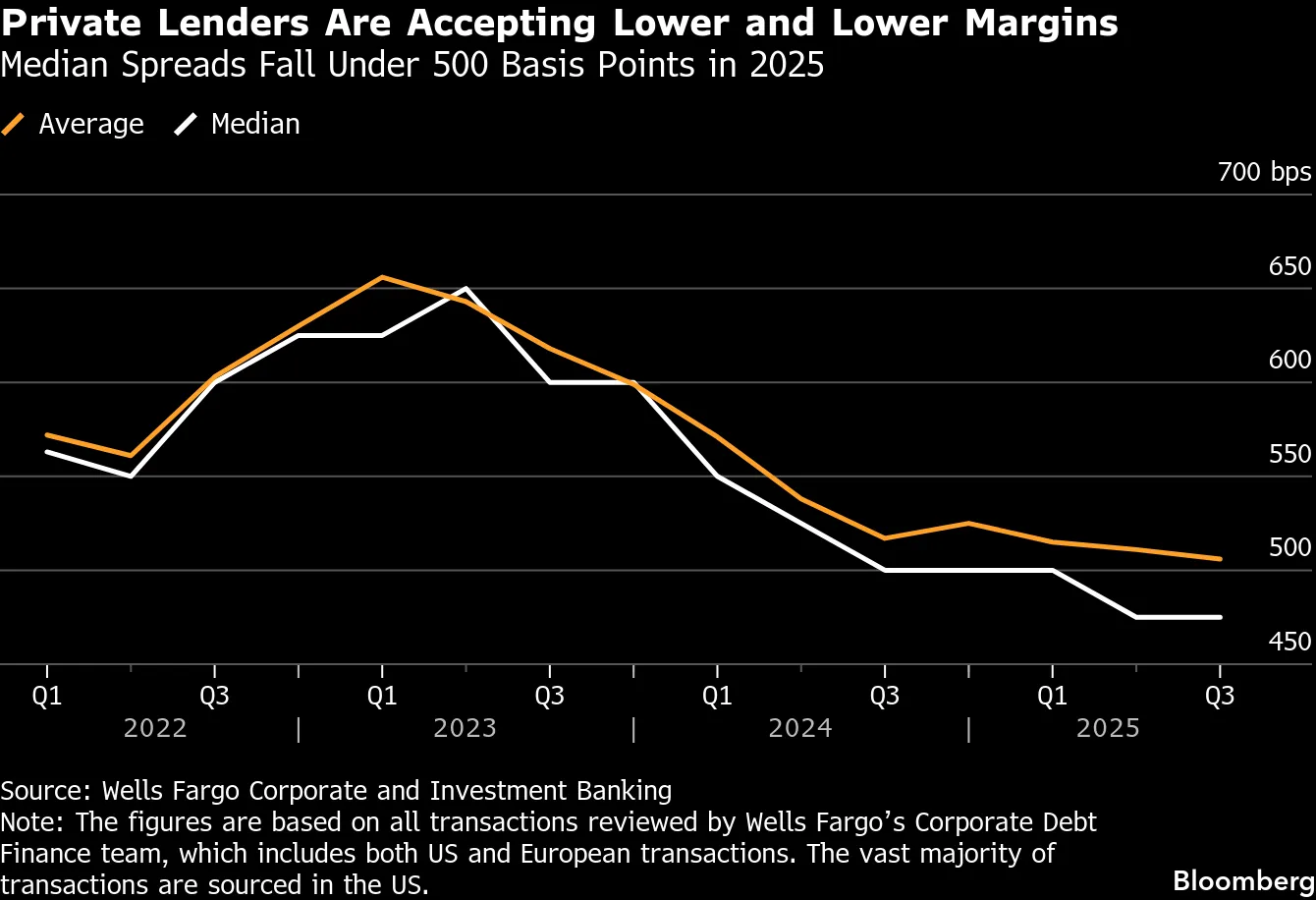
This repricing of risk is also reinforced by technology exposure. As Finch reports, PC/PE firms may have significantly higher exposure to technology companies than they disclose to clients. Tech valuations do not, in themselves, signal an imminent collapse, but the market’s perception of risk is fundamentally different, and higher risk requires higher compensation.
Paying for risk is the core fundamental justification for the declines. These firms turned out to be riskier in many ways than investors initially assumed. After the fact, investors are demanding higher returns or seeking to withdraw capital, both of which clash with the structure and strategy of most funds in this sector.
Where is the biggest problem?
The biggest issue concerns BlackRock and Blue Owl, not because these companies show any signs of illiquidity or imminent failure, but because they must deal with the consequences of expanding the market beyond reasonable limits by (mainly) enabling retail investor exposure to products whose risk profile is fundamentally incompatible with the nature of “private” market investments.
It’s time to look at the metrics. BlackRock’s current P/E is around ~26, compared to the S&P 500’s ~28. Its dividend yield is about 2.5% (paid quarterly), and its gross margin exceeds 47%. Many things can be said about BlackRock, but it cannot reasonably be called overvalued or “in crisis.”
Finally, it’s worth remembering the scale of the company and its potential “problems.” BlackRock manages $14 trillion in assets. The private credit market totals roughly $3–5 trillion, while the entire private assets market is around $10–20 trillion, bearing in mind that parts of these markets overlap.
If the market were pricing in a loss of value across most of the firm’s assets on a scale that could threaten liquidity, derivatives markets would be showing something close to Armageddon. Nothing like that is happening. Expectations are stable, volatility is moderate, and CDS remain at their typical, still low, levels.
The material on this page does not constitute financial advice and does not take into account your level of understanding, investment objectives, financial situation or any other specific needs. All information provided, including opinions, market research, mathematical results and technical analyzes published on the Website or transmitted To you by other means, it is provided for information purposes only and should in no way be construed as an offer or solicitation for a transaction in any financial instrument, nor should the information provided be construed as advice of a legal or financial nature on which any investment decisions you make should be based exclusively To your level of understanding, investment objectives, financial situation, or other specific needs, any decision to act on the information published on the Website or sent to you by other means is entirely at your own risk if you In doubt or unsure about your understanding of a particular product, instrument, service or transaction, you should seek professional or legal advice before trading. Investing in CFDs carries a high level of risk, as they are leveraged products and have small movements Often the market can result in much larger movements in the value of your investment, and this can work against you or in your favor. Please ensure you fully understand the risks involved, taking into account investments objectives and level of experience, before trading and, if necessary, seek independent advice.