S&P 500 — US Large Cap Index
 FTSE 100 — UK Blue Chips
 Euro Stoxx 50 — Eurozone Leaders
 DAX 40 — German Equities
 CAC 40 — French Market Index
 Nikkei 225 — Japan Benchmark
 Hang Seng — Hong Kong Index
 Shanghai Composite — China Mainland
 ASX 200 — Australian Market
 TSX Composite — Canada Index
 Nifty 50 — India Large Cap
 STI Index — Singapore Market
 KOSPI — South Korea Index
 Bovespa — Brazil Equities
 JSE Top 40 — South Africa Index
 IPC Index — Mexico Market
- The Australian Dollar maintains its position after PBoC left its one- and five-year LPRs unchanged at 3.10% and 3.60%, respectively.
- The AUD advanced as US Dollar softened, weighed down by rising concerns over the economic impact of new US tariffs.
- Trade tensions escalated further after the White House imposed tariffs on Chinese vessels docking at US ports.
The Australian Dollar (AUD) recovers its losses from the previous session against the US Dollar (USD) on Monday. The AUD/USD pair held firm following the People’s Bank of China’s (PBoC) decision to keep its Loan Prime Rates unchanged, maintaining the one-year rate at 3.10% and the five-year rate at 3.60%.
The AUD/USD pair gained support as the USD weakened amid growing concerns over the economic fallout from US tariffs. The AUD was further buoyed after US President Donald Trump announced exemptions for key technology products — many of which are made in China, Australia’s top trading partner and a major consumer of its commodity exports — from the proposed “reciprocal” tariffs.
Nonetheless, tensions remained as the White House imposed tariffs on Chinese ships docking at US ports, risking disruption to global shipping routes. However, late Thursday, Trump noted that China had made several overtures and stated, “I don’t want to go higher on China tariffs. If China tariffs go higher, people won’t buy.” He also expressed optimism that a trade deal could be reached within three to four weeks.
Australian Dollar appreciates as US Dollar struggles amid decline in 2-year Treasury yield
- The US Dollar Index (DXY), which measures the USD against a basket of six major currencies, dropped over 0.50%, trading around 98.50, its lowest level since April 2022, at the time of writing. The Greenback faces headwinds as the 2-year yield on US Treasury bonds has depreciated by more than 1%, standing at 3.75%.
- Federal Reserve (Fed) Chair Jerome Powell warned that a sluggish economy paired with persistent inflation could challenge the Fed’s objectives and raise the risk of stagflation. In political developments, reports on Thursday suggested President Trump’s frustration with Fed Chair Powell, even considering his removal. Although markets showed little immediate reaction, White House economic adviser Kevin Hassett confirmed that Trump is exploring the possibility.
- The US Department of Labor reported on Thursday that Initial Jobless Claims fell to 215,000 for the week ending April 12, below expectations and down from the previous week’s revised figure of 224,000 (originally 223,000). However, Continuing Jobless Claims rose by 41,000 to 1.885 million for the week ending April 5.
- The US Consumer Price Index (CPI) inflation eased to 2.4% year-over-year in March, down from 2.8% in February and below the market forecast of 2.6%. Core CPI, which excludes food and energy prices, rose 2.8% annually, compared to 3.1% previously and missing the 3.0% estimate. On a monthly basis, headline CPI dipped by 0.1%, while core CPI edged up by 0.1%.
- Australia’s Unemployment Rate rose to 4.1% in March, slightly below the market forecast of 4.2%. Meanwhile, Employment Change came in at 32.2K, against the consensus forecast of 40K.
- Australia’s Westpac Leading Index’s six-month annualised growth rate, which forecasts economic momentum relative to the trend over the next three to nine months, eased to 0.6% in March from 0.9% in February.
- Reserve Bank of Australia’s (RBA) March 31–April 1 Meeting Minutes indicated ongoing uncertainty around the timing of the next interest rate adjustment. Although the Board considered the May meeting a suitable point to review monetary policy, it stressed that no decisions had been made in advance. The Board also pointed to both upside and downside risks facing Australia’s economy and inflation trajectory.
- China’s economy grew at an annual rate of 5.4% in the first quarter of 2025, matching the pace seen in Q4 2024 and surpassing market expectations of 5.1%. On a quarterly basis, GDP rose by 1.2% in Q1, following a 1.6% increase in the previous quarter, falling short of the forecasted 1.4% gain.
- Meanwhile, China’s Retail Sales surged 5.9% year-over-year, beating expectations of 4.2% and up from February’s 4%. Industrial Production also outperformed, rising 7.7% compared to the 5.6% forecast and February’s 5.9% print.
Australian Dollar remains below 0.6400 level despite a persistent upward bias
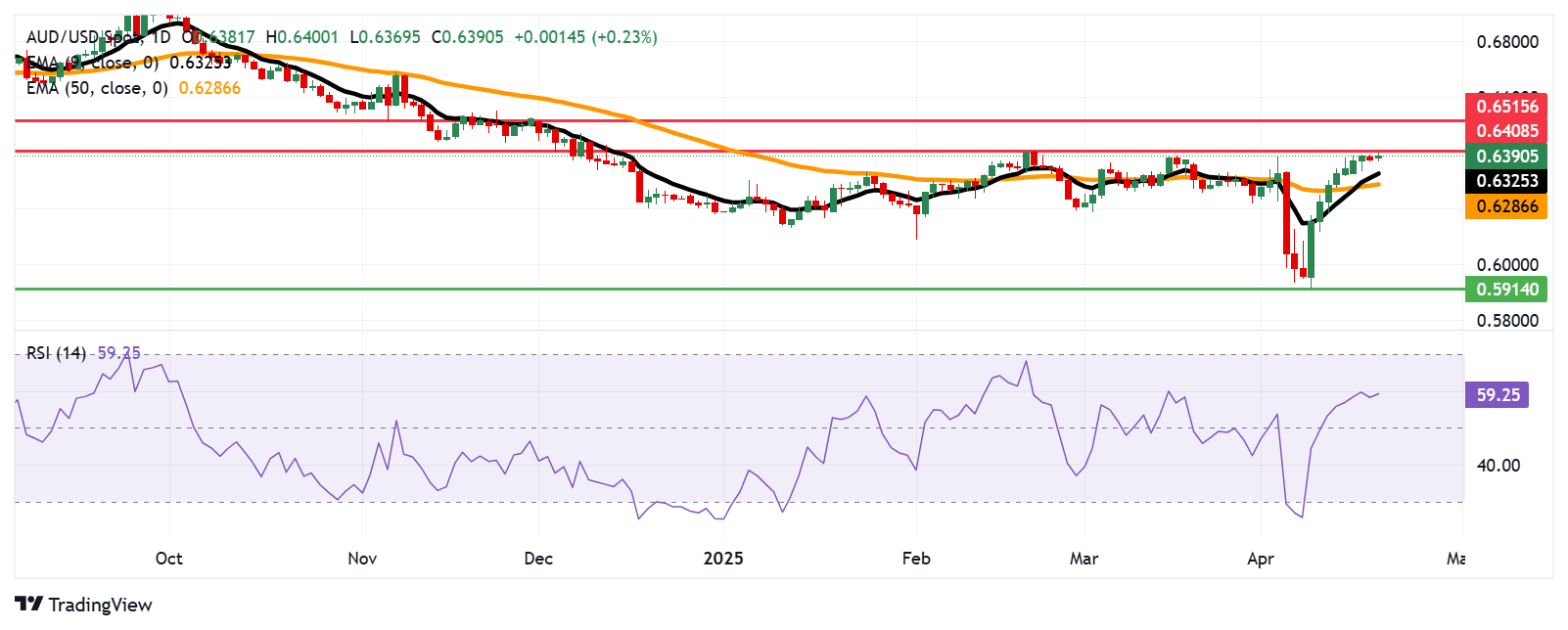
The AUD/USD pair is trading near 0.6390 on Monday, with technical indicators on the daily chart suggesting a bullish outlook. The pair remains above the nine-day Exponential Moving Average (EMA), while the 14-day Relative Strength Index (RSI) stays above the neutral 50 level—both pointing to sustained upward momentum.
On the upside, immediate resistance is seen at the psychological 0.6400 mark, followed by the four-month high of 0.6408, last tested on February 21. A decisive break above this zone could pave the way for a move toward the five-month high at 0.6515.
The initial support is located at the nine-day EMA around 0.6325, with further downside protection near the 50-day EMA at 0.6286. A break below these levels may undermine the short-term bullish bias and expose the AUD/USD pair to deeper losses toward the 0.5914 area—its lowest level since March 2020.
AUD/USD: Daily Chart
Australian Dollar PRICE Today
The table below shows the percentage change of Australian Dollar (AUD) against listed major currencies today. Australian Dollar was the strongest against the US Dollar.
| USD | EUR | GBP | JPY | CAD | AUD | NZD | CHF | |
|---|---|---|---|---|---|---|---|---|
| USD | -1.06% | -0.64% | -0.97% | -0.39% | -0.64% | -1.20% | -1.04% | |
| EUR | 1.06% | 0.27% | 0.06% | 0.64% | 0.23% | -0.17% | 0.00% | |
| GBP | 0.64% | -0.27% | -0.04% | 0.38% | -0.03% | -0.44% | -0.26% | |
| JPY | 0.97% | -0.06% | 0.04% | 0.59% | 0.21% | -0.11% | -0.03% | |
| CAD | 0.39% | -0.64% | -0.38% | -0.59% | -0.38% | -0.82% | -0.64% | |
| AUD | 0.64% | -0.23% | 0.03% | -0.21% | 0.38% | -0.39% | -0.23% | |
| NZD | 1.20% | 0.17% | 0.44% | 0.11% | 0.82% | 0.39% | 0.20% | |
| CHF | 1.04% | -0.00% | 0.26% | 0.03% | 0.64% | 0.23% | -0.20% |
The heat map shows percentage changes of major currencies against each other. The base currency is picked from the left column, while the quote currency is picked from the top row. For example, if you pick the Australian Dollar from the left column and move along the horizontal line to the US Dollar, the percentage change displayed in the box will represent AUD (base)/USD (quote).