S&P 500 — US Large Cap Index
 FTSE 100 — UK Blue Chips
 Euro Stoxx 50 — Eurozone Leaders
 DAX 40 — German Equities
 CAC 40 — French Market Index
 Nikkei 225 — Japan Benchmark
 Hang Seng — Hong Kong Index
 Shanghai Composite — China Mainland
 ASX 200 — Australian Market
 TSX Composite — Canada Index
 Nifty 50 — India Large Cap
 STI Index — Singapore Market
 KOSPI — South Korea Index
 Bovespa — Brazil Equities
 JSE Top 40 — South Africa Index
 IPC Index — Mexico Market
- The Australian Dollar advances as the US Dollar may struggle due to rising economic concerns in the US.
- ANZ Job Advertisements fell by 1.2% in May, deepening from a revised 0.3% fall in April.
- Trump plans to increase import tariffs on steel and aluminum to 50% from 25%.
The Australian Dollar (AUD) appreciated against the US Dollar (USD) by over 0.50% on Monday. The AUD/USD pair rises as the Greenback may face challenges amid growing concerns regarding slow growth and renewed inflation in the United States (US). US President Donald Trump threatened to double import tariffs on steel and aluminum, increasing them to 50% from 25%.
ANZ Job Advertisements declined by 1.2% in May, following a revised 0.3% fall in the previous month. The Australian job ads drop for the second consecutive month. Moreover, S&P Global Manufacturing Purchasing Managers’ Index (PMI) declined to 51.0 in May from 51.7 prior, dropping for the second straight month to the lowest level since February.
The AUD holds ground following the mixed Chinese Manufacturing Purchasing Managers’ Index (PMI) data released on Saturday. The National Bureau of Statistics (NBS) showed that China’s Manufacturing PMI rose to 49.5 in May, from April’s 49.0 reading. Meanwhile, the Non-Manufacturing PMI declined to 50.3 from the previous 50.4 figure, falling short of the expected reading of 50.6. The Aussie Dollar could be impacted by Chinese economic data as both countries are close trading partners.
Australian Dollar advances amid rising concerns over US growth, inflation
- The US Dollar Index (DXY), which measures the value of the Greenback against six major currencies, is holding ground near 99.50 at the time of writing. Traders seek fresh cues from the release of the US May ISM Manufacturing Purchasing Managers’ Index (PMI), which is due later in the North American session.
- US President Donald Trump said at a rally in Pennsylvania on Friday that he planned to double import tariffs on steel and aluminum to build up pressure on global steel producers and intensify the trade war. “We are going to be imposing a 25% increase. We’re going to bring it from 25% to 50% – the tariffs on steel into the United States of America, which will even further secure the steel industry in the United States,” he said, per Reuters.
- A three-judge panel at the Court of International Trade in Manhattan halted US President Donald Trump from imposing “Liberation Day” tariffs from taking effect. The federal court found that Trump exceeded his authority in imposing broad import tariffs and declared the executive orders issued on April 2 unlawful. However, the US Court of Appeals for the Federal Circuit in Washington, on Thursday, temporarily allowed Trump’s tariffs to take effect.
- Federal Open Market Committee’s (FOMC) Minutes for the latest policy meeting, released on Wednesday, indicated that Federal Reserve (Fed) officials broadly agreed that heightened economic uncertainty justified their patient approach to interest-rate adjustments. Fed officials emphasized the need to keep interest rates unchanged for some time, as recent policy shifts cloud the US economic outlook.
- Securities Times in China reports that analysts believe that the People’s Bank of China (PBoC) may boost Pledged Supplementary Lending (PSL). This move would provide low-cost, long-term funding to policy banks, which in turn support government-prioritized sectors, such as housing, urban redevelopment, and major infrastructure projects.
- Australia’s seasonally adjusted Retail Sales declined by 0.1% month-over-month in April, against the expectations of remaining consistent at 0.3% growth. Meanwhile, the monthly Building Permits fell by 5.7%, against the expected increase of 3.1%.
- The Reserve Bank of Australia (RBA) is expected to deliver more rate cuts in the upcoming policy meetings. The central bank acknowledged progress in curbing inflation and warned that US-China trade barriers pose downside risks to economic growth. Governor Michele Bullock stated that the RBA is prepared to take additional action if the economic outlook deteriorates sharply, raising the prospect of future rate cuts.
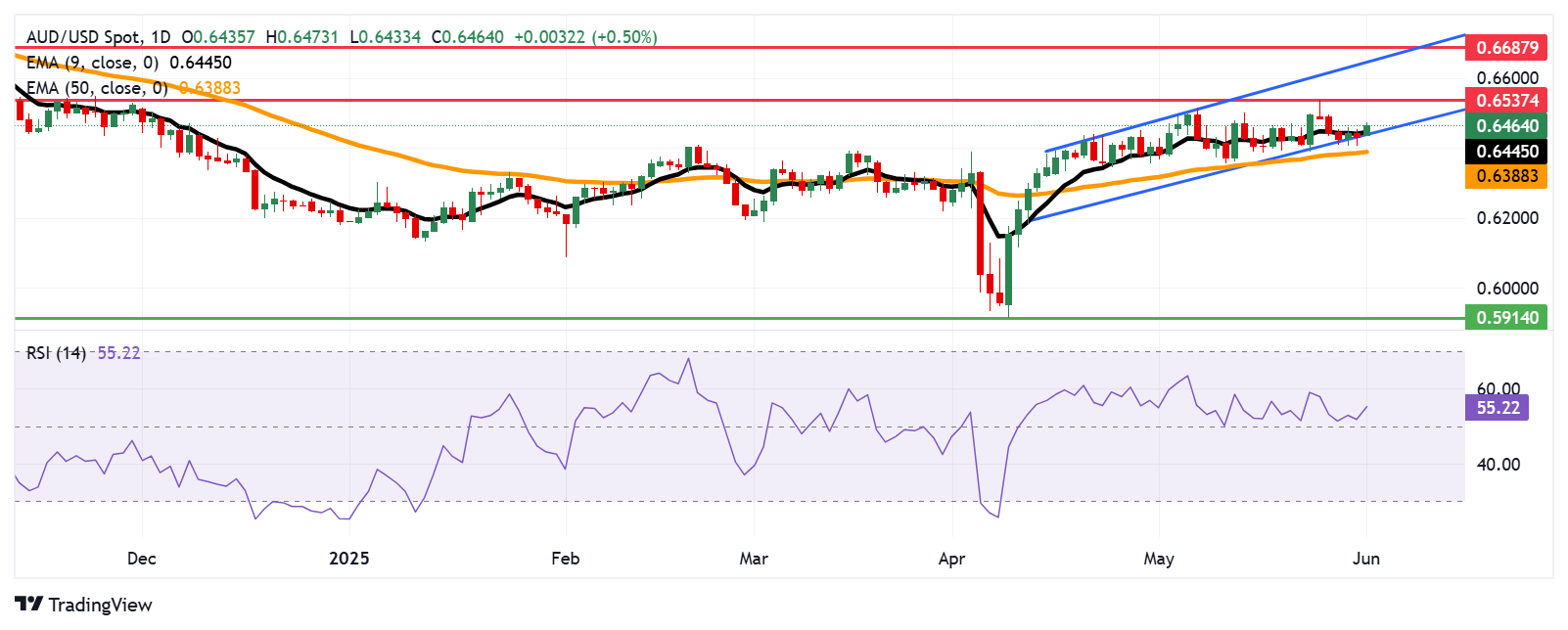
Australian Dollar rebounds from 0.6450 support near nine-day EMA
AUD/USD is trading around 0.6460 on Monday, indicating a strengthening bullish bias. The technical analysis of the daily chart suggests that the pair is stepping up within the ascending channel pattern. The short-term price momentum strengthens as the pair moves above the nine-day Exponential Moving Average (EMA). Additionally, the 14-day Relative Strength Index (RSI) is rising above the 50 mark, suggesting a persistent bullish bias.
The AUD/USD pair could target the initial barrier at 0.6537, a seven-month high recorded on May 26. A break above this crucial resistance zone could reinforce the bullish bias and support the pair to explore the region around the upper boundary of the ascending channel around 0.6650.
On the downside, the immediate support appears at the nine-day EMA of 0.6445, aligned with the ascending channel’s lower boundary around 0.6440. A break below this crucial support zone could weaken the bullish bias and lead the AUD/USD pair to test the 50-day EMA at 0.6388.
AUD/USD: Daily Chart
Australian Dollar PRICE Today
The table below shows the percentage change of Australian Dollar (AUD) against listed major currencies today. Australian Dollar was the strongest against the US Dollar.
| USD | EUR | GBP | JPY | CAD | AUD | NZD | CHF | |
|---|---|---|---|---|---|---|---|---|
| USD | -0.14% | -0.15% | -0.23% | -0.14% | -0.34% | -0.62% | -0.11% | |
| EUR | 0.14% | -0.03% | -0.08% | -0.02% | -0.20% | -0.51% | 0.02% | |
| GBP | 0.15% | 0.03% | -0.04% | 0.00% | -0.17% | -0.49% | 0.05% | |
| JPY | 0.23% | 0.08% | 0.04% | 0.06% | -0.14% | -0.43% | 0.01% | |
| CAD | 0.14% | 0.02% | -0.01% | -0.06% | -0.19% | -0.49% | 0.04% | |
| AUD | 0.34% | 0.20% | 0.17% | 0.14% | 0.19% | -0.25% | 0.31% | |
| NZD | 0.62% | 0.51% | 0.49% | 0.43% | 0.49% | 0.25% | 0.54% | |
| CHF | 0.11% | -0.02% | -0.05% | -0.01% | -0.04% | -0.31% | -0.54% |
The heat map shows percentage changes of major currencies against each other. The base currency is picked from the left column, while the quote currency is picked from the top row. For example, if you pick the Australian Dollar from the left column and move along the horizontal line to the US Dollar, the percentage change displayed in the box will represent AUD (base)/USD (quote).