S&P 500 — US Large Cap Index
 FTSE 100 — UK Blue Chips
 Euro Stoxx 50 — Eurozone Leaders
 DAX 40 — German Equities
 CAC 40 — French Market Index
 Nikkei 225 — Japan Benchmark
 Hang Seng — Hong Kong Index
 Shanghai Composite — China Mainland
 ASX 200 — Australian Market
 TSX Composite — Canada Index
 Nifty 50 — India Large Cap
 STI Index — Singapore Market
 KOSPI — South Korea Index
 Bovespa — Brazil Equities
 JSE Top 40 — South Africa Index
 IPC Index — Mexico Market

Chart of the Day: USDJPY Caught in a Trap. Tokyo Intervention and a Hawkish BoJ Loom


Key takeaways
- USDJPY trades around 158 as investors await upcoming interest rate decisions from the Fed and the BoJ.
- Japan services producer price growth accelerates to 3.7%, supporting expectations for further Bank of Japan rate hikes.
- Japanese authorities warn that they remain ready to take decisive action against excessive yen depreciation near the 160 level.
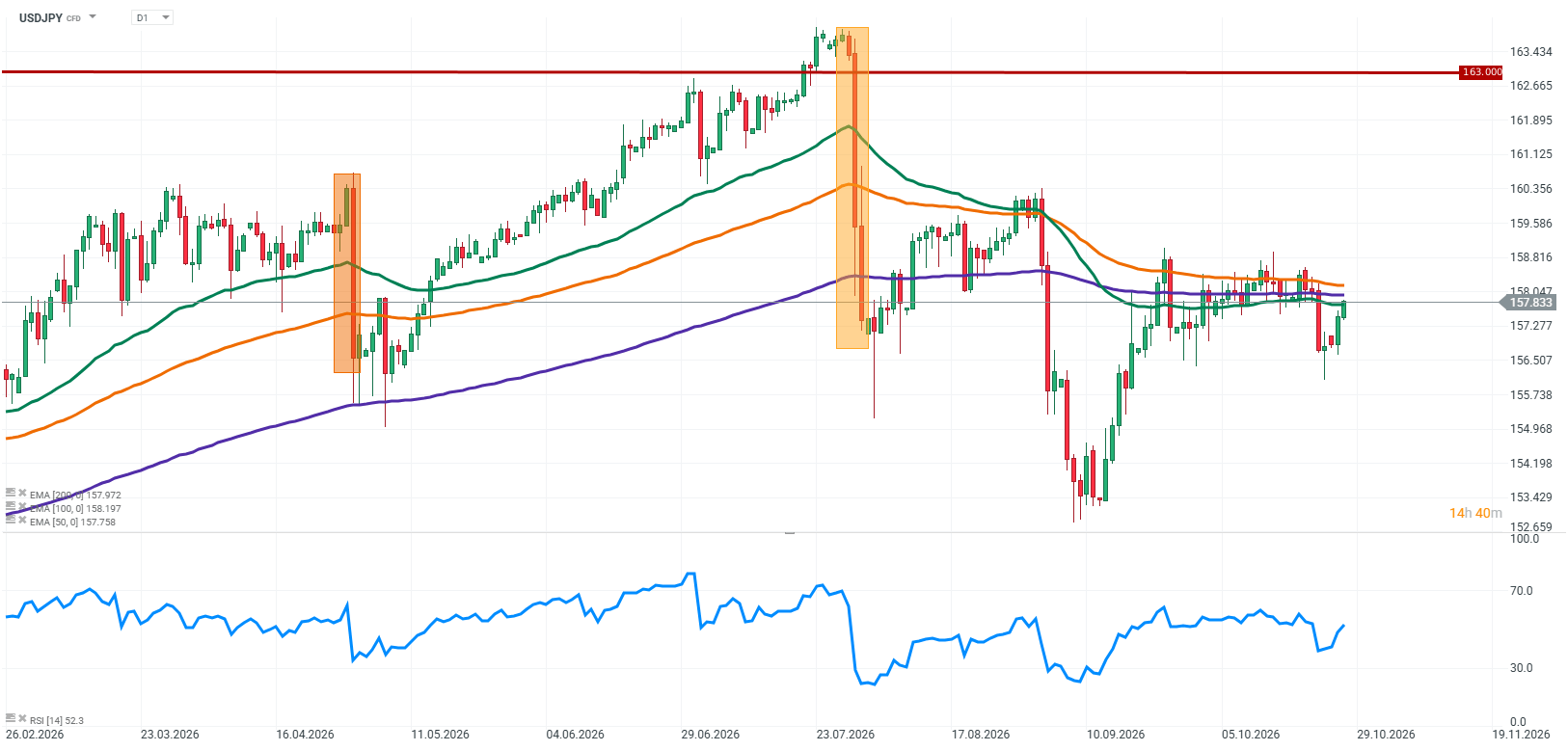
USDJPY remains in focus ahead of key meetings of the Federal Reserve and the Bank of Japan. On Tuesday, October 27, the pair is trading around 158 as investors prepare for decisions that could shape its direction over the coming weeks. Markets are not currently expecting an interest rate hike from either the Fed or the BoJ. However, this does not mean that further monetary tightening is off the table. Inflation remains a key factor. In Japan, price pressures, including rising service prices, are strengthening the case for further rate hikes. At the same time, Japanese officials are increasingly signalling that they will not stand by and allow the yen to weaken indefinitely. On the other side of the equation is the US dollar, whose outlook depends on how long inflation in the United States remains elevated.
Source: XTB Research
Key Factors Currently Driving USDJPY
Japanese Inflation Continues to Support the BoJ Rate Hike Outlook
The latest data on Japanese producer prices for services show annual growth accelerating to 3.7%. At the same time, the previous reading for August was revised lower. Despite this revision, the latest figure suggests that price pressures in the services sector remain significant. This is an important signal for the Bank of Japan. Service prices can reflect not only energy and import costs, but also more persistent economic trends, including wage pressures and the pass through of higher costs to consumers. From the central bank’s perspective, sustained inflation in this segment could support further gradual monetary policy normalisation. However, this does not mean the BoJ must raise rates this week. Following previous policy adjustments, policymakers may want to assess their impact on the economy and financial conditions. As a result, the central bank’s guidance on the future path of interest rates is becoming just as important as the decision itself.
The BoJ May Pause, but a December Hike Remains a Real Possibility
The Bank of Japan is likely to keep interest rates at 1.25% at its meeting concluding on October 30. However, this would not necessarily signal a dovish shift. The central bank could use its updated economic and inflation forecasts to indicate that monetary policy normalisation will continue and that another rate hike remains a matter of timing. The outlook for underlying inflation is particularly important. Rising energy costs, a weak yen pushing up import prices, and persistent wage pressures all argue for continued vigilance among policymakers. The BoJ may conclude that inflation has become sufficiently entrenched in the economy to warrant further gradual monetary tightening in order to maintain price stability over the longer term. Investors will primarily be looking for confirmation that a December rate hike remains a realistic option. Under this scenario, the policy rate could rise from 1.25% to 1.50%, although the final decision will depend on incoming data and the central bank’s assessment of the Japanese economy. The yen could benefit simply from a signal that another rate hike is approaching. Even if the BoJ leaves rates unchanged in October, more hawkish guidance could limit USDJPY’s upside potential. Foreign exchange markets respond not only to current interest rates, but also to expectations about their future path. The key question, however, is whether signals from Tokyo will prove more hawkish than the Fed’s message. If both central banks leave rates unchanged, but the BoJ more clearly opens the door to a December hike, expectations for the future interest rate differential could begin to work in the yen’s favour.
The Fed Is Likely to Pause, but US Inflation Remains a Risk
The Federal Reserve’s upcoming meeting concludes on October 28. The market’s base case is that interest rates will remain unchanged, giving policymakers time to assess inflation and economic conditions. For USDJPY, however, the important question is not simply whether the Fed holds rates steady, but also how it assesses the inflation outlook over the coming months. Persistent price pressures in the United States could make the Fed cautious about signalling future monetary easing. If its statement is more hawkish than markets anticipate, the dollar could remain supported even without an October rate hike. This matters because the absence of a rate increase does not automatically imply a weaker US currency. If investors conclude that US interest rates will remain elevated for longer, Treasury yields could rise, making the dollar more attractive relative to the yen. In this scenario, the arguments for further BoJ tightening may not be sufficient to trigger a sustained decline in USDJPY. The interest rate differential between Japan and the United States continues to favour the dollar, and narrowing that gap would require clearer signals of further Japanese rate hikes or a shift in expectations for Fed policy.
Tokyo Issues Another Warning: Intervention Risk Remains Real
Another important factor is the Japanese authorities’ stance on the weak yen. Finance Minister Satsuki Katayama reiterated on October 27 that the government is closely monitoring foreign exchange market movements and stands ready to take decisive action if necessary. Such warnings do not amount to an announcement of imminent intervention. However, they show that Tokyo remains vigilant and that rapid, excessive yen depreciation could prompt a response from the authorities. The 160 level remains an important reference point for investors. As the pair approaches this area, the risk of Japanese authorities stepping in to curb further yen weakness increases. However, this should not be treated as an automatic intervention threshold. The pace of the move, market conditions, and whether exchange rate movements are considered excessive also matter. As a result, intervention risk could limit USDJPY’s upside even without a clear signal from the BoJ. The warning alone could trigger a short term rebound in the yen, particularly if investors are heavily positioned for further gains in the pair.
USDJPY Ahead of Central Bank Decisions: Consolidation or Another Test of 160?
In the short term, the market is caught between two opposing forces. On one side, Japanese inflation and warnings from Tokyo increase the risk of a downside correction in USDJPY. On the other, persistent US price pressures and the interest rate differential could continue to support the dollar. Trading around the 157 to 158 area suggests that investors are waiting for fresh catalysts. Ahead of the Fed and BoJ decisions, it is difficult to identify a clear directional bias, and the tone of the policy statements may matter more than the decisions themselves. A more hawkish BoJ combined with a relatively cautious Fed could open the door to further yen appreciation and a move lower in USDJPY. The opposite combination, with a hawkish Fed and a cautious BoJ, would increase the risk of another test of 159 to 160, where the possibility of intervention could become an additional obstacle for dollar bulls.
Conclusion
USDJPY enters a week of important central bank decisions without a clear directional catalyst. Japanese inflation continues to support the prospect of further BoJ rate hikes, while the latest producer price data for services reinforce the view that price pressures have not been fully contained. At the same time, Tokyo is reminding markets that currency intervention remains a possibility. The United States cannot be overlooked, however. If US inflation remains persistent, the Fed could maintain a hawkish stance, limiting USDJPY’s downside potential. Over the coming days, the most important signals will therefore concern the outlook for December policy decisions rather than the expected October pause itself. USDJPY does not need to wait for an actual BoJ rate hike to come under pressure. Confirmation that a December move remains possible could be enough to shift market expectations. However, sustained yen appreciation will also depend on the Fed’s communication and the US inflation outlook. For now, downside risks are increasing, but a decisive reversal has yet to be confirmed. Key factors for USDJPY:
- Japanese inflation: Rising service prices strengthen the case for further BoJ rate hikes.
- A hawkish BoJ pause: Holding rates at 1.25% does not rule out an increase to 1.50% in December.
- The Fed decision: Markets expect rates to remain unchanged, making the policy statement and guidance for the coming months particularly important.
- Intervention risk: Warnings from Tokyo could limit the pair’s upside, especially near 160.
- US inflation: Persistent price pressures could support the dollar and limit yen appreciation.
- Base case: USDJPY could consolidate ahead of the central bank meetings, with a clearer direction emerging only after policymakers deliver their statements.