S&P 500 — US Large Cap Index
 FTSE 100 — UK Blue Chips
 Euro Stoxx 50 — Eurozone Leaders
 DAX 40 — German Equities
 CAC 40 — French Market Index
 Nikkei 225 — Japan Benchmark
 Hang Seng — Hong Kong Index
 Shanghai Composite — China Mainland
 ASX 200 — Australian Market
 TSX Composite — Canada Index
 Nifty 50 — India Large Cap
 STI Index — Singapore Market
 KOSPI — South Korea Index
 Bovespa — Brazil Equities
 JSE Top 40 — South Africa Index
 IPC Index — Mexico Market
Diplomacy in the Shadow of Hormuz: Short-Term De-escalation and Structural Supply Risks for Oil and Gas


The last week of July brings a noticeable reprieve to global energy commodity markets. Prices for crude oil and European natural gas recorded sharp, multi-percent drops, interrupting a growth trend that had lasted for many weeks. The main immediate factor that triggered the sell-off was the suspension of American air raids on Iran and the commencement of diplomatic talks in Oman regarding the security of sea lanes. Iran itself indicated that as long as the Americans do not attack, they will also refrain from their own attacks. On the other hand, it is unclear whether this means the opening of the Strait of Hormuz, and in turn, the Houthis carried out several attacks on Saudi oil infrastructure over the weekend. Map of Commodity Price Changes
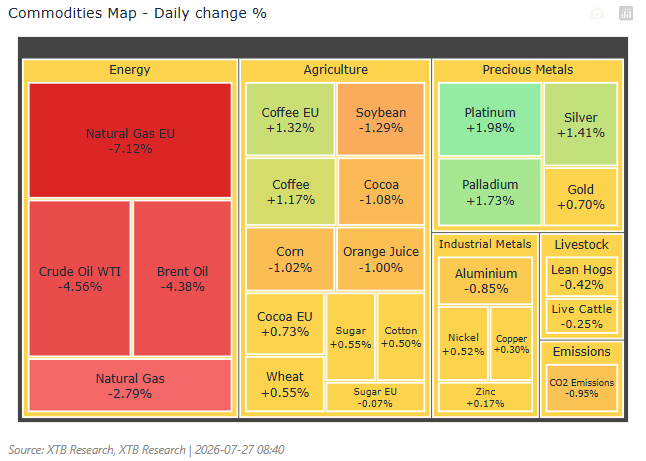
Energy commodities dominate market volatility on Monday, July 27. On the other hand, we see increases in precious metals. Source: Bloomberg Finance LP, XTB Crude Oil Tanker Flow Through the Bab el-Mandab Strait and the Strait of Hormuz
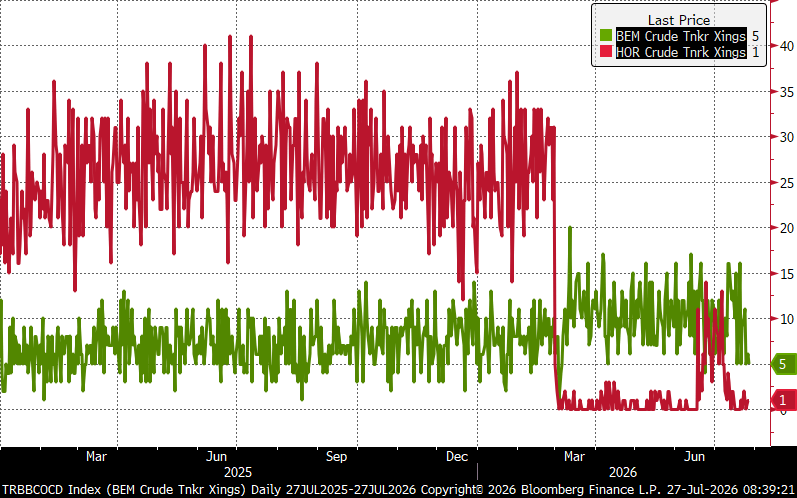
Although the market opens with hope for an end to the conflict, real data does not show improvement. The number of ships passing through the Strait of Bab el-Mandab has dropped by half from the average of recent months, while only 1 vessel is currently passing through the Strait of Hormuz. Source: Bloomberg Finance LP The analysis below discusses in detail the reasons for today’s declines, market fundamentals, and structural supply risks.
Key Price Changes and Data from the Oil and Gas Market
- Brent Crude Oil: A drop of 4.3%, although initially it was above 5%, to a level of about 86 USD per barrel. It is worth remembering that this applies to the October contract. The September contract tested 100 USD per barrel last week and is currently around 90 USD per barrel.
- WTI Crude Oil: A drop of about 4.5% to a level slightly above 84 USD per barrel.
- TTF Natural Gas (Netherlands): The nearest contract fell by as much as 7% to the level of 58.33 EUR/MWh, which was the sharpest one-day price drop since June 15. Since the beginning of the year, however, this is still an increase of over 100%.
- EU Gas Storage Level: Fill level at 55% (as of July 25–27), which is significantly below the 5-year seasonal average of 71%.
- LNG Imports to Europe: The 30-day moving average of liquefied natural gas imports to Europe was 108 thousand tonnes per day, which means a drop of about 42% year-on-year. LNG flows to northwestern Europe amounted to 94.40 million cubic meters per day (22% below the 30-day average).
- LNG Imports to China: The 30-day moving average was 170 thousand tonnes per day (a drop of 8.1% y/y), which weakens direct competition with Europe for spot cargoes.
- Traffic in Key Straits: On Sunday, July 26, only 8 merchant ships passed through the Strait of Hormuz, and 14 through the Bab al-Mandeb Strait (the lowest daily result this year). For ships carrying oil, the numbers were 5 and 1, respectively.
- Norwegian Gas Export: Reported flows to the UK and Northwest Europe remained stable at 321.30 million cubic meters per day (compared to the 5-day average of 315.30 million m³/d).
Percentage Changes in Commodity Prices Before 9 AM CET
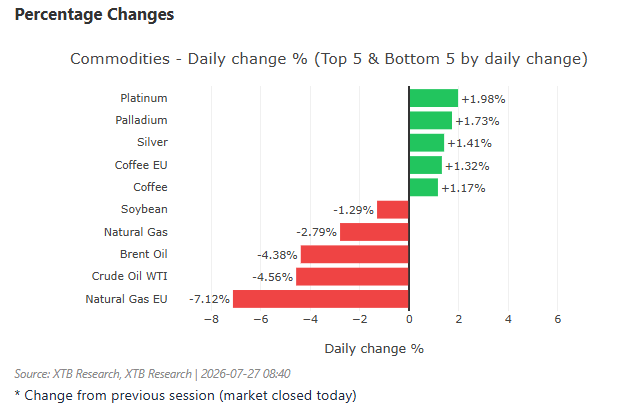
The largest increases and decreases at the market open on Monday, July 27. It is visible that the instruments gaining the most are those that benefit from the decline in inflation expectations, due to the sell-off in energy commodities. Source: XTB
Geopolitical and Diplomatic Background
1. Pause in US and Iranian Military Operations
The main driver of the drop in energy prices was the unexpected suspension by the United States of a series of night air attacks on targets in Iran after 13 days of continuous operations. In response, Iranian armed forces reported the suspension of their retaliatory actions. It is speculated that this is related to the desire to stop the shelling of targets in the vicinity of the Bab el-Mandab Strait, although it is worth remembering that the Houthis themselves do not have to comply with the request from Iran. The following conclusions result from media reports and statements by authorities:
- Attempt to Open a Diplomatic Window: US Ambassador to the UN Mike Waltz and President Donald Trump declared that this move aims to “give space for negotiations,” although the option for further escalation (“locked and loaded”) still remains available.
- Signals from the Military and Intelligence: Some sources (including Axios and NYT reports) indicate that military commanders, including Admiral Brad Cooper, suggested that the current air raids had reached their limit of effectiveness, and continuing the intensive campaign raises the risk of exhausting the stocks of Patriot interceptor missiles in the region.
- Omani Mediation: Meetings between diplomatic representatives of Iran and Oman took place in Tehran to establish rules for safe navigation in the Strait of Hormuz, through which about 20% of the world’s oil supply and a significant volume of LNG are transported under normal conditions. Iran had previously suggested the desire to create a permanent system of transit fees. The amount of 1 dollar per barrel of oil is constantly appearing in the media.
2. Actions of the Houthi Rebels and the Threat to the Saudi Bypass
Parallel to the talks with Iran, the tension shifted to the Red Sea region. Yemeni Houthi rebels announced a blockade of Saudi ports and carried out missile and drone attacks on Saudi Aramco infrastructure in the ports of Jizan and Yanbu. Alternative Oil Transit Routes from the Persian Gulf
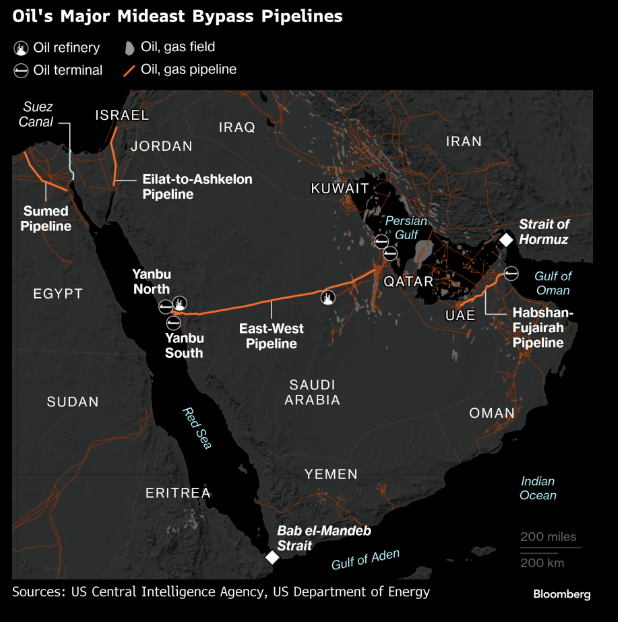
The port of Yanbu currently constitutes a key terminal for Saudi oil. Source: Bloomberg Finance LP Yanbu, as the western terminus of the East-West pipeline, served as a key bypass route for Saudi oil (allowing it to circumvent the blocked Strait of Hormuz and transport up to 6 million barrels per day). These attacks led many shipowners to turn off satellite transponders or abandon routes through Bab al-Mandeb, which further complicates the physical delivery of the raw material to the markets. Oil Transit Through the Yanbu Terminal
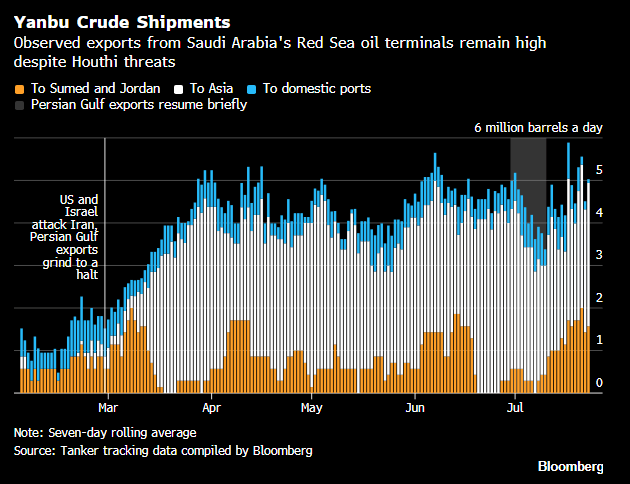
Up to 5 million barrels of oil per day are exported through Yanbu, compared to a maximum of two before the start of the war. Source: Bloomberg Finance LP
Hidden Supply Challenges and Structural Risks
Although the market reacted with falling prices to the news of diplomacy, market commentators caution against excessive optimism. The situation on the physical commodity market remains extremely tight due to several overlapping crises.
1. Ukrainian Attacks on Russian Infrastructure and CPC Port
Market attention was focused on the Middle East, but a massive supply shock is developing in the Black Sea basin and in Russia:
- Attacks on Refineries: In the period from January to July 2026, Ukraine carried out at least 63 attacks on 26 Russian refineries (compared to 21 attacks on 11 facilities in the analogous period of 2025).
- Paralysis of Exports from Novorossiysk: The Russian oil terminal port of Sheskharis in Novorossiysk suspended loadings.
- Collapse of Supplies from the CPC Terminal: Drone attacks on ships near the Caspian Pipeline Consortium (CPC) terminal paralyzed the export of Kazakh oil (approx. 1.8 million barrels per day, which is almost 2% of global supply). European refineries, deprived of this raw material, are forced to limit processing or buy very expensive alternative spot oil.
- Tensions in the Finished Fuels Market: Raw material shortages and the destruction of refining capacity caused a drastic jump in diesel prices (the European benchmark rose to around 170 USD/bbl) and jet fuel (~180 USD/bbl), while gasoline prices at US stations again exceeded 4 USD per gallon.
Ukrainian Attacks on Russian Oil Infrastructure
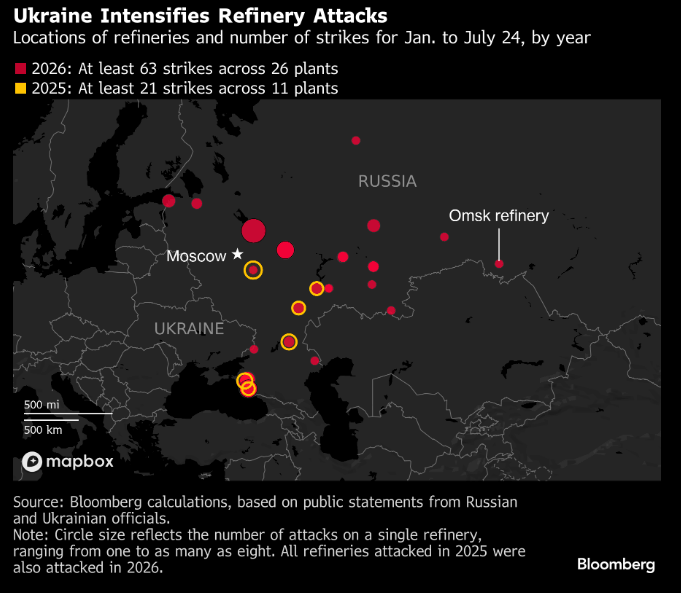
Ukrainian attacks on Russian oil infrastructure. Source: Bloomberg Finance LP
2. Depleted Strategic Petroleum Reserves (SPR)
During the first wave of the conflict, the sharp rise in prices was halted thanks to reduced imports by China and the release of hundreds of millions of barrels from the strategic reserves of the US and developed countries. Currently, these reserves are largely depleted, which means that the market does not have a safety buffer in the event of a permanent blockade of shipping routes. US Oil Stocks and Reserves
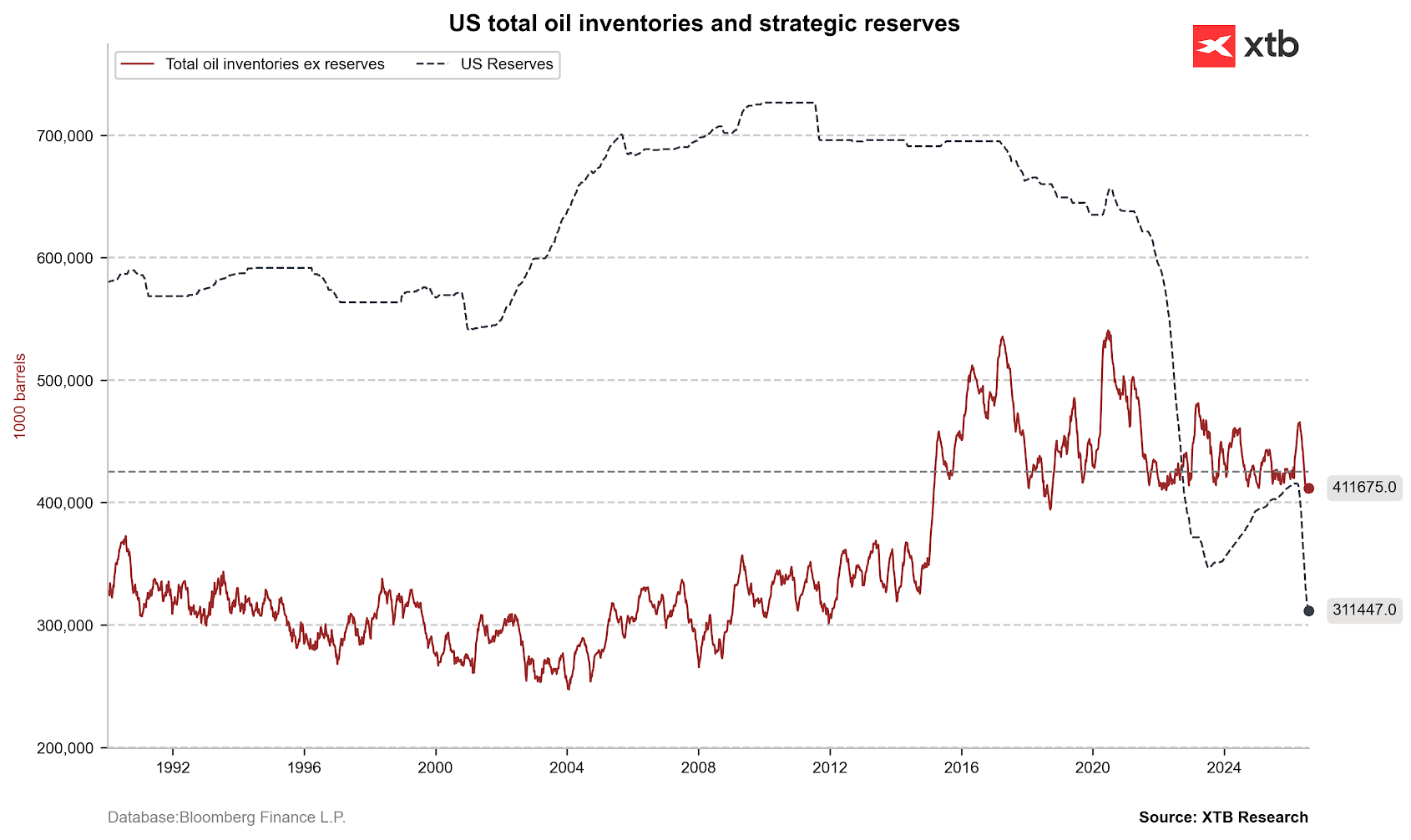
Although oil stocks are stabilizing, reserves continue to fall sharply over the past several weeks. Source: Bloomberg Finance LP, XTB
3. Infrastructure Problems in Europe (Gas and Energy)
The drop in TTF gas prices to ~58 EUR/MWh conceals local balance challenges:
- Storage Deficit: The 55% level at the end of July limits the possibility of flexible response to possible frost attacks during the winter season.
- Unplanned Reactor Shutdowns at Nuclear Power Plants in France: The EDF concern reported unplanned failures and a drastic reduction in capacity, among others, at the Flamanville 2 reactor (a drop from 1330 MW to 650 MW), Penly 2 (a drop from 1330 MW to 60 MW), Nogent 2, St Alban 2, and Chooz 1. This forces the energy sector to use more gas in gas power plants.
Forecasts and Market Perspectives
- Goldman Sachs: Maintains the base scenario for Brent crude at 80 USD per barrel in the fourth quarter, but notes that the persistence of transport disruptions will cause prices to jump above 120 USD/bbl.
- Morgan Stanley: Points out that a potential return of blocked oil would cause an oversupply, but the current world “jumps from failure to failure,” which excludes lasting stabilization.
- Repsol and TotalEnergies: The CEOs of both concerns emphasize that the fuel market (especially diesel and jet fuel) is extremely tight, and investors are beginning to treat permanent volatility as the “new normal.”
- Impact on Central Bank Policy: Sharp fluctuations in energy prices will be a key point of discussion during the US Federal Reserve (Fed) meeting scheduled for July 28–29, 2026, in the context of threats of renewed inflation growth.
Comparison of Oil Prices and Crack Spread
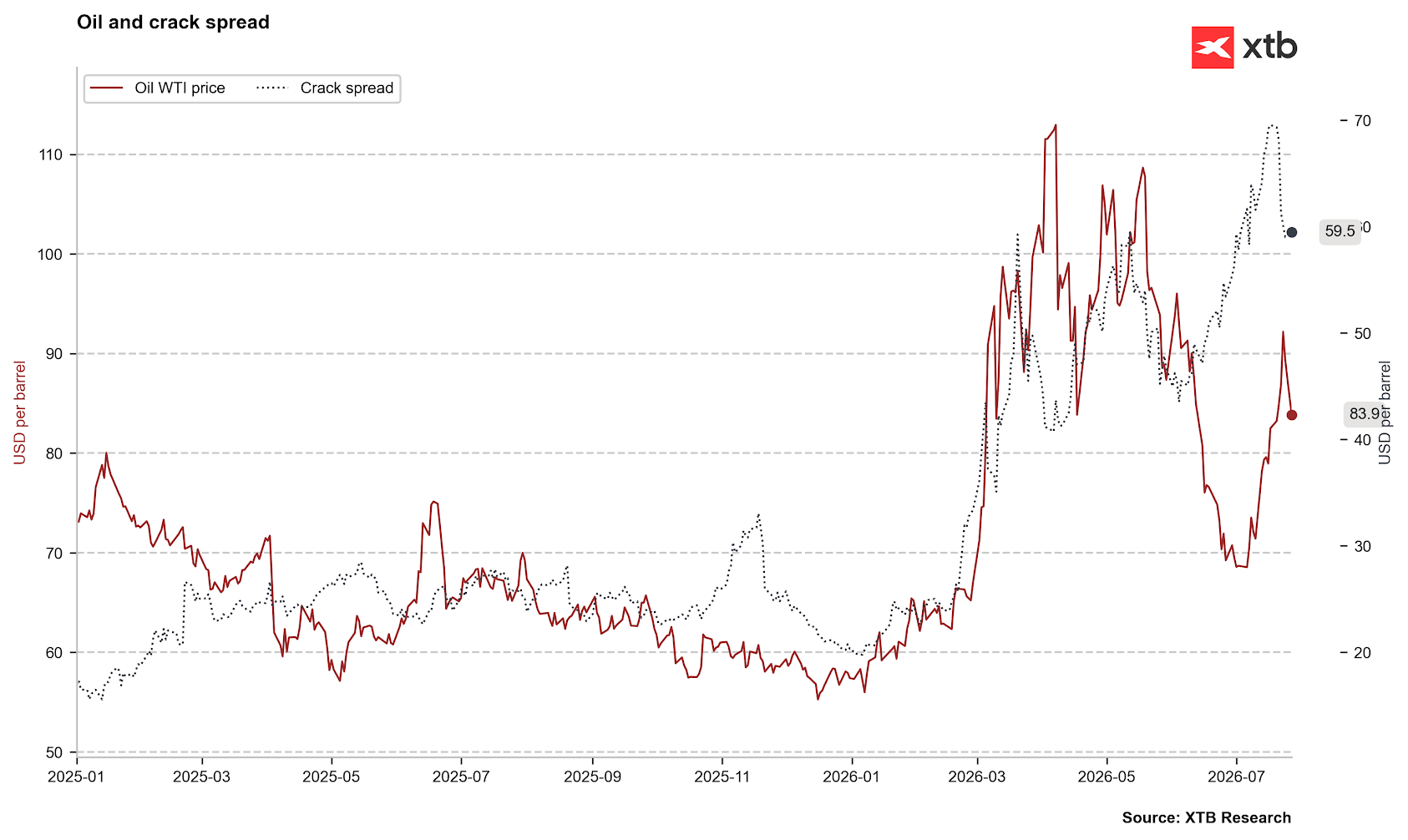
It is worth noting that the drop in the crack spread occurred a few days before the current retreat in oil prices. Source: Bloomberg Finance LP, XTB
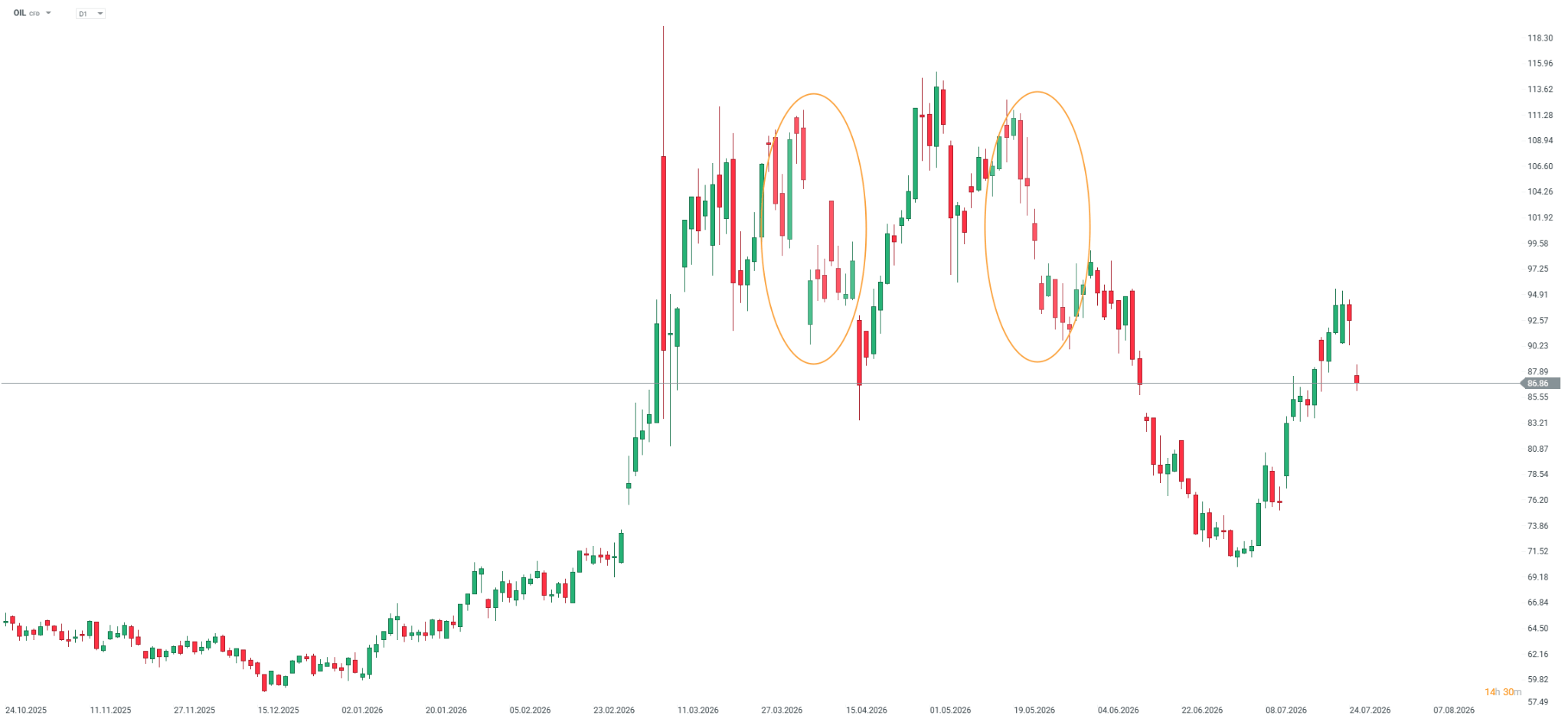
The current situation on the oil market is beginning to resemble that of April or May, when we saw sharp price drops. The first time we quickly returned to growth, and the second time there was consolidation, after which the terms of the memorandum were agreed upon. From the perspective of technical analysis, the key support will be not only at 86 USD per barrel, but 84 USD per barrel. The demand zone associated with the gap from June and the local trough from April runs between these levels. Source: xStation5
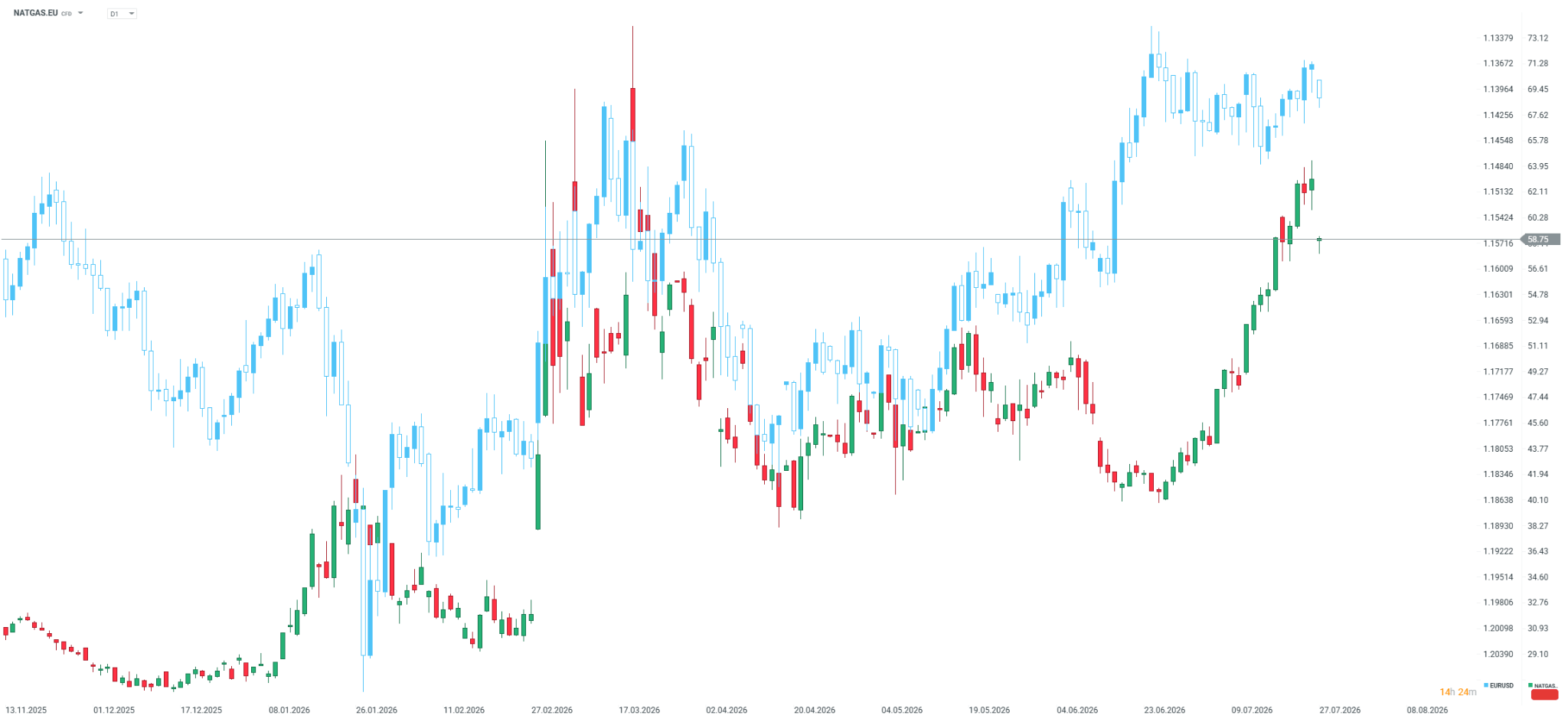
The price of European gas clearly fell at the market open. It is worth remembering that the price of gas has a huge impact on the European economy, which is why a return to growth could lead to a deepening of the decline in EURUSD significantly below 1.14. Currently, due to the short-term decline in risk, we are observing a rebound in the euro this morning. Source: xStation5