S&P 500 — US Large Cap Index
 FTSE 100 — UK Blue Chips
 Euro Stoxx 50 — Eurozone Leaders
 DAX 40 — German Equities
 CAC 40 — French Market Index
 Nikkei 225 — Japan Benchmark
 Hang Seng — Hong Kong Index
 Shanghai Composite — China Mainland
 ASX 200 — Australian Market
 TSX Composite — Canada Index
 Nifty 50 — India Large Cap
 STI Index — Singapore Market
 KOSPI — South Korea Index
 Bovespa — Brazil Equities
 JSE Top 40 — South Africa Index
 IPC Index — Mexico Market
Dollar and Treasury yields rise on the hawkish tone of Fed Chair Kevin Warsh’s Jackson Hole remarks EURUSD is falling following the release of Fed Chair Kevin Warsh’s speech and during his remarks, as markets interpreted his message as clearly hawkish. The key point was not that Warsh explicitly signaled a rate hike, but rather the combination of three factors: persistent inflation, a relatively strong economy, and the suggestion that the current level of interest rates may not be as restrictive as markets had previously assumed.
- Warsh stressed that the Fed must be confident that underlying inflation is moving toward the 2% target clearly and at a sufficient pace. If that does not happen, the central bank will have more work to do, which markets interpret as leaving the door open to further policy tightening.
- At the same time, the Fed Chair said that recent inflation data do not yet show a meaningful improvement in underlying trends. This limits the scope for rapid policy easing and raises the risk that rates will remain elevated for longer.
- Another important point was Warsh’s assessment that current financial conditions are difficult to describe as restrictive. If the economy continues to grow solidly despite rates at 3.50–3.75%, markets may begin to assume that the neutral interest rate is higher than previously thought.
- Warsh also remains relatively optimistic about economic growth, pointing to strong investment in AI and technology infrastructure. That kind of growth backdrop reduces concerns that somewhat higher rates would quickly push the economy into recession.
- In practice, this gives the Fed more room to maintain restrictive policy or even tighten further if inflation does not begin to fall more decisively.
- For the bond market, this means higher expected rates in the future, which is why Treasury yields moved higher, with the policy-sensitive 2-year yield reaching its highest level since July.
- Higher U.S. bond yields increase the relative attractiveness of dollar-denominated assets, supporting the USD and putting downward pressure on EURUSD.
For the dollar, the most important point is therefore not simply that Warsh sounded “hawkish,” but the combination of solid economic growth and inflation that still requires the Fed’s attention. That mix raises a broader question about the level of the neutral interest rate in the U.S. If the neutral rate is higher than markets had previously estimated, the current policy stance may be less restrictive than it appears. Recent comments from other Federal Reserve officials have also pointed in that direction. In such a scenario, the Fed may not need to rush into further rate hikes, but the case for policy easing becomes weaker, especially given the tight energy market and the recent rise in food and agricultural commodity prices, including wheat. This mechanism supports higher Treasury yields and a stronger dollar, and therefore adds downward pressure on EURUSD.
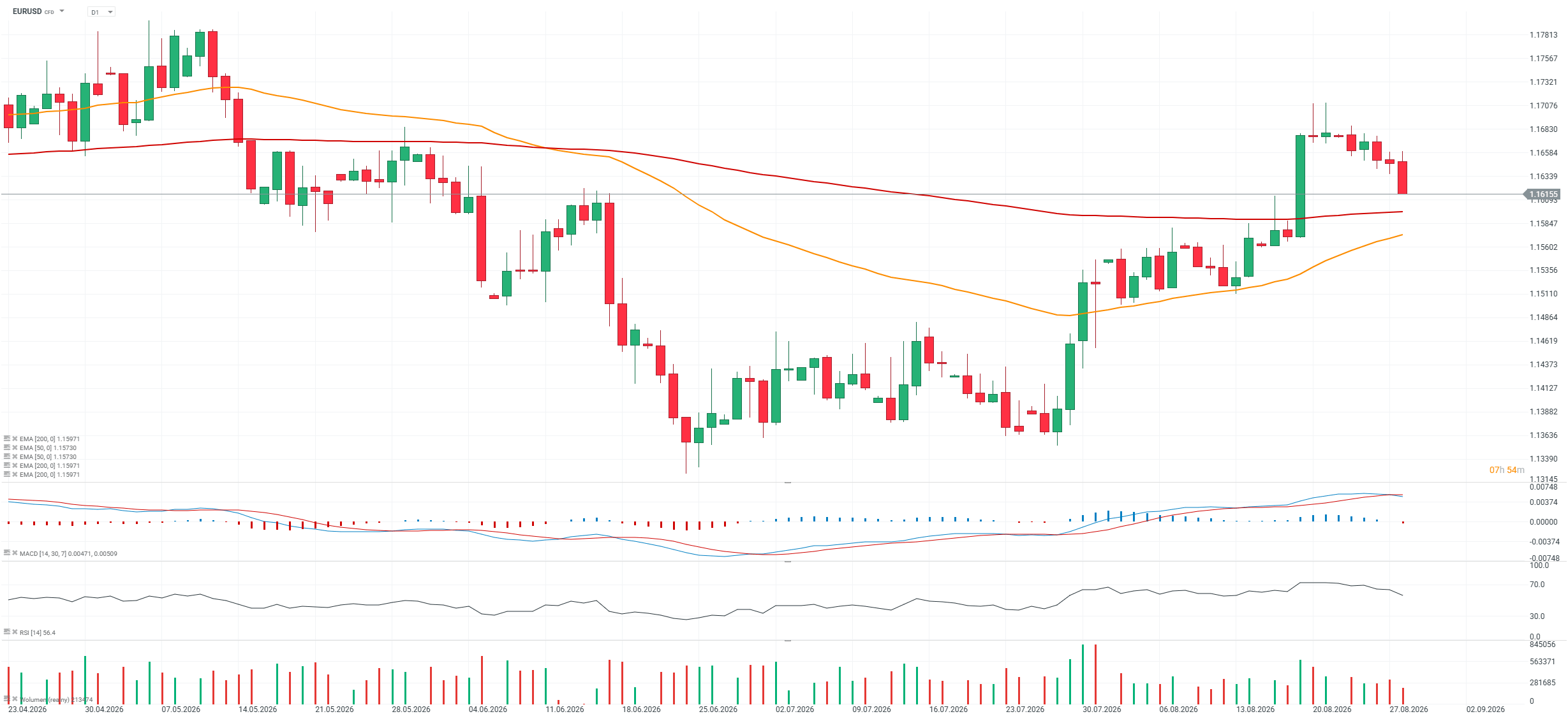
Source: xStation5