S&P 500 — US Large Cap Index
 FTSE 100 — UK Blue Chips
 Euro Stoxx 50 — Eurozone Leaders
 DAX 40 — German Equities
 CAC 40 — French Market Index
 Nikkei 225 — Japan Benchmark
 Hang Seng — Hong Kong Index
 Shanghai Composite — China Mainland
 ASX 200 — Australian Market
 TSX Composite — Canada Index
 Nifty 50 — India Large Cap
 STI Index — Singapore Market
 KOSPI — South Korea Index
 Bovespa — Brazil Equities
 JSE Top 40 — South Africa Index
 IPC Index — Mexico Market
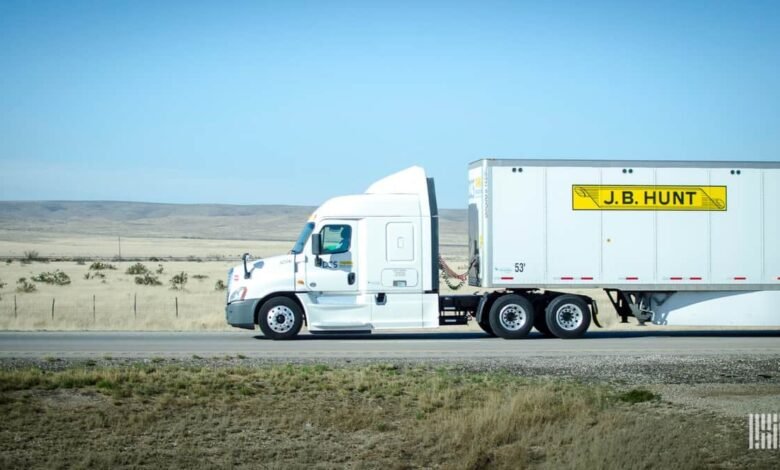
J.B. Hunt Stock Crashes 13% as Diesel Costs and Driver Expenses Squeeze US Transportation Stocks

Today Markets Analysis
J.B. Hunt Transport Services (NASDAQ: JBHT) shares plunged around 13% on September 16 after CFO Brad Delco warned that third-quarter earnings could decline 5% to 10% from the second quarter.
The warning exposed a much broader problem emerging across the U.S. transportation industry: fuel, labour and financing costs are rising faster than companies can immediately pass those costs through to customers.
J.B. Hunt is particularly exposed because of its large intermodal operation, where freight moves through a combination of rail and trucking. Management continues to see demand and is spending aggressively to recruit and retain drivers, but that investment is creating a substantial near-term earnings burden.
The company expects approximately $25 million of additional driver-related costs in Q3, while the rapid increase in diesel prices is expected to create at least another $10 million sequential fuel-cost headwind.
The market had been expecting considerably stronger earnings, making the warning particularly significant.
U.S. Transportation Market Snapshot
| Factor | Current Signal |
|---|---|
| J.B. Hunt share move | Around -13% |
| Q3 earnings outlook | -5% to -10% sequentially |
| Additional driver-related costs | ~$25 million |
| Additional fuel-cost impact | At least ~$10 million |
| U.S. diesel | Around $6.30/gallon |
| Diesel annual increase | More than 70% |
| J.B. Hunt Q2 revenue | $3.50 billion |
| Q2 EPS | $1.91 |
| FedEx Sept. 16 move | -2.12% |
| UPS Sept. 16 move | -3.50% |
J.B. Hunt reported Q2 revenue of $3.50 billion, up 19% year over year, with net earnings of $181 million and diluted EPS of $1.91.
Why Did J.B. Hunt Stock Collapse?
The immediate catalyst was management’s warning that third-quarter earnings could fall 5% to 10% sequentially.
That is a major change from the expectations investors had been carrying into the quarter.
The warning came at the Morgan Stanley Laguna Conference, where CFO Brad Delco highlighted the combination of rapidly rising diesel costs, driver-related expenses and other operating pressures.
At the midpoint of the company’s 5%-10% sequential decline range, analysts calculated an implied EPS of roughly $1.77, compared with consensus around $2.10 at the time.
That gap explains why the market reaction was so severe.
Investors were not simply reacting to one weaker quarter. They were reassessing whether the transportation industry’s recent improvement in profitability can survive an environment of rapidly escalating input costs.
Fuel Prices Are Crushing Transportation Margins
Diesel is now one of the industry’s biggest problems.
U.S. diesel prices have climbed to around $6.30 per gallon, roughly 70% above year-ago levels, according to recent market reporting.
For trucking companies, fuel is a direct and unavoidable operating expense.
The industry does have an important mechanism to mitigate this problem: fuel surcharges.
But there is a crucial timing issue.
When diesel prices rise suddenly, carriers can face higher costs immediately while contractual fuel-surcharge mechanisms adjust with a delay.
J.B. Hunt management estimates that this mismatch alone could create at least a $10 million sequential fuel-cost headwind in Q3.
That means even if customers ultimately absorb much of the higher fuel bill, the carrier can still suffer a temporary margin squeeze.
And that is exactly what investors are now pricing into transportation stocks.
The Driver Shortage Creates Another Cost Shock
Fuel isn’t the only problem.
J.B. Hunt is also increasing spending to recruit and retain drivers.
Management expects approximately $25 million more in driver-related costs during Q3 than Q2, including recruitment, advertising, onboarding, training and sign-on incentives.
This creates an unusual situation.
The additional spending is partly connected to stronger expected freight demand.
In other words, the company is not necessarily spending more because the business is deteriorating. It is spending more because it wants sufficient capacity to handle higher volumes.
But financial markets generally care about the timing of earnings.
The company may ultimately benefit from the additional capacity, while investors are currently being asked to absorb the cost before that benefit arrives.
Intermodal: The Opportunity and the Problem
Intermodal transportation is particularly important to J.B. Hunt.
The company combines rail and trucking to move freight over long distances, potentially providing a more fuel-efficient alternative to moving the entire shipment by road.
Higher diesel prices can therefore create a longer-term argument in favour of intermodal.
If road freight becomes significantly more expensive, shippers may have greater incentive to use rail for suitable long-distance routes.
That could ultimately benefit J.B. Hunt.
However, the short-term economics are more complicated.
J.B. Hunt still requires trucks and drivers for the road portions of intermodal shipments, while higher labour and fuel costs are hitting the company before pricing fully catches up.
Recent reporting indicates that intermodal pricing has lagged the rise in costs, contributing to the current margin pressure.
Higher Bond Yields Add Another Headwind
Transportation is a capital-intensive industry.
Companies require significant investment in:
- Trucks
- Trailers
- Rail equipment
- Terminals
- Warehouses
- Technology
- Maintenance
- Infrastructure
Higher bond yields therefore create two separate pressures.
First, they can increase the cost of financing.
Second, higher interest rates increase the discount rate applied to future corporate cash flows, which can put pressure on equity valuations.
That combination is particularly relevant when a company is simultaneously facing higher fuel and labour expenses.
The result is a less favourable environment for transportation companies even if underlying freight demand remains healthy.
Is This a J.B. Hunt Problem — or a U.S. Transportation Problem?
The market reaction suggests investors are increasingly treating the warning as an industry signal rather than an isolated corporate problem.
Other transportation shares also came under pressure.
On September 16, UPS fell 3.50% and FedEx declined 2.12%, while other trucking companies also recorded losses.
The magnitude of the moves differs considerably, however.
That distinction is important.
J.B. Hunt’s warning is unusually specific because management provided investors with a direct estimate of the earnings impact from higher fuel and driver costs.
The broader sector is facing similar cost pressures, but individual companies have different exposure to fuel, pricing, freight volumes, labour and network structures.
Therefore, the J.B. Hunt selloff should not automatically be interpreted as evidence that every transportation company faces the same earnings decline.
Bullish Sentiment
1. Freight Demand Has Not Collapsed
One of the most important positives is that J.B. Hunt’s additional hiring appears connected to the company’s expectation of stronger demand.
Management is spending money to increase capacity rather than simply cutting operations.
If freight volumes continue improving, today’s costs could ultimately translate into greater revenue and operating leverage.
2. Intermodal Could Benefit From Expensive Diesel
Persistent high diesel prices could make rail-linked intermodal freight more attractive relative to long-haul trucking.
That creates a potential structural advantage for J.B. Hunt’s core intermodal business.
3. Pricing Can Eventually Catch Up
Fuel surcharges and freight-rate adjustments provide transportation companies with mechanisms to recover higher costs.
The immediate problem is the lag.
If pricing catches up with fuel and labour costs, the current margin compression could moderate.
4. Q2 Demonstrated Strong Revenue Growth
J.B. Hunt’s Q2 revenue increased 19% year over year to $3.50 billion, while operating income increased 32%.
That demonstrates that the underlying business had considerable momentum before the latest cost shock.
Bearish Sentiment
1. Diesel Has Become a Major Margin Threat
Diesel around $6.30 per gallon dramatically increases the cost base for transportation operators.
If fuel remains elevated, surcharge mechanisms may continue to lag the underlying expense.
2. Labour Costs Are Rising at the Same Time
J.B. Hunt expects roughly $25 million of additional driver-related expenses in Q3.
That means the company is being squeezed from both sides: fuel and labour.
3. Pricing Is Not Catching Up Quickly Enough
The most significant concern is the gap between what transportation companies pay and what they can charge customers.
If freight rates remain slow to adjust while fuel and wages rise, margins can continue deteriorating.
4. Higher Financing Costs
Elevated yields increase financing costs and can weigh on valuations across capital-intensive transportation businesses.
5. Demand Could Eventually Be Damaged by Higher Costs
There is also a second-order risk.
If transportation companies increase rates sufficiently to recover their costs, shippers may respond by reducing shipments, changing routes or shifting to alternative logistics solutions.
The industry therefore has to balance cost recovery against customer demand.
A Critical Test for the Transportation Sector
The J.B. Hunt warning raises a much larger question:
Can U.S. transportation companies pass higher costs through to customers quickly enough?
There are three possible stages.
Stage One — Cost shock
Diesel and labour costs rise rapidly.
Stage Two — Margin compression
Contractual pricing and fuel surcharges lag behind the increase.
Stage Three — Price adjustment
Transportation companies increase rates and surcharges sufficiently to recover the additional costs.
The market is currently concerned that the sector is still between stages two and three.
That is why the earnings warning has had such a powerful effect on J.B. Hunt.
The Oil Market Is Critical
The transportation sector’s outlook is closely connected to crude oil.
Brent crude remained above $100 per barrel on September 17 despite falling further during the session as Saudi Arabia increased alternative crude shipments and some supply-disruption concerns eased.
For transportation companies, however, even a modest decline from extreme highs does not immediately solve the problem.
Diesel prices can remain elevated because refining economics, inventories, distribution costs and geopolitical supply disruptions also matter.
The U.S. government has even temporarily eased hours-of-service restrictions for fuel-truck drivers in response to the current fuel-supply situation, highlighting the logistical pressure created by elevated fuel prices.
What Traders Are Watching Next
The next major indicators for transportation stocks include:
- U.S. diesel prices — whether the recent record levels begin to decline.
- J.B. Hunt’s Q3 results — scheduled for October 15, 2026.
- Freight volumes — whether stronger demand continues into the peak season.
- Intermodal pricing — whether rates begin catching up with costs.
- Fuel surcharge recovery — how quickly higher diesel expenses are passed through.
- Driver availability and wages — particularly ahead of peak shipping periods.
- Bond yields — higher financing costs remain a sector-wide issue.
- UPS and FedEx margins — providing additional evidence about the broader transportation environment.
- Crude oil — the most important external cost variable for the sector.
Currency Hedger View
The J.B. Hunt selloff highlights how quickly commodity-market movements can migrate into corporate earnings.
For U.S. transportation companies, the most obvious exposure is fuel. But for international logistics groups, the problem is broader because fuel costs, equipment purchases, freight contracts and overseas revenues can all create currency exposure.
A stronger or weaker U.S. dollar can alter the cost of imported equipment and affect the translated value of international revenues.
This makes fuel hedging and FX hedging important risk-management tools for transportation companies operating across multiple jurisdictions.
Currency Hedger focuses on foreign exchange exposure, currency risk and hedging strategies for businesses operating in internationally traded markets.
Today Markets View
J.B. Hunt’s 13% selloff is an important warning for the U.S. transportation sector because it exposes a growing gap between freight demand and freight profitability.
The company is still seeing enough demand to justify hiring drivers and expanding capacity. Its Q2 results also showed strong revenue and operating-income growth.
But the economics have changed rapidly.
Diesel is around $6.30 per gallon, driver-related costs are increasing, financing remains expensive and pricing mechanisms are taking time to catch up.
The critical issue for transportation investors is therefore not simply whether freight demand is strong.
It is whether transportation companies can convert that demand into profitable revenue while absorbing the extraordinary increase in their cost base.
“J.B. Hunt’s warning is significant because the company is not describing a collapse in freight demand. It is highlighting the difficulty of making money from that demand when fuel, labour and financing costs are rising faster than pricing can adjust.”
— Louis Roche, Analyst, Today Markets
Bottom Line
J.B. Hunt’s 13% plunge has exposed a serious margin problem developing across U.S. transportation and logistics.
The immediate pressure comes from three directions: record-level diesel costs, sharply higher driver-related expenses and elevated financing costs.
Yet there is an important counterpoint.
J.B. Hunt is increasing hiring because it continues to see demand opportunities, while high fuel prices could eventually make intermodal transportation more attractive relative to long-haul road freight.
The central question is therefore timing.
If fuel prices remain elevated and freight rates continue to lag costs, transportation margins could remain under pressure.
If fuel prices retreat and pricing catches up with expenses, the current earnings shock could prove more temporary.
For now, investors are demanding evidence that higher freight volumes can translate into higher profits rather than simply higher costs.
Market analysis contributed by Currency Hedger, an Octalas Group division specialising in foreign exchange, currency risk and hedging.
Analysis by Louis Roche, Analyst, Today Markets