S&P 500 — US Large Cap Index
 FTSE 100 — UK Blue Chips
 Euro Stoxx 50 — Eurozone Leaders
 DAX 40 — German Equities
 CAC 40 — French Market Index
 Nikkei 225 — Japan Benchmark
 Hang Seng — Hong Kong Index
 Shanghai Composite — China Mainland
 ASX 200 — Australian Market
 TSX Composite — Canada Index
 Nifty 50 — India Large Cap
 STI Index — Singapore Market
 KOSPI — South Korea Index
 Bovespa — Brazil Equities
 JSE Top 40 — South Africa Index
 IPC Index — Mexico Market
- The Japanese Yen is undermined by receding safe-haven demand amid a positive risk tone.
- Concerns about Trump’s tariffs and hopes for a US-Japan trade deal could limit JPY losses.
- The divergent BoJ-Fed policy expectations further contribute to capping the USD/JPY pair.
The Japanese Yen (JPY) trims a part of modest Asian session losses on Tuesday and remains close to a multi-month high touched against its American counterpart last week. The rapidly escalating US-China trade war and persistent worries about the potential economic fallout from Trump’s disruptive tariffs continue to underpin demand for traditional safe-haven assets, including the JPY. Adding to this hopes that Japan might strike a trade deal with the US turn out to be another factor offering support to the JPY.
Moreover, signs of broadening inflation in Japan keep the door open for more interest rate hikes by the Bank of Japan (BoJ). In contrast, investors have been pricing in the possibility of aggressive policy easing by the Federal Reserve (Fed) amid worries that the escalating US-China trade war would hinder the US economic growth. This fails to assist the US Dollar (USD) to register any recovery from its lowest level since April 2022 and further benefits the lower-yielding JPY, which, in turn, caps the USD/JPY pair.
Meanwhile, US President Donald Trump’s tariff reprieve on consumer electronics and signal that he may temporarily exempt the auto industry from the 25% levies remain supportive of the upbeat market mood. This acts as a headwind for the JPY and assists the USD/JPY pair to stick to modest intraday gains above the 143.00 mark. The fundamental backdrop, however, seems tilted firmly in favor of the JPY bears, which, along with a bearish USD, suggests that the path of least resistance for the pair is to the downside.
Japanese Yen bulls have the upper hand amid rising trade tensions, BoJ rate hike bets
- On Monday, US President Donald Trump said that he was looking into possible exemptions for the auto industry from the 25% tariffs as car companies need a little bit of time to transition to US-made parts. This comes after the White House announced that smartphones, computers, and other electronics imported largely from China would be temporarily exempted from Trump’s punishing reciprocal tariffs.
- Moreover, the rest of the world would be given a 90-day reprieve on additional duties beyond the new 10% tariffs. Trump, however, said that exemptions were only temporary and added that he would unveil tariffs on imported semiconductors over the next week. Trump also threatened that he would impose tariffs on pharmaceuticals in the not-too-distant future and kept in place 145% duties on Chinese imports.
- Investors pared their bets for early interest rate hikes by the Bank of Japan on the back of increasing uncertainty over US tariff policy. The BoJ, however, is still expected to raise the policy rate amid rising domestic prices and wages. In contrast, the markets have been pricing in the possibility that the Federal Reserve will resume its rate-cutting cycle soon amid a tariffs-driven US economic slowdown.
- Fed Governor Christopher Waller said the Trump administration’s tariffs posed a significant shock to the US economy that might force the US central bank to cut rates to avert a recession. Separately, Atlanta Fed President Raphael Bostic noted that we still have a ways to go on inflation as tariffs could place upward pressure on prices. The Fed is unable to make bold moves in any direction, Bostic added.
- Meanwhile, market players remain optimistic about a positive outcome from US-Japan trade talks. In fact, Trump said last week that tough but fair parameters are being set for a negotiation. Adding to this, US Treasury Secretary Scott Bessent said that Japan may be a priority in tariff negotiations, fueling hopes for a US-Japan trade deal. This should continue to act as a tailwind for the Japanese Yen.
- Tuesday’s US economic docket features the release of the Empire State Manufacturing Index, which, along with trade-related developments, might influence the US Dollar. The focus, however, will remain glued to Fed Chair Jerome Powell’s speech on Wednesday, which will be scrutinized for cues about the future rate-cut path. This, in turn, will influence the USD and provide a fresh impetus to the USD/JPY pair.
USD/JPY needs to move beyond 144.00 to support prospects for further recovery
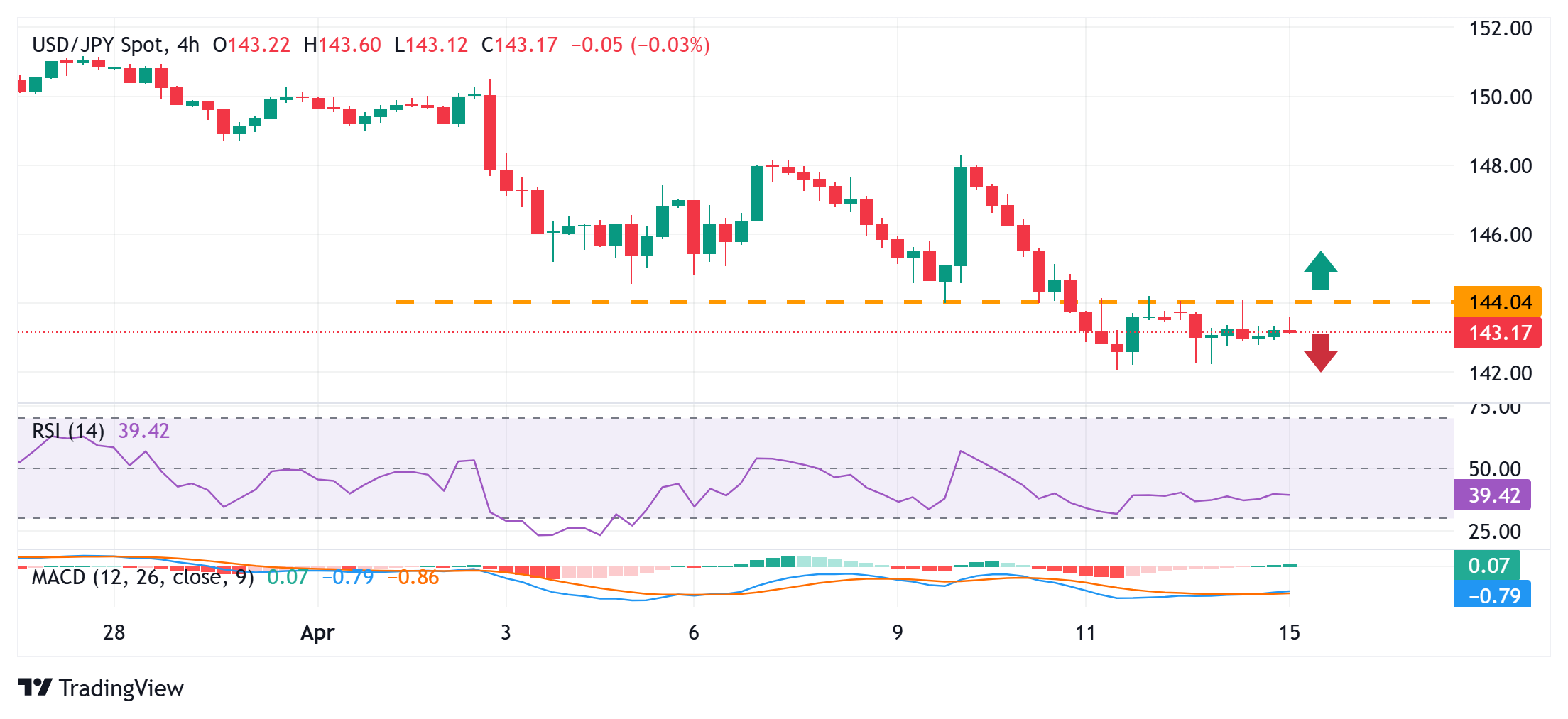
From a technical perspective, any subsequent move-up is likely to confront stiff resistance and cap the USD/JPY pair near the 144.00 mark, or the overnight swing high. A sustained strength beyond, however, might trigger a short-covering rally and lift spot prices to the 144.45-144.50 horizontal barrier en route to the 145.00 psychological mark. The momentum could extend further towards the 145.50 zone and the 146.00 round figure.
On the flip side, weakness back below the 143.00 mark now seems to find some support near the 142.25-142.20 area ahead of the 142.00 mark, or a multi-month low touched last Friday. A convincing break below would be seen as a fresh trigger for bearish traders and drag the USD/JPY pair to the 141.65-141.60 support en route to the 141.00 mark. The subsequent fall would expose the 140.75 support and the September 2024 swing low, around the 140.30-140.25 region, before spot prices eventually drop to the 140.00 psychological mark.