S&P 500 — US Large Cap Index
 FTSE 100 — UK Blue Chips
 Euro Stoxx 50 — Eurozone Leaders
 DAX 40 — German Equities
 CAC 40 — French Market Index
 Nikkei 225 — Japan Benchmark
 Hang Seng — Hong Kong Index
 Shanghai Composite — China Mainland
 ASX 200 — Australian Market
 TSX Composite — Canada Index
 Nifty 50 — India Large Cap
 STI Index — Singapore Market
 KOSPI — South Korea Index
 Bovespa — Brazil Equities
 JSE Top 40 — South Africa Index
 IPC Index — Mexico Market
UK labour market data for the three months to September was weak, and the signs also point to weakness for October. The number of people on the payroll is falling, and the unemployment rate rose in Q3 to a pandemic high. Although the number of job vacancies is stable, the number of candidates per job is rising, and it could be harder to find work if the current labour market trends continue. The question now is, what is causing the labour market slowdown, is it global factors, or is the UK in a unique position?
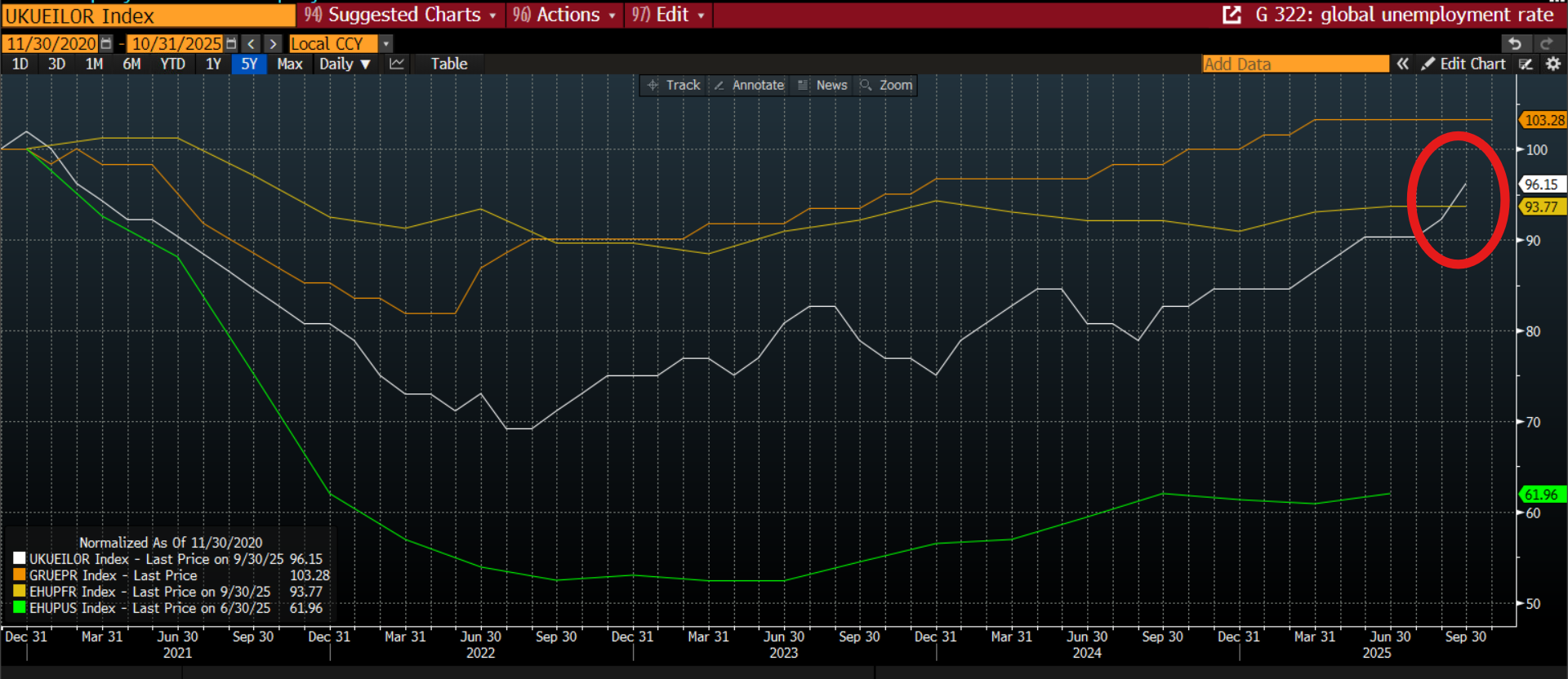
We have analyzed two data sets to try and answer this question. The first is looking at the UK’s unemployment rate versus its peers. As you can see in the chart below, the UK does not have the highest unemployment rates. Germany and France have significantly higher rates of unemployment than the UK, in France it stands at 7.6% and in Germany, the rate is 6.3%. It’s obviously difficult to compare the UK to the US right now, since economic data releases have been delayed due to the government shutdown. However, prior to the government shutdown, the August unemployment rate in the US was 4.3%.
The chart below has been normalized to show how the unemployment rates in the US, UK, France and Germany move together, and this is where the picture starts to look murky for the UK. There has been a steeper uptrend in unemployment in the UK since the start of the year vs. its peers, and the pace of increase is now faster than France’s.
Thus, the direction of travel seems to be a rapidly deteriorating labour market picture in the UK, that is worse than its main global peers.
Chart 1: UK (white line), France and Germany unemployment rates, normalized to show how they move together.
Source: XTB and Bloomberg
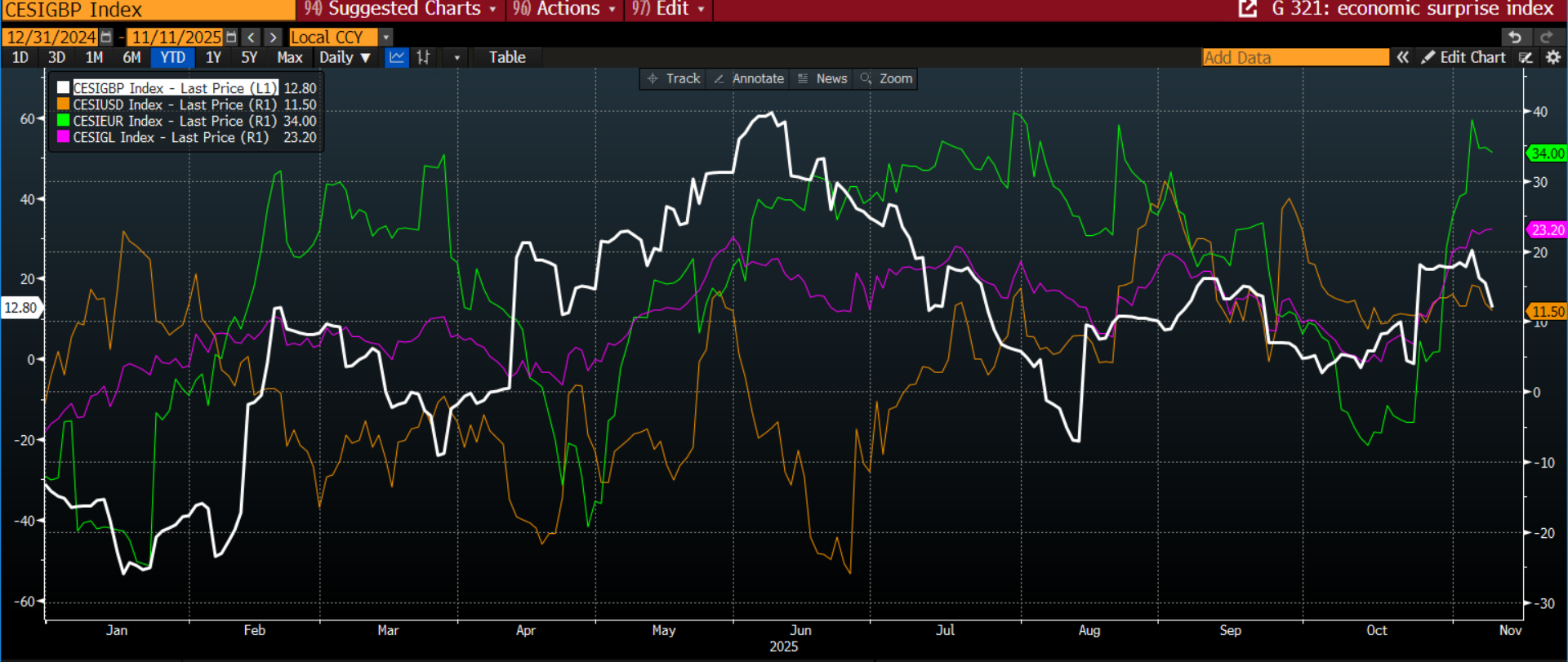
But is the UK an outlier by other measures? Another way to compare the UK economy is to look at the UK’s economic surprise index relative to its peers. The chart below looks at the Citi Economic Surprise Index for the US, UK, Eurozone and Global. As you can see, there is clear gap, with economic data in the US and the UK surprising on the downside, while Eurozone and global data are surprising on the upside.
However, the UK’s economic surprise index has turned sharply lower, and is worse than its peers. This suggests that the economic picture is deteriorating in the UK, and it is worse than global trends.
Chart 2: Citi Economic Surprise Index for UK, Eurozone, US and Global
Source: XTB and Bloomberg
Why the future is bleak for the UK
Overall, these two data sets suggest two things: 1, that the path of least resistance is for a weaker economy in the UK, so there could be further bad news to come. 2, the pre-budget media storm is not giving many pro-growth vibes, so there is nothing to stop the UK economy from deteriorating further.
Some will argue that the government’s decisions, for example, higher employer national insurance, large increases to the national living wage, and an employee rights bill, all in a matter of months, is breaking the UK labour market. The data would support this. Added to this, higher income taxes in this month’s budget could trigger even more economic decline.
The material on this page does not constitute financial advice and does not take into account your level of understanding, investment objectives, financial situation or any other specific needs. All information provided, including opinions, market research, mathematical results and technical analyzes published on the Website or transmitted To you by other means, it is provided for information purposes only and should in no way be construed as an offer or solicitation for a transaction in any financial instrument, nor should the information provided be construed as advice of a legal or financial nature on which any investment decisions you make should be based exclusively To your level of understanding, investment objectives, financial situation, or other specific needs, any decision to act on the information published on the Website or sent to you by other means is entirely at your own risk if you In doubt or unsure about your understanding of a particular product, instrument, service or transaction, you should seek professional or legal advice before trading. Investing in CFDs carries a high level of risk, as they are leveraged products and have small movements Often the market can result in much larger movements in the value of your investment, and this can work against you or in your favor. Please ensure you fully understand the risks involved, taking into account investments objectives and level of experience, before trading and, if necessary, seek independent advice.