S&P 500 — US Large Cap Index
 FTSE 100 — UK Blue Chips
 Euro Stoxx 50 — Eurozone Leaders
 DAX 40 — German Equities
 CAC 40 — French Market Index
 Nikkei 225 — Japan Benchmark
 Hang Seng — Hong Kong Index
 Shanghai Composite — China Mainland
 ASX 200 — Australian Market
 TSX Composite — Canada Index
 Nifty 50 — India Large Cap
 STI Index — Singapore Market
 KOSPI — South Korea Index
 Bovespa — Brazil Equities
 JSE Top 40 — South Africa Index
 IPC Index — Mexico Market
Novo Nordisk CEO Seeks to Reassure Investors Following Earnings Report

European indices have opened Wednesday’s trading session caught between corporate optimism and geopolitical uncertainty in the Middle East. The pan-European Stoxx 600 index is up by a symbolic 0.07 per cent, briefly setting a new intraday high after closing the previous session at an all-time high. Most of the major regional benchmarks remain virtually unchanged, with investors focusing more on the quarterly results being released by companies than on broad index movements. A key factor driving market sentiment is the conflicting signals coming from the Middle East: on the one hand, President Trump spoke on Tuesday of “very good talks” with Iran; on the other, the Yemeni Houthis (linked to Iran) carried out a missile attack on a Saudi oil tanker in the Red Sea, which dampened hopes for a swift agreement on the Strait of Hormuz. The market is largely pricing in geopolitical developments, whilst corporate fundamentals remain the main driver of share prices this week. Oil prices are rising in response to the incident – Brent is up by around 1.2–1.4 per cent, trading at around US$80.3–80.5 per barrel, whilst WTI is up by 0.5–0.7 per cent to just under US$76.3. The dollar remains under pressure, which is supporting gold, which is trading close to a one-month high, and is driving the commodities sector.
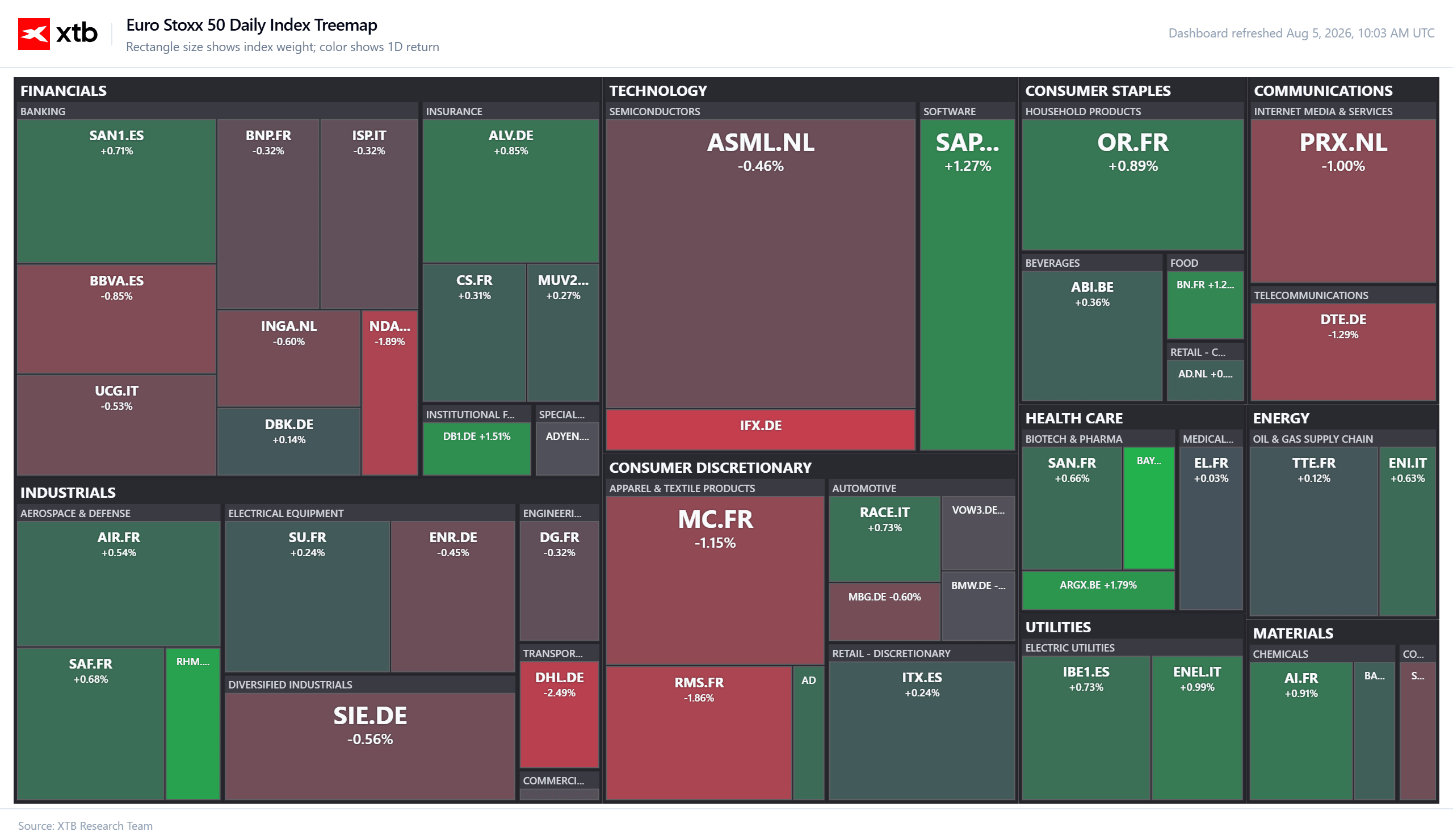
Mining companies (+1.4%) and energy companies (+0.6%) are performing best, benefiting from rising commodity and oil prices respectively. The banking sector is performing the worst (-0.9%), dragged down by HSBC following the publication of its results, whilst pressure is also being felt in the pharmaceuticals sector following a disappointing report from Novo Nordisk.
Company information
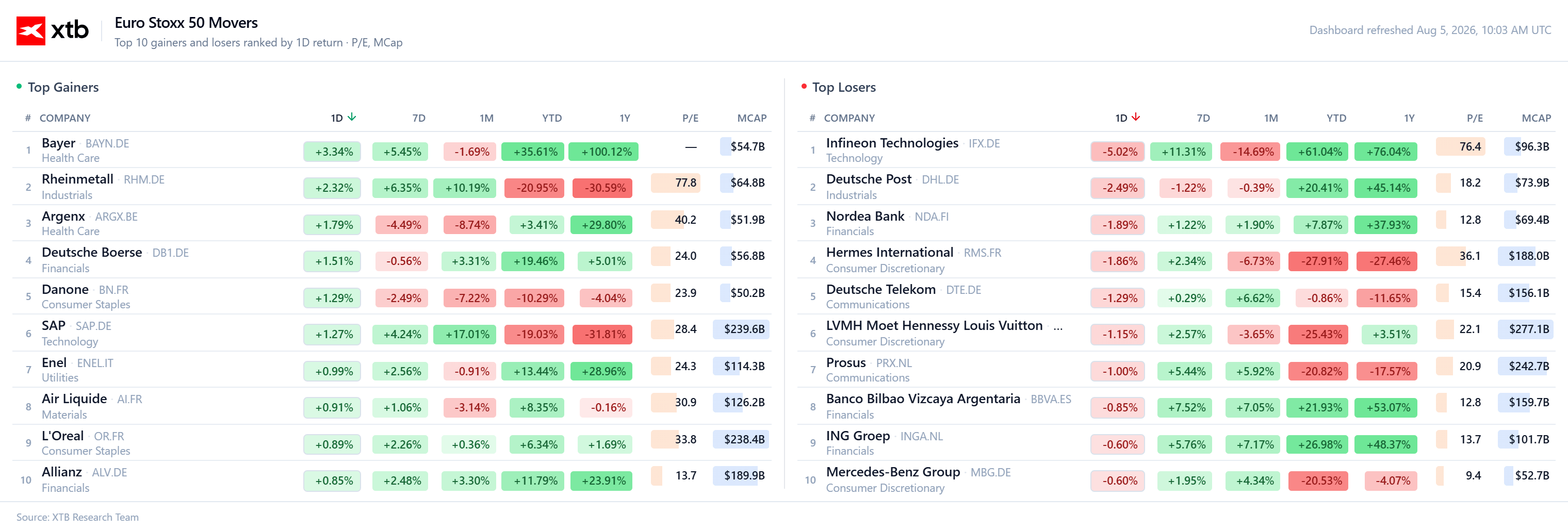
Quarterly results are dominating the news today, with the biggest price movements being seen in companies in the healthcare, energy and financial sectors.
- Siemens Energy is up 1.3% following record third-quarter results, driven by growing demand for AI data centres and power plant projects in the Middle East.
- Glencore is up 3.3% after its first-half EBITDA rose by 86% to US$10.1 billion, beating analysts’ expectations (US$9.5 billion); the company also announced plans for a secondary listing on the Australian stock exchange, as well as a special dividend and a new share buyback programme.
- Sandoz is leading the gains in the index with a rise of 7.4 per cent, following a 9 per cent increase in net sales driven by strong growth in the biosimilars segment.
- HSBC is down 3.5% in response to yesterday’s results, dragging down the entire banking sector, whilst Heineken is up by 2.8% following a strong second quarter, buoyed by above-average sales in the Asia-Pacific region, particularly in Vietnam.
- On the Euro Stoxx 50 index, Infineon (-5.02%) is the biggest faller, followed by Deutsche Post (-2.49%) and Nordea (-1.89%), whilst Bayer (+3.34%) leads the gainers, ahead of Rheinmetall (+2.32%) and Argenx (+1.79%).
Novo Nordisk remains one of the most closely watched companies on the European pharmaceutical market, and today’s publication of its results for the first half of 2026 is a key test of the management’s credibility with investors.
Results and forecasts
The company has revised its full-year forecast upwards, now projecting a decline in adjusted sales and operating profit of between -6% and 0% at constant exchange rates, which represents an improvement on the previous forecast of a decline of between -4% and -12%. Adjusted sales in the second quarter rose by 7% at constant exchange rates, whilst adjusted operating profit increased by 11%, with the rise in volumes being partially offset by lower prices. Adjusted operating profit for Q2 2026 amounted to DKK 33,389 million.
Market reaction and context
Despite the improved forecasts, the company’s shares initially fell by around 3.8–4.3 per cent, as investors focused on slightly weaker-than-expected sales of the Wegovy tablet and yet another disappointing result from a clinical trial of the next-generation drug CagriSema. Citi analysts summed up the results succinctly: “Overall, nothing to inspire”, whilst Jefferies noted that the upward revision of the forecast leaves little room for further growth in market consensus expectations. The company’s share price, listed in Copenhagen, remains nearly 70 per cent below its mid-2024 peak, despite a rebound of around 30 per cent from its March low. However, the shares have now halted their decline and are gaining just over 2 per cent.
CEO Strategy and Pipelines
CEO Mike Doustdar, who is currently celebrating his first year in the role, assured investors that the company would step up its research and seek smaller, complementary acquisitions to rebuild its pipeline before the semaglutide patent expires at the start of the next decade. The Wegovy tablet, launched this year in the US, the UK and the United Arab Emirates, has, according to Doustdar, captured around 90 per cent of the market for oral obesity drugs despite competition from Eli Lilly’s tablet, and the company plans to launch in Germany “soon”. Around 80 per cent of patients taking the tablet had not previously used any GLP-1 therapy, suggesting that the product is expanding the obesity market rather than taking patients away from the injectable version of Wegovy.
Competitive pressure
Novo Nordisk is facing growing pressure from its US rival Eli Lilly, whose drugs Zepbound and Mounjaro are rapidly gaining market share despite having entered the market later. Analysts estimate the market for obesity drugs to be worth over US$100 billion a year by 2030, making the stakes for the pipeline exceptionally high. Morten Gregersen of the Danish asset manager Formuepleje commented that yet another disappointment with CagriSema “highlights Novo’s biggest strategic problem”.