S&P 500 — US Large Cap Index
 FTSE 100 — UK Blue Chips
 Euro Stoxx 50 — Eurozone Leaders
 DAX 40 — German Equities
 CAC 40 — French Market Index
 Nikkei 225 — Japan Benchmark
 Hang Seng — Hong Kong Index
 Shanghai Composite — China Mainland
 ASX 200 — Australian Market
 TSX Composite — Canada Index
 Nifty 50 — India Large Cap
 STI Index — Singapore Market
 KOSPI — South Korea Index
 Bovespa — Brazil Equities
 JSE Top 40 — South Africa Index
 IPC Index — Mexico Market
Nuclear stocks under pressure. Is it AI data centres fault?

In recent months, several factors have converged to weaken sentiment toward nuclear-related stocks, which is clearly visible in the declines seen across companies broadly exposed to the sector, including Uranium Energy Corp, Cameco, Oklo, Kazatomprom, Denison Mines, NuScale, Centrus Energy and BWX Technologies. Importantly, however, this does not yet appear to represent a deterioration in the long-term outlook for nuclear energy. Instead, it looks more like a cooling of what had previously become an extremely crowded investment narrative, closely linked to the data center boom. One of the main reasons for the weaker sentiment is growing uncertainty around the scale of future data center investment. Previously, markets assumed that rapidly rising power demand from AI infrastructure would create a major tailwind for nuclear energy, including SMR projects. Investors are now becoming more selective toward this thesis. Holtec, which had been preparing for an IPO, itself cited uncertainty surrounding data center development as one of the factors that had worsened conditions for the sector. The market is increasingly asking not only how much power will ultimately be needed, but also when new reactors will actually come online and who will finance them.
Higher rates and the cost of capital are hitting the most capital-intensive projects
Nuclear energy requires very high upfront investment, while returns often materialize only after many years. In such an environment, higher interest rates mean more expensive financing, higher discount rates and lower attractiveness for projects that are still years away from commercialization. This is particularly important for younger companies developing SMRs, which are still burning cash and may require further rounds of financing. The longer the cost of capital remains elevated, the greater the pressure on balance sheets and the more closely investors scrutinize project timelines, financing needs and the realistic path toward positive cash flow.
Investors are focusing more closely on valuations, cash burn and realistic deployment timelines
After very strong share-price gains, some nuclear companies were valued as if the commercialization of new technologies were already close to guaranteed. Recent weeks, however, have brought greater skepticism toward elevated valuation multiples, particularly among companies where revenues remain limited and profitability is still a distant prospect. This has been compounded by new share issuance and a growing number of listed companies offering exposure to the nuclear theme, reducing the scarcity premium that investors had previously been willing to pay. The postponement of the IPO of Holtec, a company operating in the industrial nuclear energy sector, is another sign that investors are no longer willing to pay almost any price for the narrative alone. They are increasingly demanding tangible contracts, predictable cash flows and more realistic project execution timelines.
Uranium remains strong despite the sell-off in nuclear stocks
The physical uranium market is holding up much better than the share prices of many nuclear-related companies. Spot U₃O₈ prices remain around $90 per pound and close to their highest levels of the year, while long-term contract prices are even higher. This suggests that the recent weakness in companies such as BWXT, Oklo and NuScale is more closely related to a correction in elevated valuations, a higher cost of capital and growing skepticism over the pace of reactor commercialization than to any deterioration in the uranium market itself. Importantly, despite relatively subdued activity in the spot market, uranium prices have gradually increased in recent months. Demand from utilities and producers remains visible, while higher prices in long-term contracts suggest that buyers are still willing to pay a premium to secure future supply. In other words, the physical market is not currently confirming the narrative of weakening nuclear-sector fundamentals, even though sentiment toward nuclear equities has deteriorated significantly.
Data centers are facing a major problem. Why?
In the US, the queue of new large power consumers has grown to enormous proportions, which could mean that the nuclear-energy boom associated with data center demand may take much longer to translate into the financial performance of individual companies. ERCOT in Texas alone is tracking more than 438 GW of large-load requests, with nearly 89% attributable to data centers. That represents around 390 GW of potential demand from data centers alone. For comparison, the record peak load across the entire ERCOT system was around 85.5 GW. However, these numbers need to be interpreted very carefully. The 390 GW figure does not mean that this amount of data center capacity will actually be built. Projects in the queue are at very different stages of development, some developers reserve capacity across multiple potential locations, and some projects will ultimately be abandoned. This is precisely why ERCOT launched its Batch Zero verification process, designed to distinguish genuine projects from more speculative applications. There is no single official nationwide data center queue in the United States. However, industry tracker SAVRN is currently monitoring 224 identified projects that have been delayed, suspended or withdrawn. In 117 cases, local community opposition was cited as one of the reasons, while 55 involved legal proceedings, 49 faced zoning problems and 39 were affected by local moratoriums. This is not a comprehensive list of all data centers under construction, but it illustrates the scale of administrative obstacles.
Construction continues, but timelines are starting to slip
Back in April, the FT, citing SynMax data, reported that nearly 40% of US data centers scheduled for completion in 2026 could face delays of more than three months. The main reasons included insufficient available power, permitting issues, shortages of skilled workers and equipment constraints. Power infrastructure is proving particularly problematic. Lead times for some high-voltage transformers have increased from around one year before the AI boom to several years today. Utilities and developers are increasingly ordering equipment years in advance because without transformers, switchgear and new transmission lines, even a completed data center may simply be unable to secure sufficient electricity. The DOE has also indicated that rapidly rising data center loads are one of the main reasons why the US transmission grid needs significant expansion. In other words, the bottleneck has shifted from the world of GPUs and capital toward power plants, transformers, transmission lines and permits.
The regulatory environment has deteriorated noticeably in recent days
The most important new signal came from Texas. On September 21, Governor Greg Abbott ordered a halt to the issuance of permits for data centers until an audit of projects moving through the ERCOT process is completed. Projects are expected to be reviewed, among other things, for their impact on grid reliability, water consumption and local infrastructure. This matters because Texas has been one of the key locations for the US AI infrastructure boom. ERCOT had already introduced a special Batch Zero process for customers requiring more than 75 MW, while developers are now required to provide substantially more information and demonstrate that projects are genuine and sufficiently advanced. A similar trend is emerging in Virginia. Loudoun County, the heart of the US “Data Center Alley,” has introduced an approximately 12-month delay in processing new applications, while state authorities are increasing scrutiny of electricity costs, noise and the impact of data centers on local communities.
The first signs of greater financial caution are also emerging, although the boom is still continuing
This may be the most interesting change from the perspective of equity markets. SoftBank-backed SB Energy, which plans to build massive infrastructure for OpenAI and Nvidia, has slowed preparations for an IPO that had targeted a valuation of around $50 billion. According to the FT, investors have become more skeptical about the scale of financing required to build enormous AI campuses. SB Energy has contracted future power capacity measured in gigawatts, but at the same time requires more than $170 billion in capital expenditure and has yet to bring any of its own data centers online. The market is therefore beginning to ask the same questions it is asking about SMR projects: not “will there be demand?”, but rather “how much will it cost, who will finance it and when will it actually become operational?” Paradoxically, the biggest problem still appears to be excessive demand rather than insufficient demand.
According to the latest Morgan Stanley estimates cited by the FT, US data center electricity demand could become so large that by 2028 the potential gap between required and available power supply may reach 30–40%. This is an investment-bank estimate rather than an official system forecast, but the direction is broadly consistent with warnings from grid operators. For the nuclear/BWXT/SMR narrative, it is therefore important to distinguish between two separate issues. The negative development is that some data centers are likely to be completed later than previously expected, which could also delay demand for new power sources. On the other hand, the underlying problem that was supposed to justify nuclear expansion — a shortage of reliable 24/7 power — has not disappeared. Access to electricity has instead become one of the main constraints on the entire AI infrastructure boom.
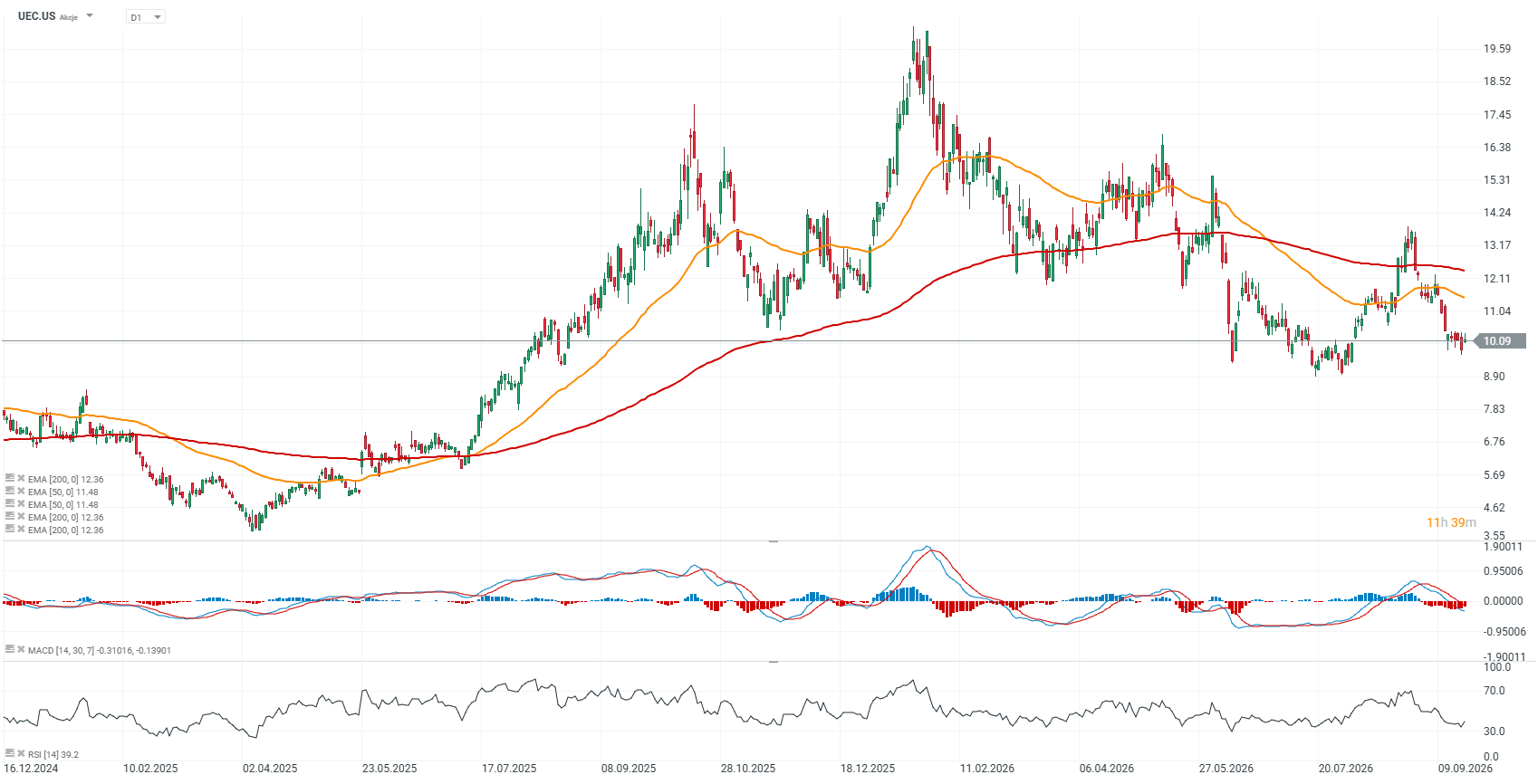
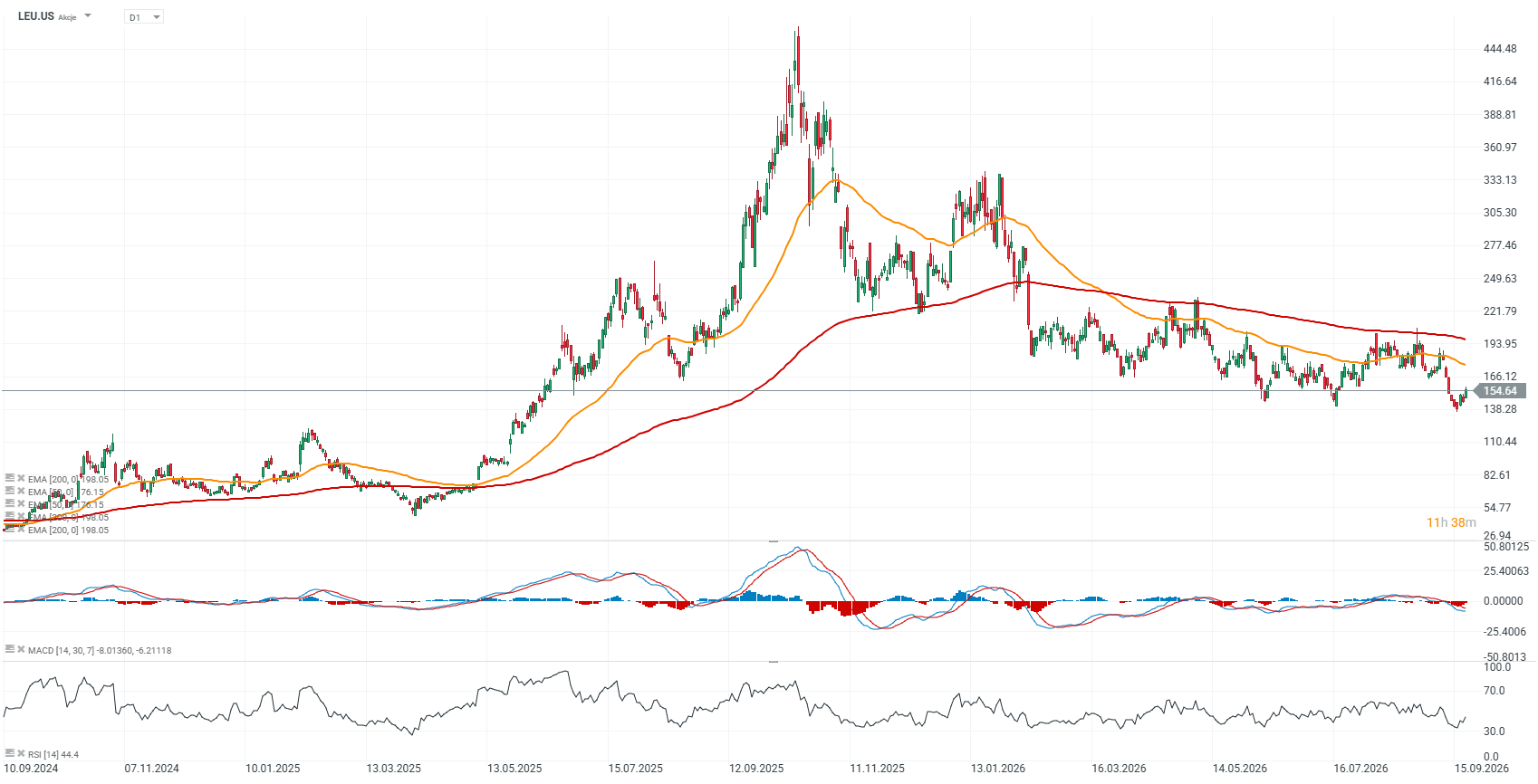
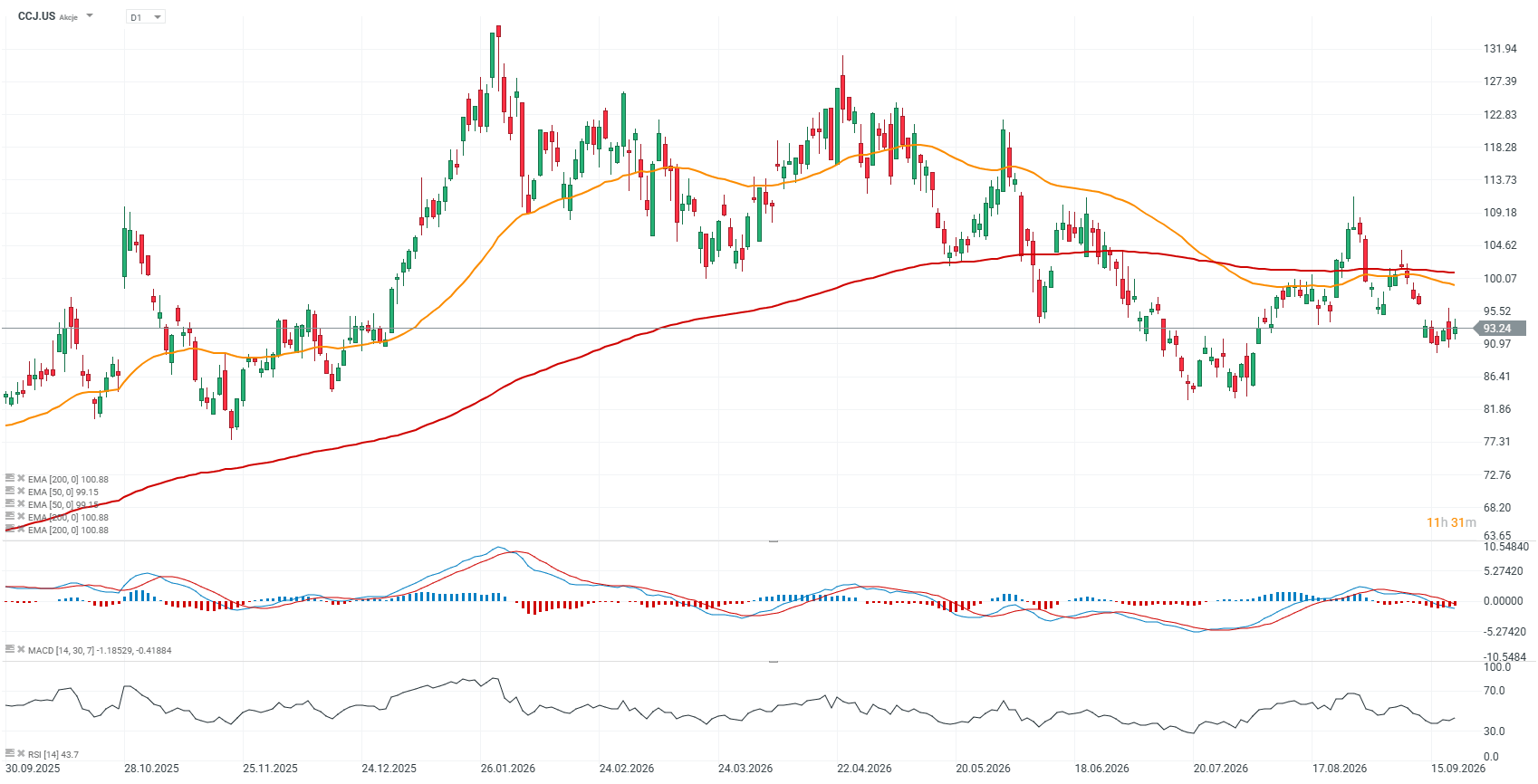
Uranium Energy Corp UEC.US / Centrus Energy LEU.US / Cameco CCJ.US share-price charts
Source: xStation5
Source: xStation5
Source: xStation5