S&P 500 — US Large Cap Index
 FTSE 100 — UK Blue Chips
 Euro Stoxx 50 — Eurozone Leaders
 DAX 40 — German Equities
 CAC 40 — French Market Index
 Nikkei 225 — Japan Benchmark
 Hang Seng — Hong Kong Index
 Shanghai Composite — China Mainland
 ASX 200 — Australian Market
 TSX Composite — Canada Index
 Nifty 50 — India Large Cap
 STI Index — Singapore Market
 KOSPI — South Korea Index
 Bovespa — Brazil Equities
 JSE Top 40 — South Africa Index
 IPC Index — Mexico Market
Oil slides 2.5% to $88 as Middle East tensions ease, Is the uptrend over?


Oil prices are sharply lower today, falling nearly 2.5% to just below $88 per barrel after Donald Trump called off the military strike on Iran announced yesterday and stated that a ceasefire agreement is now being finalized. Iranian officials have also signaled that negotiations are progressing toward a potential deal. Brent crude is on track for its first close below $88 per barrel since the opening week of the conflict. The decline reflects a rapid unwinding of geopolitical risk premiums as investors increasingly price in a diplomatic resolution and the reopening of the Strait of Hormuz.
According to recent reports, a preliminary agreement could be signed as early as Sunday, while Iranian officials have indicated that the framework text is close to completion. The draft reportedly contains 14 provisions, including the reopening of the Strait of Hormuz and a 60-day negotiation period covering nuclear weapons concerns and uranium enrichment issues.
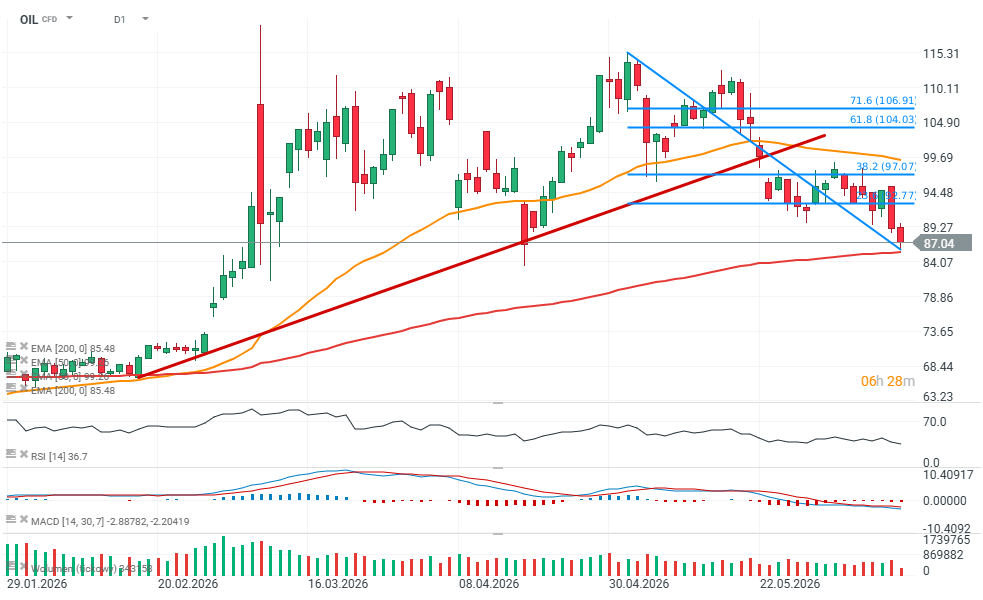
OIL (H1, D1 chart)
Looking at oil prices, the contract tested the 200-session exponential moving average (EMA200, red line) near $85.5 per barrel before recovering part of its losses. Holding the $85 area as support could prove crucial for bulls, especially given previous price reactions in this zone, as reflected by multiple long lower shadows on recent candles. If geopolitical tensions persist, a sustained break below these levels appears unlikely. On the other hand, if negotiations with Iran progress successfully and shipping traffic through the Strait of Hormuz returns to normal, the market may increasingly view a move back above $100 per barrel as unlikely.
In that scenario, oil could come under pressure to retest pre-war price levels near $74 per barrel. Such a move would imply a decline of roughly 17% from current levels. Key resistance levels based on Fibonacci retracements are currently located around $93 and $97 per barrel. While the end of the strong uptrend in oil prices is not yet confirmed, the probability of a broader trend reversal appears higher now than at any point since the conflict began in late February and early March.
Source: xStation 5