S&P 500 — US Large Cap Index
 FTSE 100 — UK Blue Chips
 Euro Stoxx 50 — Eurozone Leaders
 DAX 40 — German Equities
 CAC 40 — French Market Index
 Nikkei 225 — Japan Benchmark
 Hang Seng — Hong Kong Index
 Shanghai Composite — China Mainland
 ASX 200 — Australian Market
 TSX Composite — Canada Index
 Nifty 50 — India Large Cap
 STI Index — Singapore Market
 KOSPI — South Korea Index
 Bovespa — Brazil Equities
 JSE Top 40 — South Africa Index
 IPC Index — Mexico Market
Silver Price Forecast: XAG/USD Holds Above $66 as Fed Policy and Middle East Risks Drive the Outlook

Silver prices are consolidating around $66.35 per ounce at the start of the week after posting a strong recovery through the second half of last week. The white metal remains above its short-term trend support, but gains have paused as traders assess the Federal Reserve’s renewed tightening cycle, changing expectations for inflation and developments surrounding the Middle East.
Spot silver closed around $66.35 on Friday, after rising sharply from the week’s low near $62.30. The September 18 session saw silver trade between approximately $65.35 and $67.34, highlighting the elevated volatility that continues to characterise the precious-metals market.
The immediate macroeconomic focus is on the relationship between oil prices, inflation expectations and Federal Reserve policy. Brent crude fell to around $101.71 and WTI to approximately $98.15 on Monday as markets responded to renewed hopes for diplomatic progress involving the United States and Iran.
Lower oil prices can reduce concerns about a prolonged inflation shock, potentially limiting expectations for aggressive monetary tightening and improving the relative appeal of non-yielding precious metals such as silver.
However, the Federal Reserve remains a significant counterweight. Minneapolis Fed President Neel Kashkari said inflation remains too high across the US economy and is not simply the result of higher energy prices. He also supported the Fed’s latest rate increase to 3.75%-4.00%.
Silver therefore enters the week with competing fundamental forces: easing oil prices and geopolitical uncertainty can support precious metals, while persistent US inflation and expectations of additional Fed tightening can limit upside.
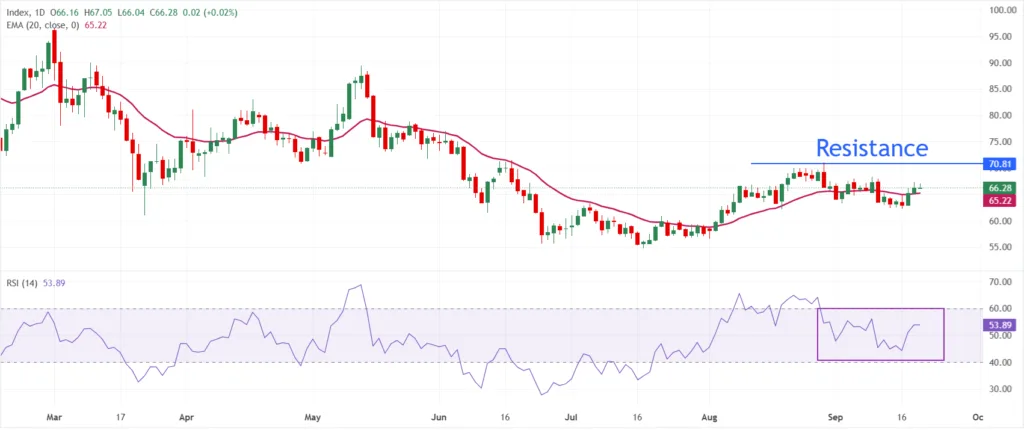
Technically, the market remains constructive while silver holds above the 20-day EMA around $65.22. The next major upside hurdle is the August 28 high near $71.12.
Silver Market Snapshot
| Indicator | Current Level / Outlook |
|---|---|
| XAG/USD | ~$66.35 |
| Friday close | ~$66.35 |
| September weekly low | ~$62.30 |
| Immediate support | $65.22 |
| Secondary support | $63.00-$63.50 |
| Major psychological support | $60.00 |
| Immediate resistance | $67.27 |
| September resistance zone | $67.30-$68.30 |
| Major resistance | $71.12 |
| 20-day EMA | $65.22 |
| RSI | ~54 |
| Fed funds target | 3.75%-4.00% |
| Brent crude | ~$101.71 |
| WTI crude | ~$98.15 |
| Primary themes | Fed policy, inflation, oil, geopolitics, industrial demand |
Silver Price Today: XAG/USD Consolidates Near $66.35
Silver is trading in a relatively tight range around $66.35, following a strong recovery from the mid-September sell-off.
Market data shows that XAG/USD closed September 18 around $66.22, after reaching an intraday high above $67.30. The metal has therefore recovered a substantial portion of its earlier decline, but buyers have so far struggled to establish a sustained break above the upper-$67 area.
The pause is understandable given the number of competing macroeconomic signals.
Oil prices are falling, which reduces some of the immediate inflation pressure that previously supported expectations for higher interest rates. At the same time, Fed officials continue to warn that inflation remains too high.
This leaves silver caught between a potentially supportive decline in inflation expectations and a still-restrictive US monetary-policy environment.
Falling Oil Prices Reduce Inflation Pressure
Oil prices have fallen for a fourth consecutive session as markets assess the possibility of diplomatic progress in the Middle East.
Brent crude declined to around $101.71 per barrel, while WTI fell to approximately $98.15. Reuters reported that the decline followed renewed expectations for potential US-Iran diplomatic discussions.
For precious metals, lower oil prices can have an important second-order effect.
When energy prices fall, markets may reduce expectations for persistent inflation and therefore reduce the need for increasingly restrictive monetary policy.
That can benefit silver because it reduces the relative disadvantage of holding an asset that does not generate interest.
However, the relationship is not one-directional. If lower oil prices are interpreted as evidence of weaker global demand rather than simply easing supply-risk premiums, the resulting deterioration in economic expectations could weigh on silver’s industrial-demand component.
Fed Policy Remains a Major Silver Driver
The Federal Reserve raised its policy rate to 3.75%-4.00% last week, resuming a tightening cycle after a lengthy period without an increase.
This is important because higher interest rates generally increase the opportunity cost of holding non-yielding assets.
Silver can therefore face pressure when Treasury yields and expectations for future Fed increases rise.
Yet silver’s recent price action demonstrates that the relationship is not mechanical.
The metal advanced even as the Fed raised rates, with silver gaining around 3.1% for the week according to market coverage, while Friday’s move alone was approximately 2.3%.
This suggests that other factors — including precious-metal demand, geopolitical uncertainty and easing oil-price pressures — are currently offsetting some of the negative effect from tighter monetary policy.
Kashkari Warns Inflation Remains Broad-Based
Minneapolis Fed President Neel Kashkari has provided a clear indication that the central bank remains concerned about inflation.
Kashkari said inflation is still too high across the US economy and stressed that price pressures extend beyond energy and food. He also pointed to resilient economic growth as an additional factor contributing to inflation.
That message matters for silver because it reduces the likelihood that the market can simply assume the Fed will quickly reverse course.
If inflation remains broad-based, the central bank may need to maintain restrictive policy for longer or consider additional rate increases.
For silver, this creates a fundamental ceiling unless inflation expectations begin to ease without a significant deterioration in industrial demand.
Middle East Developments Remain Important
The Middle East remains another major source of volatility.
Comments from US President Donald Trump regarding potential discussions with Iranian President Masoud Pezeshkian have increased expectations of possible diplomatic engagement, contributing to the decline in oil prices.
A sustained improvement in the geopolitical situation could reduce the safe-haven premium embedded in precious metals.
At the same time, a renewed escalation could have the opposite effect by increasing demand for defensive assets and raising concerns over energy supplies and inflation.
Silver therefore remains sensitive to developments in both directions.
Silver’s Dual Role Supports the Longer-Term Fundamental Story
Unlike gold, silver has an unusually strong industrial component.
The metal is widely used in electronics, electrical applications, solar technology and other industrial processes. That means silver can benefit from stronger manufacturing and technology investment but can also be vulnerable to weaker global industrial activity.
This dual role makes silver different from a pure monetary precious metal.
When monetary conditions become more supportive, investment demand can lift silver.
When industrial activity accelerates, physical demand can provide another source of support.
But when interest rates rise aggressively at the same time as manufacturing activity deteriorates, silver can face pressure from both sides.
Silver Technical Analysis
The technical structure remains moderately constructive.
XAG/USD is holding above the 20-day EMA around $65.22, while the RSI is near 54, indicating positive but not overbought momentum. FXStreet’s technical analysis identifies the 20-day EMA as the immediate downside reference and the August 28 high at $71.12 as the major upside hurdle.
Independent technical data places the current pivot around $66.32, with initial support near $65.30 and resistance near $67.27.
The structure therefore creates a clearly defined short-term range.
A move above $67.30 would strengthen the recovery and put the $68.30 region back into focus.
A sustained break through $71.12 would represent a much more significant technical development because it would take silver above the late-August swing high.
Conversely, a daily close below $65.22 would weaken the immediate bullish structure and increase the risk of a deeper correction.
Bullish Sentiment
1. Silver Holds Above the 20-Day EMA
The metal remains above the $65.22 20-day EMA, preserving its short-term constructive structure.
As long as this level holds, buyers retain a technical platform from which to challenge higher resistance.
2. Falling Oil Prices Could Reduce Rate Pressure
Brent and WTI have both fallen sharply as markets assess potential diplomatic developments.
Lower energy prices could reduce inflation expectations and, over time, ease pressure for additional monetary tightening.
That would improve the environment for non-yielding precious metals.
3. Silver Has Demonstrated Resilience Despite Fed Tightening
Silver gained around 3.1% over the week despite the Federal Reserve raising rates.
The ability to hold above $65 after the rate decision indicates that monetary tightening alone has not been sufficient to reverse the recent recovery.
4. Geopolitical Uncertainty Remains
Even if oil prices decline, unresolved geopolitical risks can continue to support demand for precious metals.
Any renewed escalation in the Middle East could increase safe-haven demand and simultaneously raise concerns about inflation and global supply chains.
Bearish Sentiment
1. Persistent US Inflation
Kashkari’s comments indicate that inflation remains a broad-based concern rather than simply an energy-price problem.
If inflation remains elevated, markets may continue pricing additional Fed tightening.
2. Higher Interest Rates Increase Silver’s Opportunity Cost
A Fed funds rate of 3.75%-4.00% makes interest-bearing assets relatively more attractive than non-yielding metals.
Further increases in US yields could therefore put renewed pressure on silver.
3. Failure Below $67-$68
Silver has so far struggled to convert its recovery into a sustained break above the upper-$67 area.
Failure to clear this resistance zone could encourage profit-taking and return the metal toward the $65.22 support region.
4. Industrial Demand Risk
Silver’s industrial exposure can become a disadvantage if global manufacturing and investment weaken.
A deterioration in Chinese or global industrial activity would potentially reduce one of the key sources of physical silver demand.
Silver Price Forecast: What Traders Are Watching
The immediate technical map is relatively clear.
Bullish scenario:
- $67.27 — first resistance
- $68.30 — next upside area
- $69.50-$70.00 — psychological resistance zone
- $71.12 — August 28 high and major breakout level
- Above $71.12 — broader recovery structure strengthens
Bearish scenario:
- $65.30 — immediate technical support
- $65.22 — 20-day EMA
- $63.50-$63.00 — recent consolidation/support region
- $62.30 — September low
- $60.00 — major psychological support
The $65.22-$67.30 region is therefore the key short-term battlefield.
A sustained move above $67.30 would improve the upside structure, while a break below $65.22 would indicate that bullish momentum is weakening.
Silver Price Outlook: Fed Versus Inflation and Industrial Demand
The fundamental outlook for silver remains dependent on whether the market focuses more heavily on monetary policy or on the combination of industrial demand, geopolitical uncertainty and falling oil prices.
The Fed’s renewed tightening cycle is clearly a headwind.
However, silver’s recent resilience suggests that investors are not treating higher interest rates as the only factor determining the metal’s value.
The interaction between US inflation and energy prices is particularly important.
If oil continues falling, headline inflation pressure could ease. That could reduce expectations for additional tightening and support precious metals.
If oil prices rebound sharply because of renewed Middle East disruption, the outcome becomes more complicated. Higher oil could increase demand for inflation hedges, but it could also force central banks to maintain restrictive monetary policy.
Silver therefore remains highly sensitive to the direction of both variables.
Silver and the US Dollar
The US Dollar remains another important driver of XAG/USD.
Because silver is priced in dollars, a stronger US currency generally makes the metal more expensive for international buyers and can create downward pressure.
The dollar has recently remained relatively firm as markets reassess the Fed’s policy trajectory.
For silver to establish a sustained move above $67-$68, the market may therefore need either a stabilisation or decline in the dollar, lower US yield expectations, stronger commodity demand, or a combination of these factors.
Conversely, renewed dollar strength alongside higher Treasury yields would increase the pressure on XAG/USD.
Fundamental Outlook
Silver enters the week with a mixed but closely balanced fundamental backdrop.
The supportive factors include:
- Falling oil prices
- Potential easing in inflation expectations
- Strong recent silver demand
- Persistent geopolitical uncertainty
- Industrial applications
- Continued interest in precious metals
The negative factors include:
- Fed tightening
- Broad-based US inflation
- Higher interest rates
- Potential US Dollar strength
- Uncertainty around global industrial demand
This means the next major directional move is likely to depend on whether the market begins pricing a prolonged period of restrictive Fed policy or instead shifts toward expectations that lower energy prices will gradually ease inflation pressure.
Today Markets View
Silver begins the week around $66.35, consolidating after a strong recovery from the $62.30 September low.
The technical structure remains constructive while XAG/USD holds above the $65.22 20-day EMA, with the $67.27-$68.30 area representing the first major upside test. The larger technical hurdle remains $71.12, the August 28 high.
Fundamentally, the market remains divided.
Falling oil prices are easing some inflation concerns, while potential diplomatic developments in the Middle East could reduce the energy-price shock. At the same time, Fed officials continue to emphasise that inflation remains too high and broad-based, keeping the possibility of additional monetary tightening in view.
The key levels for traders are therefore $65.22 on the downside and $67.27-$68.30 on the upside. A sustained move through $71.12 would provide a more significant technical signal, while a daily close below the 20-day EMA would weaken the current recovery structure.
For now, silver remains caught between Fed tightening, easing oil prices, geopolitical uncertainty and industrial-demand expectations. The metal’s ability to remain above $65 despite the latest Fed rate increase keeps the broader recovery structure intact, but a decisive break above $67-$68 is still required before the market can establish stronger upside momentum.
Louis Roche, Analyst, Today Markets