S&P 500 — US Large Cap Index
 FTSE 100 — UK Blue Chips
 Euro Stoxx 50 — Eurozone Leaders
 DAX 40 — German Equities
 CAC 40 — French Market Index
 Nikkei 225 — Japan Benchmark
 Hang Seng — Hong Kong Index
 Shanghai Composite — China Mainland
 ASX 200 — Australian Market
 TSX Composite — Canada Index
 Nifty 50 — India Large Cap
 STI Index — Singapore Market
 KOSPI — South Korea Index
 Bovespa — Brazil Equities
 JSE Top 40 — South Africa Index
 IPC Index — Mexico Market

US indices have opened the new week without a clear direction, pausing after Friday’s rally, which pushed the Nasdaq and the S&P 500 to record highs. At the start of the session, the S&P 500 is hovering around its closing level (around 7,728 points, +0.1 per cent), the Nasdaq is slightly up, and the Dow is down slightly – the market has clearly run out of steam and is looking for new impetus. The main drag is the technology sector, and more specifically semiconductors, where Intel is weighing on the entire sector following reports of a possible collaboration between TSMC and Elon Musk’s Terafab project.
Investors’ attention, however, is shifting across the Atlantic – it is the mounting tensions surrounding the eurozone’s public finances that are driving sentiment today, alongside persistently high US bond yields (the 10-year yield at around 5.30 per cent) and volatile oil prices. At the heart of the problem lies France, where the budget deadlock and concerns over the government’s ability to reduce the deficit have led to a historic sell-off in bonds – the spread between French and German 10-year bonds reached around 150 basis points on Friday, the widest since the eurozone debt crisis in 2011. The unease is beginning to spread to other countries: in Spain, Prime Minister Sánchez announced a snap general election for 29 November after failing to push through a housing bill, which has added to the political risk in the region.
The result has been a flight from the euro, which fell to a 17-month low against the dollar (around 1.12), whilst the dollar index climbed to levels close to its ‘Liberation Day’ highs (over 102 points). An additional development is the surprise from Brazil, where Flávio Bolsonaro unexpectedly overtook Lula in the first round of the election, triggering a strong rally in Brazilian assets. The oil market is nervous – Brent is fluctuating between $100 and $103, torn between Saudi Arabia’s price cut and the return of supply on the one hand, and the escalation of fighting in Yemen and reports of an attack on oil infrastructure on the other.
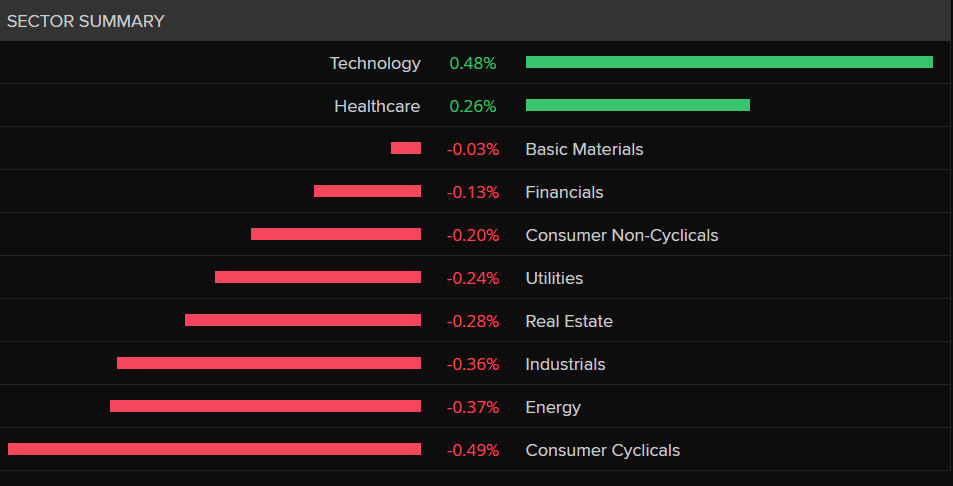
The broader market is dominated by red, with only two sectors managing to stay in positive territory: technology (+0.5 per cent) and healthcare (+0.3 per cent). The remaining sectors are in the red, with cyclical consumer goods (-0.5 per cent), energy (-0.4 per cent) and industrials (-0.4 per cent). This paints a picture of a consolidation session, in which the market is weighing up Friday’s optimism regarding the postponement of the Fed’s October rate rise (around an 80 per cent chance of a pause) against the risk of the European bond market turmoil spilling over into global risk appetite. It is worth noting that retail investors are entering this volatile period with their highest exposure to shares since 2017 and a record-low level of cash, which historically has often signalled increased market vulnerability to fluctuations.
Source: LSEG Company news:
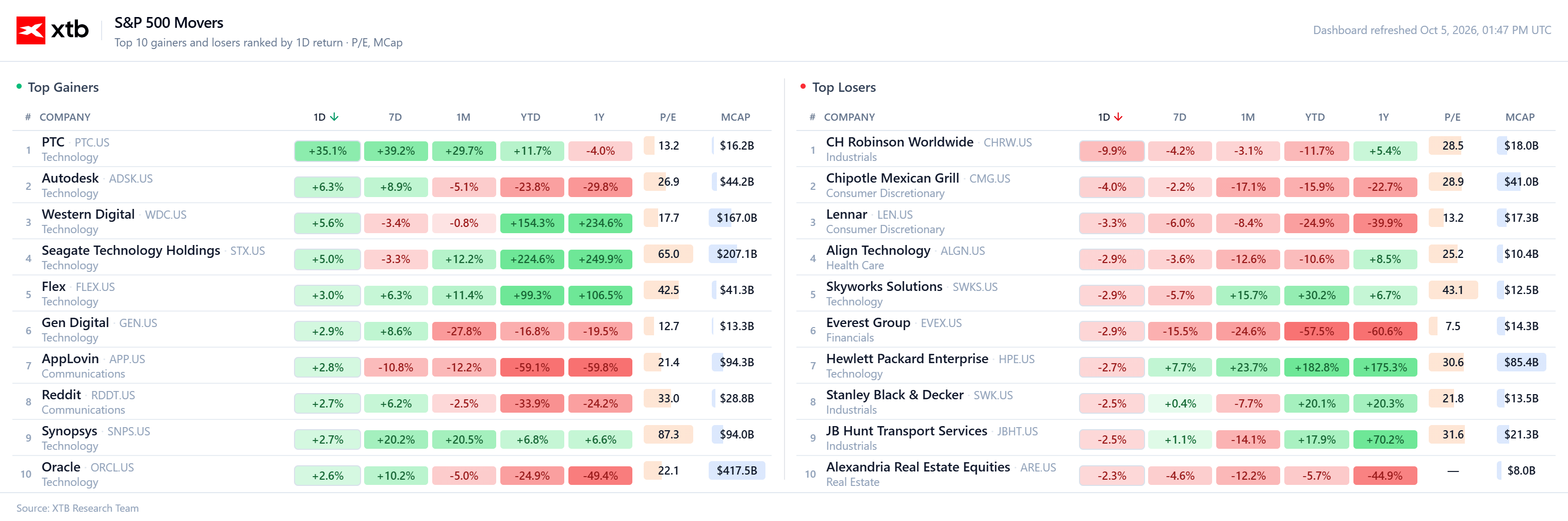
PTC has surged by around 36% after France’s Schneider Electric agreed to acquire the industrial software maker for US$205 per share (around US$22.6 billion in cash); Schneider itself is down by more than 7% in Paris, whilst analysts are describing the deal as “opportunistic”.
Intel is down by around 4 per cent following reports that TSMC is in talks to join Musk’s Terafab project, in which Intel has been participating since April – investors had hoped Intel would have the project all to itself; TSMC is up by around 1.6 per cent.
Nvidia is up by around 0.5–0.6 per cent, buoyed by better-than-expected revenue from its partner Hon Hai (Foxconn), which confirms that spending on AI infrastructure remains high. Hard drive manufacturers are rebounding following Friday’s sell-off – Western Digital (+approx. 1.6%) and Seagate (+approx. 2%) are rising on the back of ‘buy’ recommendations from Bernstein and Citi. In the logistics sector, RXO has surged by over 20 per cent following news of its takeover by CH Robinson at US$30.25 per share; the acquirer itself has fallen by around 7 per cent, making it the worst-performing company in the S&P 500 today. In addition, DraftKings (+approx. 5% following an upgrade by BofA) and Harley-Davidson (+approx. 5.7% following an upgrade by Citi), whilst Brazilian companies listed in the US (including Itaú, Bradesco and the EWZ ETF) are gaining over ten per cent following the election results. Strategy (MSTR) purchased a further 334 bitcoins for USD 28.7 million, increasing its holdings to 848,000 BTC.