S&P 500 — US Large Cap Index
 FTSE 100 — UK Blue Chips
 Euro Stoxx 50 — Eurozone Leaders
 DAX 40 — German Equities
 CAC 40 — French Market Index
 Nikkei 225 — Japan Benchmark
 Hang Seng — Hong Kong Index
 Shanghai Composite — China Mainland
 ASX 200 — Australian Market
 TSX Composite — Canada Index
 Nifty 50 — India Large Cap
 STI Index — Singapore Market
 KOSPI — South Korea Index
 Bovespa — Brazil Equities
 JSE Top 40 — South Africa Index
 IPC Index — Mexico Market

Facts
- Chicago wheat futures (WHEAT) are rising for a third consecutive session and have gained around 15% since the end of June.
- Ukraine’s grain exports fell 75% year-on-year in the first part of August.
- S&P Global Energy sees continued upside risk for wheat prices amid the Russia-Ukraine conflict, which is disrupting exports through the Black Sea.
- Russia and Ukraine together account for more than 25% of global wheat exports.
- Russian grain exports in August are expected to amount to less than half of the five-year average.
- According to Ukrainian Agriculture Minister Taras Vysotskyi, if the ports remain closed, around 30 million tonnes of Ukrainian agricultural exports may fail to reach the global market.
- Alternative export routes are currently unable to fully replace the volumes normally shipped through Black Sea ports.
Recommendation
Long WHEAT at market price
- Take Profit: 704
- Stop Loss: 627
Opinion
The wheat market is currently facing several sources of supply risk, with the most significant concentrated around the Black Sea. Ukrainian attempts to de-escalate tensions may periodically trigger corrections, but at this stage they do not change the fundamental picture. For the wheat market, actual export flows, port and vessel availability, and freight costs remain key. Weather risks are also emerging alongside geopolitical pressures, with Russia and Ukraine recently intensifying attacks on grain infrastructure and vessels in the Black Sea region. Another global weather factor that could support wheat prices this year is an exceptionally strong El Niño, which is increasing uncertainty over future harvests. Russia and Ukraine together account for more than 25% of global wheat exports.
At the same time, three major terminals in Novorossiysk suspended operations following a drone attack, while no vessels entered Ukraine’s Greater Odesa ports in August. Ukrainian grain exports fell 75% year-on-year in the first part of the month, while Russian shipments in August are expected to amount to less than half of the five-year average. These figures cover the broader grain market rather than wheat alone, but their scale illustrates the extent of the disruption to exports from the region. The timing is particularly important. Black Sea wheat is typically among the cheapest sources of grain on the global market at this point in the year, meaning that the disruptions are occurring precisely when Russian and Ukrainian supply would normally play a major role in international trade.
Importers are already responding. Indonesia, the world’s second-largest wheat importer, has purchased Australian wheat for September and October delivery. Other buyers in Southeast Asia have also turned to Australian wheat, while Bangladesh has sought offers from Romania. Inquiries have also been directed toward North America. If this trend persists, part of global demand could shift toward more expensive sources of supply, while improving the relative competitiveness of U.S. wheat. Freight costs are another important signal. The cost of August shipments from Ukraine to Indonesia has risen from around $70 to almost $90 per tonne, yet charterers are still struggling to find shipowners willing to enter the conflict-affected region. Alternative rail and port routes may alleviate some of the pressure, but they cannot replace the capacity of Black Sea ports.
I view Ukraine’s attempts to de-escalate the situation primarily as a source of short-term volatility. Reports of a possible halt to reciprocal attacks on civilian targets in the Black Sea were enough for wheat futures to give back earlier gains. However, unless political statements are followed by an actual resumption of shipping and exports, it is difficult to argue that the geopolitical risk premium can be sustainably removed from wheat prices. A second argument supporting higher prices comes from weather conditions in Europe. Persistent drought and high temperatures are increasing the risk of disruption to autumn planting for the 2027 harvest.
Low soil moisture is becoming a concern for winter wheat planting. In Bavaria, rainfall since the beginning of April is at its lowest level since 2015, while some longer-term forecasts point to continued dry conditions across northern France, Germany and Poland. With the current soil-moisture deficit, the risk is increasingly extending to next year’s production potential. From the perspective of CBOT wheat futures, the combination of these two factors is important. In the short term, grain availability from one of the world’s most important export regions is constrained, while risks are simultaneously emerging for the next European growing season. Chicago wheat futures have already gained around 15% since the end of June, so corrections should be expected, particularly following reports confirming any potential de-escalation of the conflict. In the base-case scenario, however, a further rise in CBOT Wheat futures from current levels appears likely. The main factors supporting this view are deteriorating physical availability of Black Sea wheat, rising transportation costs and the first signs of import demand being redirected toward alternative suppliers.
Weather risks in Europe provide an additional argument and may become increasingly important as the winter wheat planting season approaches. The main risk to this scenario is an effective de-escalation in the Black Sea. Until an improvement becomes visible in actual grain flows, the balance of risks for CBOT Wheat remains tilted toward higher prices. I recommend taking a long position in WHEAT with a target price of 704 cents per bushel and a stop-loss order at 627 cents per bushel, with both levels determined using price-action methodology.
WHEAT chart (D1 interval)
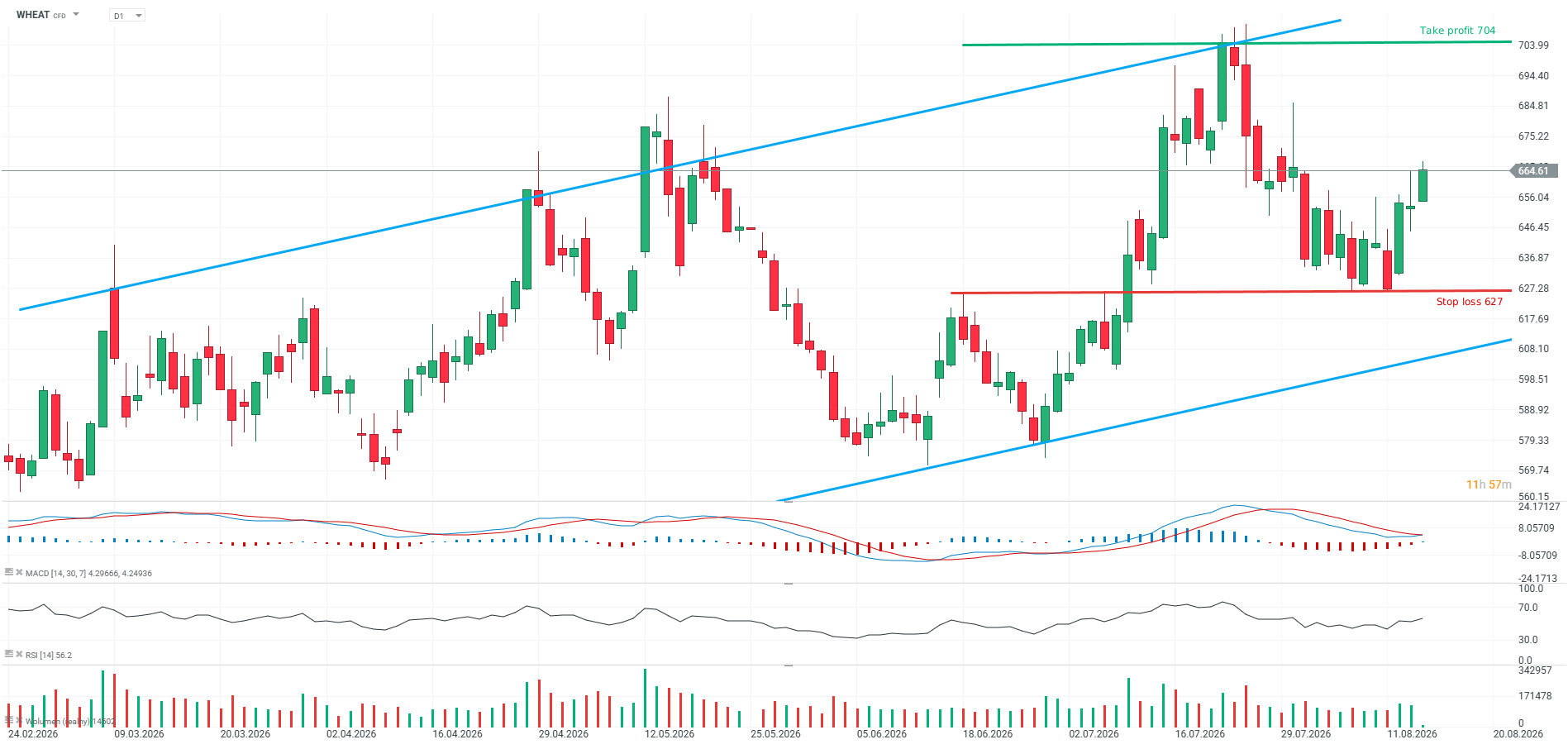
Source: xStation5 This recommendation is based on fundamental analysis of the wheat market and information obtained from market commentary. The target levels were determined using Price Action analysis.
Supporting charts
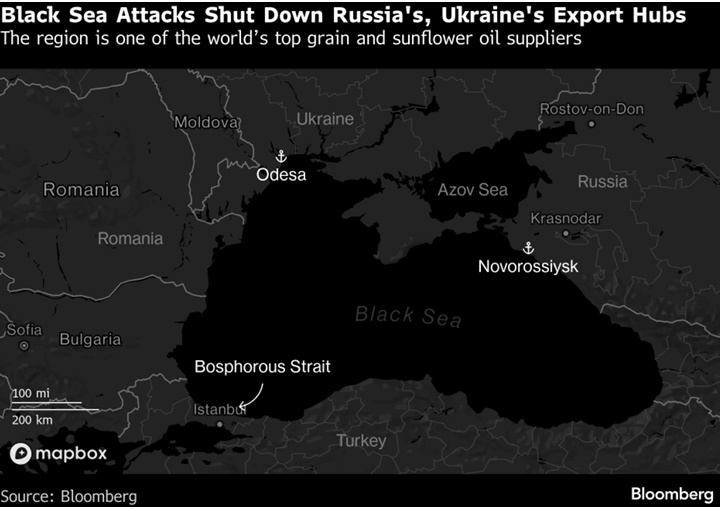
Source: Bloomberg Finance L.P.
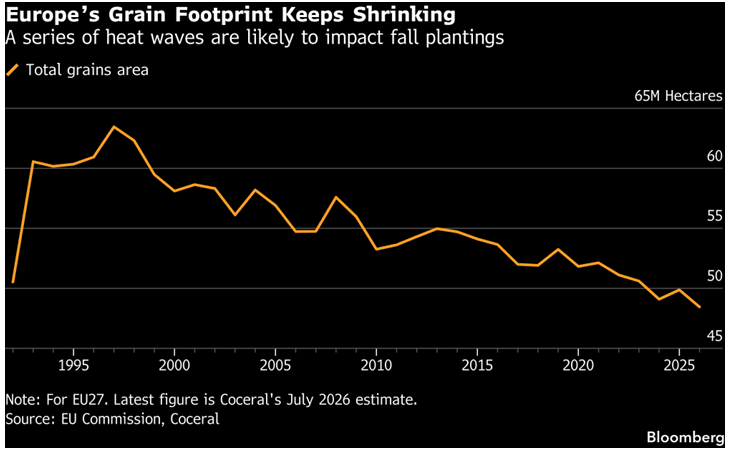
Source: EU Commission, Coceral, Bloomberg Finance L.P.