S&P 500 — US Large Cap Index
 FTSE 100 — UK Blue Chips
 Euro Stoxx 50 — Eurozone Leaders
 DAX 40 — German Equities
 CAC 40 — French Market Index
 Nikkei 225 — Japan Benchmark
 Hang Seng — Hong Kong Index
 Shanghai Composite — China Mainland
 ASX 200 — Australian Market
 TSX Composite — Canada Index
 Nifty 50 — India Large Cap
 STI Index — Singapore Market
 KOSPI — South Korea Index
 Bovespa — Brazil Equities
 JSE Top 40 — South Africa Index
 IPC Index — Mexico Market

Today Markets Analysis: USD/JPY is holding around 154.80 as the US Dollar remains supported by elevated US Treasury yields and safe-haven demand, while traders await this week’s Federal Reserve and Bank of Japan policy decisions. The pair remains caught between two competing forces: resilient US Dollar demand on one side and growing expectations of further BoJ tightening on the other.
For currency markets, the key issue is no longer simply whether the Fed or BoJ changes rates. The more important question is what each central bank signals about the path of interest rates from here.
US Dollar Supported by Higher Yields
The US Dollar continues to find support from elevated US Treasury yields, with the benchmark 10-year yield remaining around historically high levels.
Higher US yields increase the relative attractiveness of dollar-denominated assets and are helping keep the USD firm against the yen.
At the same time, persistent geopolitical uncertainty is supporting demand for traditional safe-haven currencies, providing another source of support for the dollar.
This combination is particularly important for USD/JPY because the pair is highly sensitive to the difference between US and Japanese interest rates.
If US yields remain elevated while Japanese rates stay comparatively low, the interest-rate differential continues to favour the dollar.
However, that relationship could change quickly if the Bank of Japan delivers a more hawkish message.
BoJ Tightening Expectations Strengthen Yen Support
The Japanese Yen has gained an important source of support from changing expectations around Bank of Japan policy.
Markets are increasingly focused on the possibility of further monetary tightening, while policymakers appear more comfortable with the argument for gradually moving away from Japan’s ultra-loose monetary policy.
This has already encouraged investors to reduce some of their previous bearish positioning on the yen.
For USD/JPY, the implication is significant.
A more hawkish BoJ could encourage Japanese bond yields to rise and reduce the attractiveness of holding dollars against the yen.
The market therefore faces a potential conflict:
| Market FactorCurrent DirectionImpact on USD/JPY | ||
|---|---|---|
| US Treasury yields | Elevated | Bullish |
| US Dollar safe-haven demand | Firm | Bullish |
| Geopolitical uncertainty | Elevated | Bullish |
| Fed policy expectations | Key risk | Two-way |
| BoJ tightening expectations | Increasing | Bearish |
| Japanese rate expectations | Higher | Bearish |
| USD/JPY around 154.80 | Firm | Supportive |
Fed Decision Could Set the Next Direction
The Federal Reserve meeting is likely to be the first major catalyst for the dollar.
Markets will be watching not only the rate decision but also the Fed’s assessment of inflation, economic growth and the future path of monetary policy.
A hawkish Fed could keep US yields elevated and provide another leg higher for USD/JPY.
However, if policymakers signal greater confidence that inflation is moving lower and that additional tightening will not be necessary, US yields could fall and the dollar could lose some of its recent support.
For businesses with dollar exposure, this distinction is important.
The initial market reaction to the Fed decision could be very different from the move that develops over the following days as investors reassess the longer-term interest-rate outlook.
BoJ Could Create a Stronger Yen Move
The Bank of Japan meeting later in the week could prove even more important for USD/JPY.
A cautious BoJ would allow the existing US yield advantage to remain a major driver of the pair.
A more hawkish BoJ, however, could trigger a sharp yen recovery.
This is particularly relevant because speculative positioning has already shifted in favour of the yen. If the BoJ reinforces expectations of additional rate increases, investors who remain positioned for a weaker yen could be forced to reduce those positions.
That could create a rapid move lower in USD/JPY.
For currency hedgers, this creates a clear warning: the yen does not need a dramatic change in Japanese economic fundamentals to strengthen sharply if positioning and expectations shift at the same time.
Technical Levels Become Important
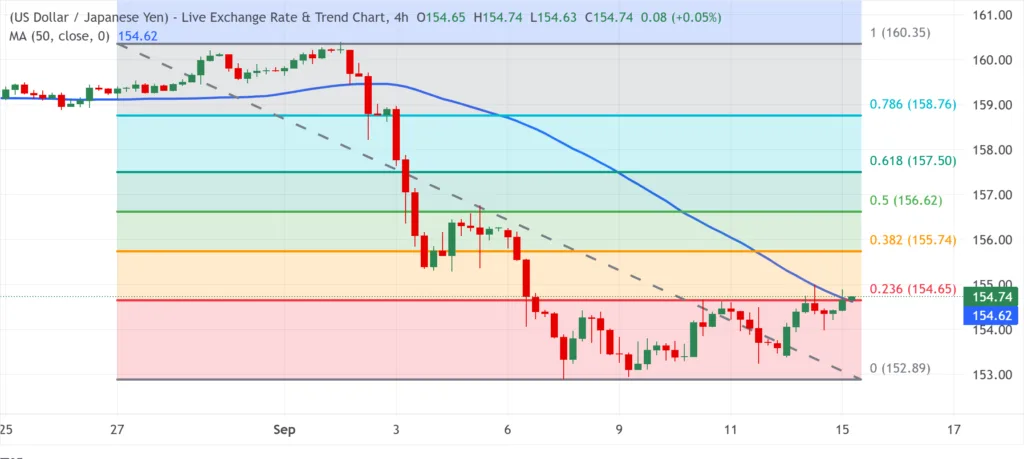
USD/JPY is currently trading around 154.80, keeping the pair above the important 154.60–154.65 support area.
This zone combines the 50-period moving average on the four-hour chart with the 23.6% Fibonacci retracement.
As long as the pair holds above this area, the recent recovery remains technically intact.
On the upside, traders are watching:
- 155.74 – first resistance
- 156.62 – next resistance
- 157.50 – important resistance
- 158.76 – higher resistance
- 160.35 – major high area
On the downside:
- 154.60–154.65 – immediate support
- 152.89 – next important structural support
A sustained break below 154.60 would weaken the current bullish USD/JPY structure and increase the risk of a deeper yen recovery.
What Currency Hedgers Are Watching Next
For businesses exposed to USD/JPY, the coming central-bank decisions create a particularly important period for hedge management.
Companies should focus on:
- Federal Reserve guidance
- Bank of Japan policy signals
- US 10-year Treasury yields
- Japanese government bond yields
- USD/JPY around 154.60–154.65
- US-Japan interest-rate differentials
- Changes in speculative yen positioning
- Geopolitical developments and safe-haven flows
The key risk is attempting to wait for a perfect exchange rate before hedging.
If the BoJ produces a stronger-than-expected tightening signal, USD/JPY could move lower quickly. Conversely, a hawkish Fed combined with continued high US yields could push the pair towards the mid-155s and beyond.
Currency Hedger View
For companies with upcoming USD payments against JPY, the current environment argues for a balanced and staged hedging strategy rather than relying on a single forecast.
Businesses that cannot tolerate a significant adverse move should consider maintaining a core level of protection before the central-bank decisions.
Companies with greater flexibility may choose to leave part of their exposure open, allowing them to benefit if USD/JPY moves favourably.
The important distinction is between managing risk and speculating on the outcome of the central-bank meetings.
For a corporate treasury team, protecting the budget rate is generally more important than trying to capture the final few points of a market move.
Today Markets View
USD/JPY remains supported around 154.80, but the bullish dollar trend is facing an increasingly important test.
Elevated US yields and safe-haven demand continue to favour the dollar, while growing expectations of further BoJ tightening are strengthening the case for a firmer yen.
The 154.60–154.65 area is therefore an important near-term level. Holding above it would keep the recovery structure intact and leave 155.74 and 156.62 as the next upside levels.
A break below the support zone would instead signal that the yen is beginning to regain control, with 152.89 becoming the next major downside reference.
For businesses managing currency exposure, the central-bank meetings should be treated as a risk-management event rather than simply a trading event.
Bottom Line
USD/JPY remains firm near 154.80, supported by elevated US yields, dollar safe-haven demand and geopolitical uncertainty.
However, increasingly hawkish expectations for the Bank of Japan are limiting the yen’s downside and could trigger a sharper recovery if policymakers signal further tightening.
With both the Fed and BoJ in focus, volatility is likely to remain elevated.
For corporate currency hedgers, the priority should be protecting upcoming exposures while retaining flexibility to take advantage of favourable market moves.
Analysis by Louis Roche, Analyst, Today Markets
Market analysis contributed by Currency Hedger, an Octalas Group division specialising in foreign exchange, currency risk and hedging.