S&P 500 — US Large Cap Index
 FTSE 100 — UK Blue Chips
 Euro Stoxx 50 — Eurozone Leaders
 DAX 40 — German Equities
 CAC 40 — French Market Index
 Nikkei 225 — Japan Benchmark
 Hang Seng — Hong Kong Index
 Shanghai Composite — China Mainland
 ASX 200 — Australian Market
 TSX Composite — Canada Index
 Nifty 50 — India Large Cap
 STI Index — Singapore Market
 KOSPI — South Korea Index
 Bovespa — Brazil Equities
 JSE Top 40 — South Africa Index
 IPC Index — Mexico Market
Chart of the Day: EURUSD Awaits US CPI. Inflation Could Determine the Fed’s Next Move


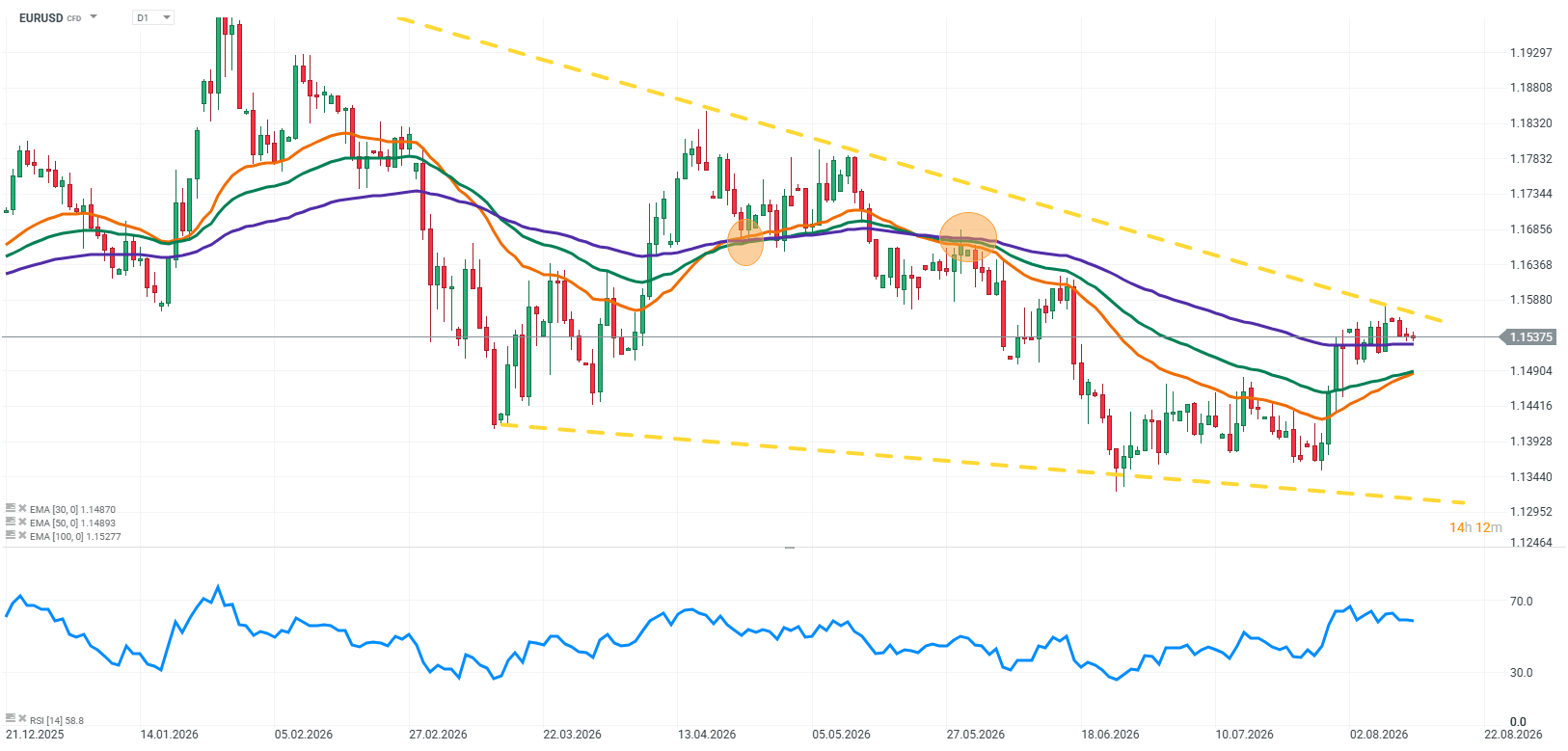
Wednesday’s EURUSD session is primarily focused on anticipation of the day’s most important release: US CPI inflation data. Today’s reading could play a major role in determining how the market prices the Federal Reserve’s next meeting. In recent days, expectations for further rate hikes in the US have clearly weakened. The main reason has been weaker labor market data. Both the ADP report, which showed just 44,000 new private-sector jobs, and the subsequent NFP report came in weak. In July, nonfarm payrolls fell by 23,000, while the market had expected an increase of around 80,000. Previous months’ data were also revised sharply lower. As a result, the market has become increasingly skeptical about further Fed rate hikes. Today’s inflation data could either reinforce that view or challenge it once again. If CPI comes in below expectations, there will be even fewer arguments for further monetary tightening. If, on the other hand, inflation surprises to the upside again, the market could quickly return to pricing higher US interest rates. On the other side is the European Central Bank. The ECB has already raised interest rates this year, and the market is pricing in another move in September. Expectations for a September rate hike are currently very high. In addition, today’s German data confirmed that inflation remains elevated. CPI rose by 0.8% month-on-month and 2.8% year-on-year in July. HICP increased by 0.9% month-on-month and 2.8% year-on-year. This puts EURUSD in a particularly interesting position. On the dollar side, we have an increasingly weak labor market and declining expectations for Fed rate hikes. On the euro side, inflation is still providing the ECB with arguments for maintaining a restrictive monetary policy.
Source: xStation5
Factors Currently Shaping EURUSD
Today’s CPI report is undoubtedly the most important event for EURUSD. The market expects inflation to have risen by 3.4% year-on-year in July, compared with 3.5% in June. Core inflation is expected to increase by 2.5% year-on-year. However, the actual reading will only be the first piece of the puzzle. Much more important will be the market’s reaction to the data and how expectations for future Fed policy change. If inflation comes in below expectations, the market may further reduce the probability of another rate hike. In such a scenario, US Treasury yields could fall and the dollar could come under pressure. This would be a positive signal for EURUSD. Conversely, higher-than-expected inflation could reverse part of this move. Following very weak labor market data, the market now needs another argument to return to pricing in rate hikes. A strong CPI reading could provide exactly that. It is also important to remember that inflation remains above the Fed’s target. Therefore, even a weaker reading does not automatically mean that the central bank will have to start cutting rates quickly. For the market, the more important question right now is whether the argument for further rate hikes disappears.
Weak Labor Market Has Changed Expectations for the Fed
Until recently, the prospect of further rate hikes in the US was much more realistic. The situation changed following a series of weaker labor market reports. The July ADP report showed private-sector employment growth of just 44,000 jobs. A few days later, the NFP report delivered an even bigger disappointment. Nonfarm payrolls fell by 23,000, compared with expectations for an increase of 80,000. Previous data were also revised sharply lower. The labor market is now one of the main arguments against further Fed rate hikes. If the economy is clearly losing momentum in terms of employment, the central bank has fewer reasons to raise the cost of borrowing even further. Today’s CPI could therefore be the missing piece of the puzzle. Weaker inflation combined with a weak labor market would send the Fed a very clear signal that further rate hikes are not necessary.
The ECB Has a Completely Different Problem
The situation on the euro side currently looks different. The European Central Bank has already started a rate-hiking cycle this year, and the market expects another move in September. Importantly, expectations for the September decision are very high. This means the market is already largely pricing in another ECB move, making what the central bank does afterward even more important for the euro. If inflation remains elevated, the ECB may have arguments for maintaining a more restrictive stance. Today’s German data fit well into this picture. CPI and HICP inflation stood at 2.8% year-on-year in July, while monthly price growth also remained high. This does not, of course, mean that German inflation alone will determine ECB decisions. It is nevertheless an important part of the inflation picture across the euro area.
The Difference in Fed and ECB Expectations Is Starting to Favor the Euro
This is currently the most interesting aspect for EURUSD. Until recently, the main problem for the euro was the Fed’s advantage resulting from high interest rates and expectations of further tightening in the US. Now, the situation is beginning to change. The market has reduced expectations for further Fed rate hikes, while at the same time maintaining a high probability of another ECB rate hike in September. If today’s US CPI is weak, the divergence in expectations for the two central banks’ policies could shift even further in favor of the euro. That would provide another argument for EURUSD to move higher. If, however, US inflation comes in above expectations, the dollar could quickly regain some of its advantage. In that case, the market would once again question whether the Fed has actually reached the end of its rate-hiking cycle.
Key Takeaways
- Today’s US CPI report is the most important event for EURUSD and could have a significant impact on expectations for the Fed’s next meeting.
- Weak labor market data, including a very weak NFP report and a weak ADP reading, have clearly reduced expectations for further US rate hikes.
- A lower-than-expected CPI reading could further confirm that the Fed will have little reason to raise rates again this year.
- The ECB is currently in a different position. The central bank has already raised rates this year, and the market is pricing in another rate hike in September with a very high probability.
- Today’s German data showed inflation at 2.8% year-on-year for both CPI and HICP, providing little evidence that the ECB should quickly move away from a restrictive monetary policy.
- For EURUSD, the key question now is whether US CPI confirms the weaker picture of the US economy. If it does, the divergence in monetary-policy expectations could increasingly shift in favor of the euro.