S&P 500 — US Large Cap Index
 FTSE 100 — UK Blue Chips
 Euro Stoxx 50 — Eurozone Leaders
 DAX 40 — German Equities
 CAC 40 — French Market Index
 Nikkei 225 — Japan Benchmark
 Hang Seng — Hong Kong Index
 Shanghai Composite — China Mainland
 ASX 200 — Australian Market
 TSX Composite — Canada Index
 Nifty 50 — India Large Cap
 STI Index — Singapore Market
 KOSPI — South Korea Index
 Bovespa — Brazil Equities
 JSE Top 40 — South Africa Index
 IPC Index — Mexico Market

Chart of the Day: Nasdaq 100 Slips Into Correction. AI Rally Loses Steam – What’s Next for US100?


The Nasdaq 100 is extending its correction, with futures on the index (US100) trading 0.3% lower today as mounting pressure on semiconductor stocks points to a shift in investor sentiment towards the US technology sector. During Monday’s session, the index fell 1.39%, closing at 27,989 points, approximately 10.4% below its October 6 all-time high. This marks the Nasdaq 100’s third technical correction in 2026, although the benchmark is still up around 11% year to date. Importantly, weakness among the largest technology companies contrasts with the relatively resilient performance of the broader market. The vast majority of S&P 500 constituents finished yesterday’s session higher.
- The strongest selling pressure is concentrated in semiconductor stocks, with the sector’s benchmark index losing approximately 12% in just three sessions. On Monday, AMD fell 7.5%, Micron declined 5.8%, and Intel dropped 8.8%, while NVIDIA lost around 1.3%. Investors are becoming increasingly cautious about the future profitability of artificial intelligence investments, while weakness in US semiconductor stocks triggered another sell-off in South Korean memory chip manufacturers SK Hynix and Samsung.
- Concerns about financing enormous AI infrastructure investments are intensifying, with Oracle shares falling around 9% yesterday following reports of plans to raise $20 billion through debt and equity issuance. Investors are increasingly scrutinising whether multibillion-dollar spending on data centres and computing infrastructure will translate into sufficiently strong cash flows rather than merely rapid revenue growth.
- The largest technology companies also came under pressure, including Microsoft (-2.8%) and Apple (-1.8%). The Nasdaq’s high market-capitalisation concentration means that weakness in just a handful of its largest constituents can weigh heavily on the entire index, even when most US stocks perform relatively well.
- Even earnings that exceed analysts’ forecasts are no longer sufficient to sustain share price gains. Apple and Palantir both beat market expectations, yet the market reaction remained cautious. This is characteristic of companies trading at elevated valuation multiples, where investors have already priced in years of strong growth, leaving limited room for disappointment.
- Today’s earnings reports from AMD and Arista Networks will provide an important test of the AI sector’s underlying strength. Investors will focus on revenue guidance, profit margins and the pace of orders for computing and networking infrastructure. Additional sources of volatility include the US congressional elections, the JOLTS job openings report and renewed increases in oil prices amid tensions surrounding Iran.
The current correction does not necessarily imply a lasting deterioration in technology sector fundamentals, but it clearly illustrates a shift in how investors assess these companies. The market is becoming less focused on the potential of artificial intelligence alone and increasingly concerned with the costs of deploying it, returns on invested capital and the ability to generate cash. If upcoming earnings reports confirm strong revenue growth but also reveal further pressure on cash flows, solid financial results may not be enough to bring the correction to an end. On the other hand, the substantial cooling of technology sector valuations and potential positive catalysts, such as a decline in oil prices, should not be overlooked.
US100 chart (D1 timeframe)
Nasdaq 100 futures have retreated to around 28,000 points from record levels near 31,400 and are trading below the 200-day exponential moving average (EMA200, red line) for the first time since March 2026. A swift recovery towards 28,500 points appears to be the first objective for buyers, while the next important support level stands at 27,000 points, corresponding to the lows recorded around the turn of July and August. The magnitude of the current downward move is very similar to the correction seen during the summer, which was followed by a strong rebound. A convincing bullish candlestick, potentially testing the 28,800-point area, would provide an important initial signal of a possible recovery in upward momentum.
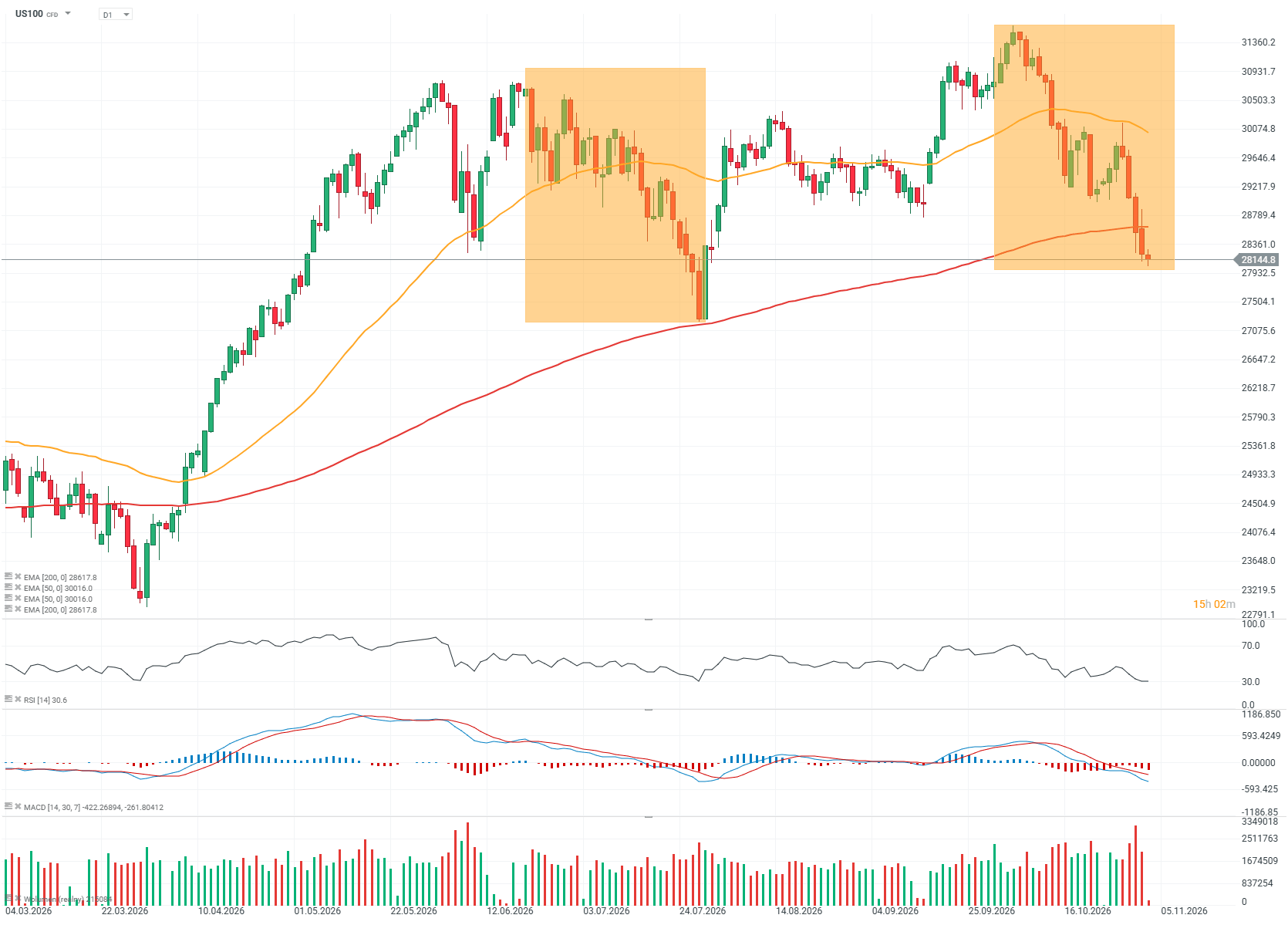
Source: xStation5
The material on this page does not constitute financial advice and does not take into acco