S&P 500 — US Large Cap Index
 FTSE 100 — UK Blue Chips
 Euro Stoxx 50 — Eurozone Leaders
 DAX 40 — German Equities
 CAC 40 — French Market Index
 Nikkei 225 — Japan Benchmark
 Hang Seng — Hong Kong Index
 Shanghai Composite — China Mainland
 ASX 200 — Australian Market
 TSX Composite — Canada Index
 Nifty 50 — India Large Cap
 STI Index — Singapore Market
 KOSPI — South Korea Index
 Bovespa — Brazil Equities
 JSE Top 40 — South Africa Index
 IPC Index — Mexico Market
Chart of the Day: USDJPY Rises Again. Intervention Is Not Enough — Markets Await BoJ Action


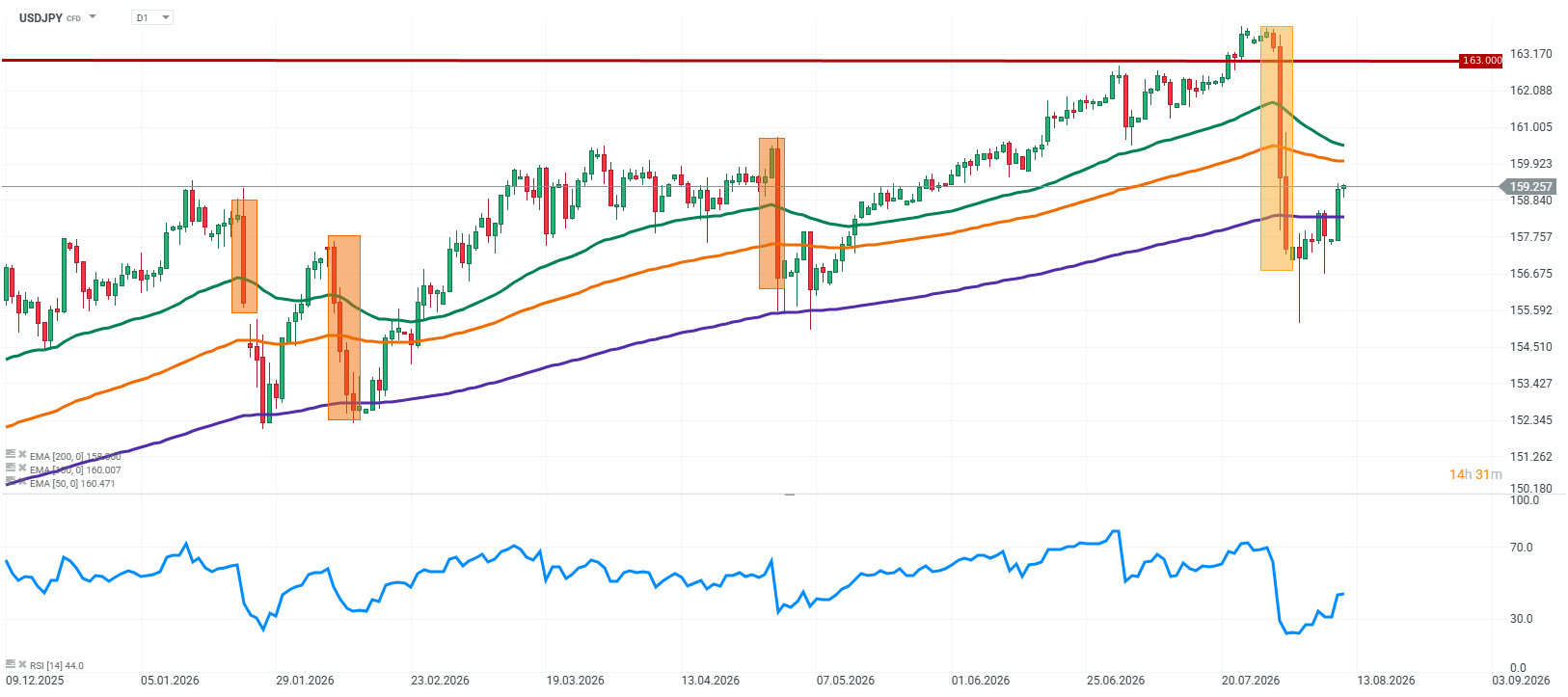
USDJPY is once again moving higher, while the yen is beginning to give back some of the gains it made following the joint intervention by Japan and the United States at the end of July. It was an exceptionally strong response from the authorities, which helped push USDJPY sharply lower in a short period of time and gave the yen some much-needed relief. The problem is that just a few days later, the market is once again testing the weakness of the Japanese currency. This shows that FX intervention can be an effective tool for stopping a sharp move, but it may not be enough to produce a lasting change in the trend. In the case of the yen, the underlying problem is much deeper. The gap between interest rates in the United States and Japan remains very wide, and this has been one of the key reasons behind the persistent pressure on the Japanese currency. The market is therefore paying increasing attention to what could happen at the Bank of Japan’s September meeting. There are growing signals that the BoJ could decide to raise interest rates again on September 17–18. Such a move would be far more important for the yen than intervention alone, as it would represent a genuine change in the interest-rate differential between Japan and the United States.
Source: xStation5
Factors Currently Driving USDJPY
Intervention Gave the Yen Some Relief, but the Effect Is Quickly Fading
At the end of July, USDJPY approached levels that were difficult for Japanese authorities to accept. The response was particularly decisive, as the United States also joined Japan in taking action this time. The joint operation quickly reversed part of the previous move and led to a strong appreciation of the yen. Initially, the effect was very clear. USDJPY fell toward 157, and the market once again began to consider the possibility of a lasting trend reversal. Today, the situation looks different. The pair is rising again, while support for the yen is starting to look increasingly fragile. The market is paying attention to the fact that Tokyo did not follow up the intervention with further aggressive action, which could indicate that policymakers primarily want to limit excessive market moves rather than permanently target a specific exchange-rate level. This is precisely why intervention alone does not solve the problem. It can stop the market for several days or weeks, but if the underlying conditions remain unchanged, pressure on the yen can quickly return.
The BoJ Needs to Do More Than Just Intervene
The most important piece of the puzzle remains the Bank of Japan’s monetary policy. The BoJ has begun the process of normalizing monetary policy and has already raised interest rates. The market is increasingly expecting that this was not the final move. Recent reports suggest that the central bank could decide to raise rates again at its September 17–18 meeting. For the yen, this would be a much more important signal than another round of FX intervention. A rate hike would narrow the interest-rate differential between US and Japanese assets, reducing the attractiveness of strategies that involve funding investments in higher-yielding currencies with the yen. For now, however, the market still needs to see whether the BoJ will actually be willing to act. The possibility of a September rate hike provides some support for the yen, but only an actual decision — combined with guidance on future moves — could change the market outlook in a more lasting way.
The Interest-Rate Differential Remains a Problem for the Yen
Even if the BoJ raises rates in September, the gap between US and Japanese interest rates will remain significant. This is where the main problem for the Japanese currency lies. The market may buy the yen for some time in anticipation of a BoJ move, but if the central bank signals a prolonged pause after the hike, the dollar’s advantage could quickly return. For this reason, a rate hike alone may not be enough. What will matter much more is whether the BoJ can convince the market that it is beginning a longer-term process of monetary policy normalization. If that happens, USDJPY could enter a more sustained downtrend. If, on the other hand, the BoJ remains cautious while the Fed keeps rates elevated for an extended period, pressure on the yen could return despite another rate hike.
The Market Is Testing Tokyo’s Credibility Again
The latest intervention was also exceptional because both Japan and the United States participated. Such a move strengthened the signal sent to the market and showed that authorities were prepared to act against excessive yen weakness. The problem, however, is that the market is already beginning to test how long that signal will remain effective. If USDJPY once again approaches the levels that previously triggered intervention, Tokyo will face a difficult choice. Another intervention would send a very strong signal, but it would become increasingly difficult to convince the market that government action can permanently reverse the trend without support from monetary policy. That is why the BoJ’s September meeting could be more important than the intervention itself. The market will want to see whether the central bank is genuinely prepared to use interest-rate policy as the second pillar in its efforts to combat yen weakness.
USDJPY Is Rising Again, but September Could Change the Picture
The current rise in USDJPY shows that the effect of the joint Japan-US intervention is gradually fading. The yen received several weeks of relief, but the fundamentals of the FX market have not changed enough to suggest that a lasting trend reversal is underway. Attention is now shifting toward the Bank of Japan. If the BoJ does indeed raise rates in September and its communication signals the possibility of further moves, the yen could receive much stronger and more durable support. If, however, the Japanese central bank raises rates but leaves the market with the impression that further hikes will be difficult to achieve, USDJPY could resume its upward move. For now, the market is showing that intervention alone has not been enough. Japan needs not only to sell dollars and buy yen, but above all to narrow the interest-rate differential. This is precisely why the BoJ’s September meeting could be one of the most important events for USDJPY during the entire third quarter.
Key Takeaways
- USDJPY is rising again, showing that the effect of the latest joint Japan-US intervention is beginning to fade.
- The intervention helped strengthen the yen sharply, but it did not change the underlying fundamentals of the market.
- The key factor for the yen remains the large interest-rate differential between the United States and Japan.
- The market is increasingly pricing in the possibility of another BoJ rate hike at the September 17–18 meeting.
- If the BoJ signals further monetary policy normalization, the yen could receive significantly more durable support than it did from intervention alone.
- If the Japanese central bank remains cautious, USDJPY could come under renewed upward pressure.
- For the yen, the key question is therefore not whether Tokyo can intervene again, but whether the BoJ is prepared to raise rates quickly enough to actually change the fundamentals behind the Japanese currency’s weakness.