S&P 500 — US Large Cap Index
 FTSE 100 — UK Blue Chips
 Euro Stoxx 50 — Eurozone Leaders
 DAX 40 — German Equities
 CAC 40 — French Market Index
 Nikkei 225 — Japan Benchmark
 Hang Seng — Hong Kong Index
 Shanghai Composite — China Mainland
 ASX 200 — Australian Market
 TSX Composite — Canada Index
 Nifty 50 — India Large Cap
 STI Index — Singapore Market
 KOSPI — South Korea Index
 Bovespa — Brazil Equities
 JSE Top 40 — South Africa Index
 IPC Index — Mexico Market
Cocoa Futures Crash Over 3% as Ivory Coast Output Surges and ICE Inventories Hit Two-Year High

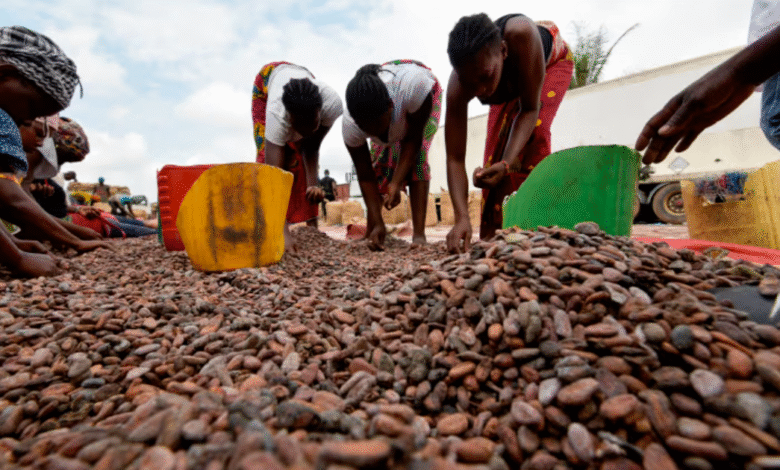
Cocoa futures fell sharply on Thursday, with New York cocoa dropping more than 3% and London cocoa nearly 3% as traders focused on improving near-term supplies, rising Ivory Coast production and elevated ICE inventories. The sell-off comes despite significant longer-term concerns over West African crop quality, Ghanaian production and potential El Niño-related supply disruptions.
December ICE NY Cocoa closed at 5,784, down 207 points, or 3.46%, while December ICE London Cocoa #7 closed at 4,240, down 125 points, or 2.86%.
Both markets fell to one-week lows.
Cocoa has been under pressure for approximately two weeks as evidence of stronger production in the Ivory Coast has reduced concerns over immediate supply availability.
The Ivory Coast cocoa regulator, Le Conseil du Café Cacao, reported that the country harvested approximately 2.06 MMT of cocoa between June 2025 and June 2026, up 30% from 1.58 MMT a year earlier.
More recent shipping data has also pointed toward substantial supply availability.
Bloomberg reported that cumulative Ivory Coast cocoa shipments reached 2.14 MMT during the international cocoa marketing year from October 1, 2025 through September 13, 2026, up 18% year-on-year.
However, the country’s own marketing calendar has shifted this year, creating an important statistical distinction.
Ivory Coast moved its marketing year start forward to September 1.
Reuters reported that deliveries under the new Ivory Coast marketing year totaled 26,000 MT between September 1 and September 13, down 45.8% from the comparable period of the previous season.
The market is therefore receiving conflicting signals depending on the reporting period used.
At the same time, ICE cocoa inventories have climbed sharply.
Stocks reached a two-year high of 3,436,742 bags on September 4 and remained close to that level at 3,429,167 bags on Thursday.
The combination of strong recent production, large export flows and elevated exchange inventories is weighing heavily on near-term prices.
However, the longer-term supply outlook remains considerably more uncertain.
Ghana is forecasting a smaller 2026/27 crop, while early assessments of the Ivory Coast main crop indicate poor pod development.
Weather conditions are also becoming an increasingly important risk factor.
The potential development of a strong El Niño could bring warmer and drier conditions to West Africa, potentially reducing cocoa yields.
The result is a market caught between adequate near-term supply and increasingly uncertain future production.
Cocoa Market Snapshot
| Factor | Current Signal |
|---|---|
| Dec 26 NY Cocoa | 5,784 |
| Daily move | -207 / -3.46% |
| Dec 26 London Cocoa #7 | 4,240 |
| Daily move | -125 / -2.86% |
| NY cocoa trend | 1-week low |
| London cocoa trend | 1-week low |
| Ivory Coast 2025/26 harvest | 2.06 MMT |
| Ivory Coast harvest YoY | +30% |
| Ivory Coast international-year shipments | 2.14 MMT |
| Ivory Coast shipments YoY | +18% |
| Ivory Coast Sep 1-13 deliveries | 26,000 MT |
| Sep deliveries YoY | -45.8% |
| ICE cocoa inventories | 3,429,167 bags |
| Recent inventory high | 3,436,742 bags |
| Ghana 2025/26 harvest | 750,000 MT |
| Ghana harvest YoY | +25.6% |
| Ghana 2026/27 crop estimate | 650,000 MT |
| Ghana crop estimate YoY | -13% |
| Ghana COCOBOD potential 2026/27 range | 450,000-550,000 MT |
| Ivory Coast early 2026/27 estimate | ~1.8 MMT |
| Ivory Coast early estimate YoY | -18% |
| StoneX 2026/27 global balance | +25,000 MT surplus |
| Transgraph 2026/27 global balance | +80,000 MT surplus |
| Q2 European grindings | 316,366 MT |
| European grindings YoY | -4.6% |
| Q2 North American grindings | 109,659 MT |
| North American grindings YoY | +7.7% |
| Q2 Asian grindings | 224,646 MT |
| Asian grindings YoY | +25% |
Why Are Cocoa Futures Falling Today?
The immediate reason for Thursday’s decline is the perception that near-term cocoa supplies are adequate.
Cocoa futures had rallied strongly in late August and early September, with New York cocoa reaching an 11.5-month high on August 31 and London cocoa reaching an 11.5-month high on September 1.
That rally was supported by concerns over West African crop quality and future production.
The subsequent improvement in supply data has caused traders to reassess that outlook.
Ivory Coast’s reported harvest of 2.06 MMT, representing a 30% increase from the previous year, has provided the market with evidence that current production is substantially stronger.
Export shipments have also remained high when measured against the international cocoa marketing year.
The result is a reduction in immediate supply anxiety.
With futures now falling, speculative and commercial traders are also reassessing positions established during the previous rally.
Ivory Coast Cocoa Production Is Driving the Near-Term Bearish Outlook
Ivory Coast is the world’s largest cocoa producer, making production and export data from the country particularly important for global prices.
The cocoa regulator reported 2.06 MMT harvested between June 2025 and June 2026, compared with 1.58 MMT a year earlier.
That represents an increase of approximately 30%.
Bloomberg’s international marketing-year data also showed shipments of 2.14 MMT, up 18% year-on-year.
Taken together, those figures provide a strong near-term supply signal.
However, there is an important complication.
Ivory Coast has changed its own marketing year this season, moving the start date to September 1 rather than the international October 1 starting point.
Reuters’ figures based on the new local marketing year showed only 26,000 MT of deliveries from September 1-13, down 45.8% from the comparable previous-season period.
This means traders need to be careful when comparing the two datasets.
The international-year shipment data remains strong, while the new local marketing-year data shows a substantial early-season decline.
ICE Cocoa Inventories Reach a Two-Year High
Exchange inventories are providing another bearish signal.
ICE cocoa stocks climbed to 3,436,742 bags on September 4, the highest level in two years.
Stocks remained elevated at 3,429,167 bags on Thursday.
Rising exchange inventories indicate that cocoa availability for delivery against futures contracts has increased substantially.
That is particularly important following the sharp price rally seen during late August and early September.
If inventories remain elevated or continue rising, traders may have less incentive to price in an immediate physical shortage.
However, inventory levels alone do not determine the longer-term supply outlook.
The condition of the upcoming West African crops remains a significant variable.
Global Cocoa Market Is Well Supplied for Now
Barry Callebaut, the world’s largest cocoa processor, said earlier this month that the global cocoa market is currently well supplied.
The company also indicated that the market is better prepared to manage supply risks than it was during the 2023/24 El Niño event, when cocoa prices reached record highs.
That assessment supports the current bearish pressure.
If processors have adequate stocks and physical supplies remain available, immediate demand for additional cocoa becomes less urgent.
However, the current situation could change if the next major West African crops disappoint.
That is where the longer-term supply outlook becomes increasingly important.
Ghana Cocoa Production Faces a Major Decline
Ghana is the world’s second-largest cocoa producer and represents one of the most important sources of global supply.
The country’s Cocoa Board estimated that the 2026/27 crop could reach approximately 650,000 MT, down 13% from the 750,000 MT produced in 2025/26.
COCOBOD has provided an even wider and more bearish production range.
It projected that 2026/27 production could fall to between 450,000 and 550,000 MT.
The potential decline has been attributed to swollen shoot disease, aging cocoa farms and adverse weather risks.
If production falls toward the lower end of that range, the global balance could tighten significantly.
However, the current marketing year has been considerably stronger.
Ghana reported 750,000 MT harvested for 2025/26, up 25.6% from 597,000 MT in 2024/25.
This helps explain why near-term supply remains adequate despite concerns over the next crop.
Ivory Coast’s Next Crop Could Be Much Smaller
While current Ivory Coast production is strong, early assessments of the next main crop are considerably less encouraging.
Early surveys indicate below-average cherelle formation, a development that can signal weaker pod production later in the crop cycle.
Initial estimates put the 2026/27 Ivory Coast crop at approximately 1.8 MMT, around 18% below the roughly 2.2 MMT produced in 2025/26.
This creates one of the most important contradictions in the cocoa market.
Current production is strong, but early indicators for the next crop are weak.
That distinction could become increasingly important as traders shift their attention away from current inventories and toward the next harvest.
West African Weather Remains a Major Cocoa Risk
Weather remains one of the largest uncertainties facing the cocoa market.
The potential development of a strong El Niño pattern could bring warmer and drier conditions to West Africa.
For cocoa trees, reduced rainfall can lower soil moisture and increase stress, potentially reducing yields.
The US Climate Prediction Center said in July that the El Niño pattern emerging across the equatorial Pacific could become one of the strongest in more than 75 years.
If the weather pattern produces prolonged dryness across the Ivory Coast and Ghana, the impact could become visible in future crop estimates.
That would potentially shift the market’s focus away from current supply availability and toward future production risk.
Cocoa Crop Quality Is Becoming More Important
The quantity of cocoa available is only one part of the market equation.
Quality is also becoming increasingly important.
Cloudy conditions and limited sunshine in the Ivory Coast and Ghana have created conditions that can encourage the spread of black pod disease.
Black pod can damage cocoa beans and reduce crop quality.
This is one reason cocoa prices were able to rally sharply despite improving production figures.
If quality deterioration becomes widespread, processors may need to pay premiums for suitable beans even when total production remains relatively strong.
Cocoa Demand Is Sending Mixed Signals
Demand data is also divided geographically.
European cocoa grindings fell 4.6% year-on-year in Q2 to 316,366 MT, according to the European Cocoa Association.
The decline was larger than the expected 1.5% fall and represented the weakest Q2 grinding level in six years.
That is a significant bearish demand signal.
However, North American demand moved in the opposite direction.
The National Confectioners Association reported Q2 North American cocoa grindings of 109,659 MT, up 7.7% year-on-year.
Asian demand was even stronger.
The Cocoa Association of Asia reported Q2 grindings of 224,646 MT, an increase of 25% year-on-year.
The global demand picture is therefore far from uniform.
European demand is weakening, while North American and Asian grinding activity has strengthened.
Bullish Sentiment
1. Ghana’s 2026/27 Crop Could Fall Sharply
Ghana’s Cocoa Board estimates production at 650,000 MT, down 13%, while COCOBOD has warned that output could potentially fall as low as 450,000-550,000 MT.
2. Ivory Coast’s Next Crop Looks Weaker
Early assessments point toward an approximately 1.8 MMT 2026/27 Ivory Coast crop, around 18% below the previous season.
3. West African Crop Quality Is a Concern
Cloudy weather, limited sunshine and black pod disease could reduce cocoa quality in the Ivory Coast and Ghana.
4. El Niño Could Damage Future Production
A strong El Niño could produce warmer and drier conditions across major West African cocoa-producing regions.
5. Global Surplus Forecasts Are Shrinking
StoneX has reduced its 2026/27 global surplus forecast to just 25,000 MT, down from 149,000 MT previously.
6. Asian Cocoa Demand Is Strong
Asian Q2 grindings increased 25% year-on-year to 224,646 MT, substantially exceeding expectations.
7. North American Grindings Increased
North American Q2 cocoa grindings rose 7.7%, contradicting concerns about a broad collapse in global demand.
Bearish Sentiment
1. Ivory Coast Current Production Is Much Higher
The Ivory Coast reported 2.06 MMT harvested, up 30% year-on-year.
2. Ivory Coast Shipments Are Strong
International marketing-year shipments reached 2.14 MMT, up 18% year-on-year.
3. ICE Inventories Are Near a Two-Year High
ICE stocks remain at 3,429,167 bags, close to the two-year high recorded earlier this month.
4. Physical Supply Is Currently Considered Adequate
Barry Callebaut has described the global cocoa market as well supplied.
5. Ghana’s Current Crop Is Strong
Ghana harvested approximately 750,000 MT in 2025/26, up 25.6% year-on-year.
6. European Cocoa Demand Is Weak
European Q2 grindings fell 4.6%, reaching the lowest Q2 level in six years.
7. Heavy Supply Is Pressuring Futures
NY cocoa fell 3.46% and London cocoa declined 2.86% on Thursday as traders reacted to improving near-term supply conditions.
The Cocoa Market Has Two Completely Different Supply Stories
The most important feature of the current cocoa market is the difference between current supply and future supply.
Current supply is relatively comfortable.
Ivory Coast production is higher.
International shipments are strong.
ICE inventories are elevated.
Barry Callebaut says the market is well supplied.
But future supply is considerably less certain.
Ghana’s next crop is expected to decline.
Early Ivory Coast crop indicators are weak.
Crop quality remains vulnerable to disease.
And El Niño could create additional weather stress.
This means the market is not simply bullish or bearish.
Instead, traders are weighing comfortable near-term availability against potentially tighter future production.
The Market Is Watching the Transition From Old Crop to New Crop
The next phase of cocoa trading will increasingly depend on the transition between the current and upcoming crops.
The current production figures have helped push prices lower because they demonstrate that physical cocoa is available.
However, traders will eventually need to price the next crop.
If early production indicators deteriorate further, the current inventory surplus could prove temporary.
Conversely, if the next crop performs better than currently expected, the market could remain well supplied for longer.
This makes upcoming crop surveys, weather patterns and West African arrivals particularly important.
Cocoa Prices Are Also Vulnerable to Positioning
The recent rally to an 11.5-month high in New York and London created substantial room for profit-taking.
Once prices began falling, the market’s attention shifted toward the strong current supply data.
The result has been a sharp reversal.
Thursday’s decline of more than 3% in New York demonstrates how quickly sentiment can change when a heavily watched commodity moves from supply concerns toward evidence of adequate availability.
Further declines could occur if inventories continue rising and West African shipments remain strong.
However, any deterioration in the next crop could quickly restore supply concerns.
What Traders Are Watching Next
The major cocoa-market catalysts include:
- Ivory Coast cocoa arrivals
- Ivory Coast crop assessments
- Ghana cocoa production
- Ghana COCOBOD forecasts
- West African cocoa quality
- Black pod disease
- Cherelle formation
- ICE cocoa inventories
- Global cocoa grindings
- European cocoa demand
- North American cocoa demand
- Asian cocoa demand
- El Niño developments
- West African rainfall
- Brazilian cocoa production
- Global cocoa balance forecasts
- StoneX supply estimates
- Transgraph global balance estimates
- Barry Callebaut processing commentary
The most important near-term question is whether rising inventories and strong Ivory Coast production continue to outweigh concerns over the next West African crop.
Currency Hedger View
Cocoa is traded internationally in US dollars, creating currency exposure for processors, manufacturers, exporters and international buyers.
For a European, Asian or other non-US cocoa buyer, movements in the US dollar can materially change the effective cost of cocoa even when futures prices remain unchanged.
A weaker domestic currency against the dollar can increase the local-currency cost of imported cocoa.
Conversely, currency appreciation can reduce the effective cost of dollar-denominated purchases.
This creates a combined exposure:
Cocoa price risk + USD exchange-rate risk.
For cocoa processors, confectionery manufacturers and international commodity businesses, managing the currency component can therefore be an important part of controlling overall input costs and protecting margins.
Currency Hedger, part of Octalas Group Ltd, focuses on foreign-exchange exposure and currency-risk management for businesses operating across international markets.
Today Markets View
Cocoa futures are under significant short-term pressure as the market responds to adequate current supplies, stronger Ivory Coast production and elevated ICE inventories.
The 3.46% decline in New York cocoa and 2.86% fall in London cocoa demonstrate how quickly the market has shifted from the supply concerns that drove the late-August rally.
However, the longer-term outlook remains considerably less straightforward.
Ghana’s next crop is expected to decline, early Ivory Coast assessments point toward lower production, crop quality remains vulnerable to disease and El Niño could create additional weather stress across West Africa.
Demand is also mixed, with European grindings falling while North American and Asian grinding activity increases.
The key question is therefore whether comfortable current inventories can persist long enough to offset the potential deterioration in future West African production.
For now, near-term supply is dominating price action.
But the cocoa market remains highly sensitive to West African weather and crop-development data, meaning the current bearish momentum could be challenged if evidence emerges that the next crop is materially smaller than expected.
“Cocoa has moved rapidly from supply anxiety toward near-term supply comfort. Strong Ivory Coast production and elevated ICE inventories are currently dominating the market, but the next crop presents a very different picture. Ghana and Ivory Coast production risks, crop quality and El Niño remain critical variables that could determine whether today’s surplus conditions persist.”
— Louis Roche, Analyst, Today Markets