S&P 500 — US Large Cap Index
 FTSE 100 — UK Blue Chips
 Euro Stoxx 50 — Eurozone Leaders
 DAX 40 — German Equities
 CAC 40 — French Market Index
 Nikkei 225 — Japan Benchmark
 Hang Seng — Hong Kong Index
 Shanghai Composite — China Mainland
 ASX 200 — Australian Market
 TSX Composite — Canada Index
 Nifty 50 — India Large Cap
 STI Index — Singapore Market
 KOSPI — South Korea Index
 Bovespa — Brazil Equities
 JSE Top 40 — South Africa Index
 IPC Index — Mexico Market
March ICE NY cocoa (CCH26) on Monday closed down -403 (-6.42%), and March ICE London cocoa #7 (CAH26) closed down -321 (-7.05%).
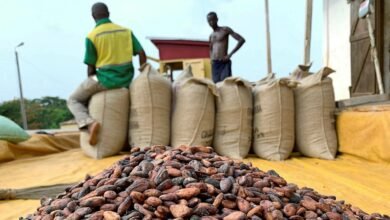
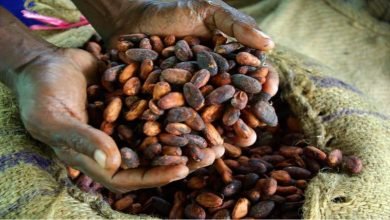
Cocoa prices sank on Monday as rains in West Africa and a delay in the seasonal Harmattan winds have benefitted cocoa crops, sparking long liquidation in cocoa futures. Cocoa farmers in the Ivory Coast and Ghana are reporting a well-balanced mix of rain and sunshine that is supporting cocoa pod development.
Increased cocoa arrivals at ports in the Ivory Coast are also negative for cocoa prices. Monday’s government data showed that Ivory Coast farmers shipped 895,544 MT of cocoa to ports this new marketing year, from October 1 through December 14, up +0.2% from 894,009 MT in the same period a year ago. The Ivory Coast is the world’s largest cocoa producer.
Cocoa prices have recently rallied sharply, hitting 5-week highs last Thursday, amid a tightening global supply outlook. On November 28, the International Cocoa Organization (ICCO) cut its global 2024/25 cocoa surplus estimate to 49,000 MT from a previous estimate of 142,000 MT. It also lowered its global cocoa production estimate for 2024/25 to 4.69 MMT from 4.84 MMT previously. In addition, Rabobank on Tuesday cut its 2025/26 global cocoa surplus estimate to 250,000 MT from a November forecast of 328,000 MT.
Shrinking ICE cocoa inventories are also supportive of cocoa prices. ICE-monitored cocoa inventories held in US ports fell to a 9-month low of 1,655,457 bags on Monday.
Cocoa futures also have support, as NY cocoa will be included in the Bloomberg Commodity Index (BCOM) starting in January, which could spark buying by passive commodity funds that track the index. According to Citigroup, the inclusion of NY cocoa futures in the BCOM may lure as much as $2 billion of buying of NY cocoa futures into the first week of January.
The outlook for ample global cocoa supplies has weighed on prices. On November 19, cocoa prices tumbled to 1.75-year nearest-future lows on expectations of a bumper cocoa crop in West Africa. Reports from cocoa farmers in the Ivory Coast stated that cocoa trees are doing well, and recent dry weather helped the harvested beans dry. Also, cocoa farmers in Ghana said favorable weather is allowing cocoa pods to develop quickly.
Chocolate maker Mondelez recently said that the latest cocoa pod count in West Africa is 7% above the five-year average and “materially higher” than last year’s crop. The harvest of the Ivory Coast’s main crop has just begun, and farmers are optimistic about its quality.
Cocoa prices were undercut after the European Parliament on November 26 approved a 1-year delay to the deforestation law, keeping cocoa supplies ample. The EU regulation, known as EUDR, aims to tackle deforestation in countries whose imports into the EU include key commodities such as soybeans and cocoa. The delay of the EUDR will allow EU countries to continue importing agricultural products from regions in Africa, Indonesia, and South America where deforestation is occurring.
On November 14, cocoa prices were undercut after the Trump administration announced it had dropped the 10% reciprocal tariffs on commodities not grown in the US, including cocoa, and the 40% tariff on food imports from Brazil. Brazil is among the world’s top 10 cocoa-producing countries.
Weak global cocoa demand is bearish for prices. On October 30, the CEO of chocolate-maker Hershey said chocolate sales this Halloween season were “disappointing.” Halloween made up nearly 18% of annual US candy sales in 2024, second only to Christmas. Meanwhile, the Cocoa Association of Asia on October 17 reported that Q3 Asia cocoa grindings fell by -17% y/y to 183,413, the smallest grindings for a Q3 in 9 years. The European Cocoa Association on October 16 reported that Q3 European cocoa grindings fell -4.8% y/y to 337,353 MT, the lowest for a third quarter in 10 years. The National Confectioners Association reported that Q3 North American cocoa grindings rose +3.2% y/y to 112,784 MT, but the addition of new reporting companies skewed the data. In related news, North American sales volume of chocolate candy was down more than -21% in the 13 weeks ending September 7, compared to the same period last year, according to data from research firm Circana.
A supportive factor for cocoa is lower cocoa production in Nigeria, the world’s fifth-largest cocoa producer. Nigeria’s Cocoa Association projects that Nigeria’s 2025/26 cocoa production will fall by -11% y/y to 305,000 MT from a projected 344,000 MT for the 2024/25 crop year. In related news, Nigeria reported that its September cocoa exports were unchanged y/y at 14,511 MT.
On May 30, the International Cocoa Organization (ICCO) revised its 2023/24 global cocoa deficit to -494,000 MT, the largest deficit in over 60 years. ICCO said 2023/24 cocoa production fell by -12.9% y/y to 4.368 MMT. ICCO stated that the 2023/24 global cocoa stocks-to-grindings ratio declined to a 46-year low of 27.0%. On Friday, the ICCO estimated a 2024/25 global cocoa surplus of 49,000 MT, marking the first surplus in four years. ICCO also said global cocoa production in 2024/25 rose by +7.4% y/y to 4.69 MMT.