S&P 500 — US Large Cap Index
 FTSE 100 — UK Blue Chips
 Euro Stoxx 50 — Eurozone Leaders
 DAX 40 — German Equities
 CAC 40 — French Market Index
 Nikkei 225 — Japan Benchmark
 Hang Seng — Hong Kong Index
 Shanghai Composite — China Mainland
 ASX 200 — Australian Market
 TSX Composite — Canada Index
 Nifty 50 — India Large Cap
 STI Index — Singapore Market
 KOSPI — South Korea Index
 Bovespa — Brazil Equities
 JSE Top 40 — South Africa Index
 IPC Index — Mexico Market
Could BTC join Gold as a global hedge against US Dollar and yield decline?

As the US dollar teeters on long-term support, yields flash warnings, and USD/JPY unravels, bitcoin’s structure points to a reversal—and a potential role alongside gold as a global safe-haven asset.
Bitcoin and Gold: The new twin pillars of safety?
A profound shift may be underway in how investors, institutions, and even governments perceive Bitcoin. Traditionally viewed as a high-beta, speculative asset, Bitcoin is now displaying characteristics of a safe-haven, particularly as macroeconomic cracks widen across currencies and sovereign bonds. The timing of this shift aligns with a historic divergence in key legacy instruments—including the USD/JPY, US Dollar Index (DXY), and the 10-year Treasury yield.
Most notably, Bitcoin’s price structure has begun to mimic the strategic behaviour of Gold—establishing support in times of uncertainty and attracting institutional flows amid fiscal and monetary instability. This raises a crucial question: Is Bitcoin on the verge of joining gold as a global safe-haven asset?
Bitcoin futures technical outlook: Falling wedge with macro fuel
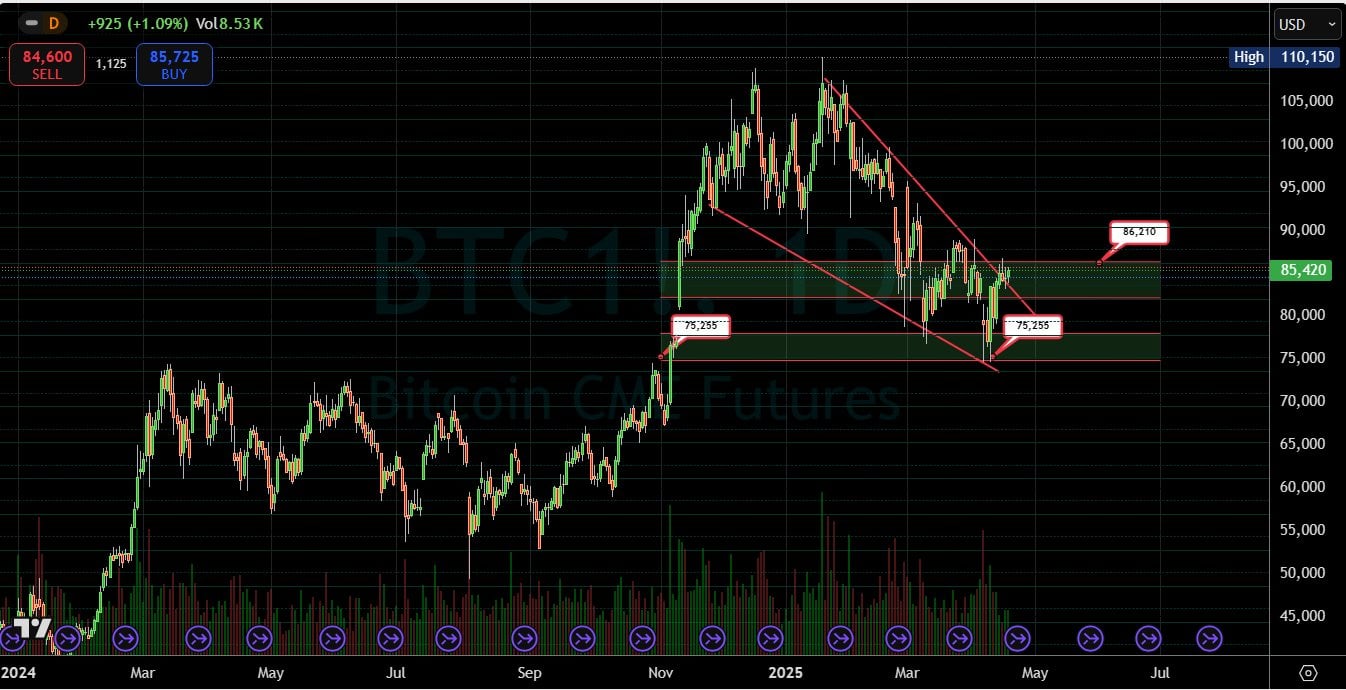
Bitcoin futures have retraced sharply from the January 2025 high of $110,150, establishing a double-bottom support zone at $75,255. This level has been tested twice, forming the base of a falling wedge pattern—a historically bullish formation that often leads to explosive trend reversals.
At the time of writing, BTC trades at $85,725, just below the critical resistance of $86,210. A confirmed breakout above this level could trigger a reversal to the upside, with targets at $94,580 and $102,950 and eventually a retest of the yearly high.
This technical setup is not occurring in isolation—it coincides with widespread fragility in the fiat financial system, prompting institutional investors to reconsider their allocation frameworks.
USD/JPY breakdown: Yen resurgence signals a macro shift
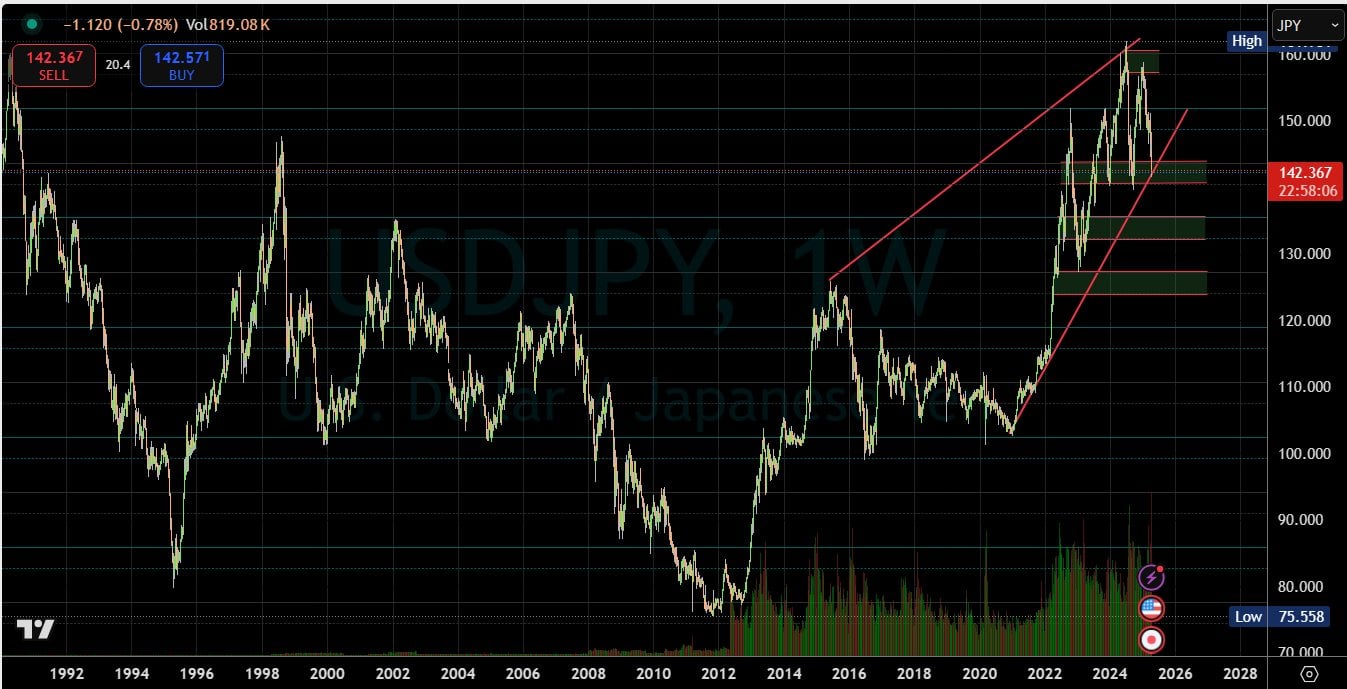
USD/JPY has declined nearly 10% since its January 2025 peak of 157 and now hovers above the critical 140 level. More importantly, the pair is testing the base of a decade-long rising wedge—a formation that, if broken, suggests a long-term reversal of trend.
The failure to reclaim 148.83—a key support turned resistance—has accelerated concerns. Should 140 be lost, downside targets emerge at 135, 132, and 127, echoing the dollar correction of 2016–2017.
Macro drivers intensify this risk:
- A hawkish pivot by the Bank of Japan
- Waning confidence in the USD as a funding currency
- A sharp drop in carry trade appeal as US yields decline
This weakness in the USD/JPY strengthens the case for non-fiat safe havens like Gold—and now, increasingly, Bitcoin.
DXY struggles at mid-cycle: Capital flow rotation underway
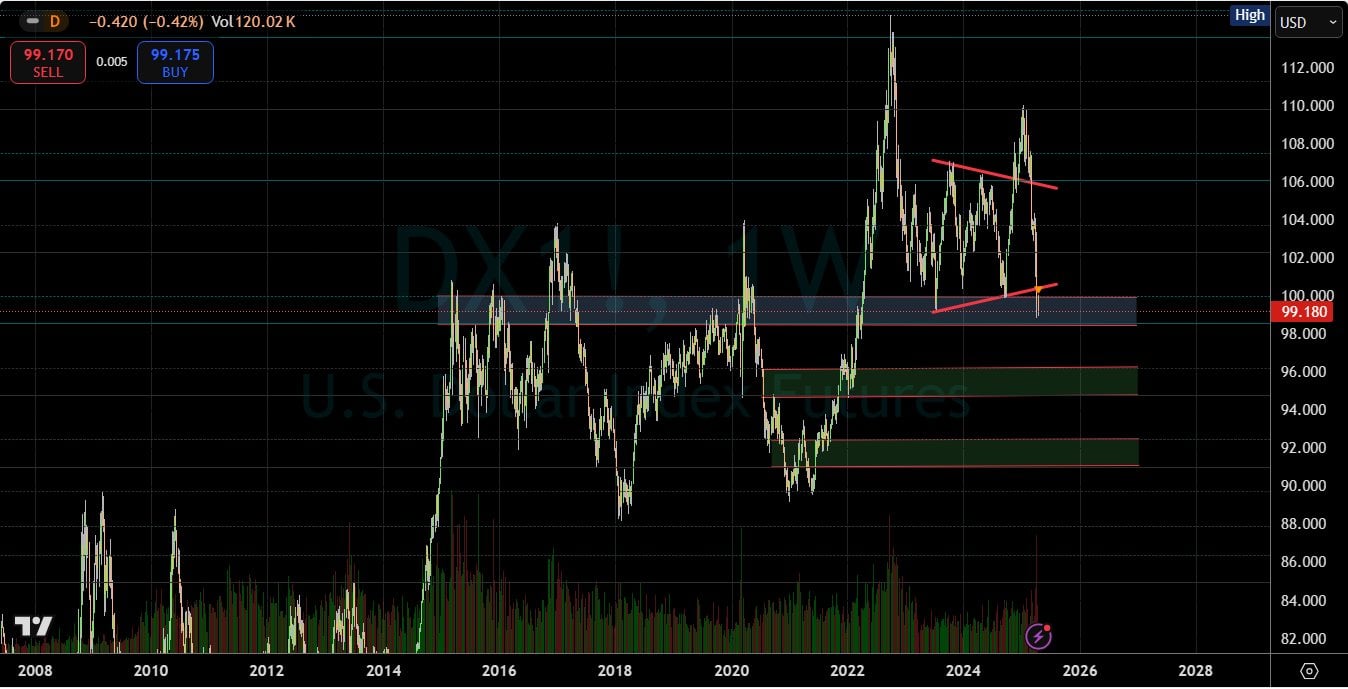
The US Dollar Index (DXY) is sitting at a generational pivot zone around the 100 level, a midpoint in its 10-year price cycle. It has failed to reclaim this level decisively, and macro headwinds continue to build:
- The re-escalation of tariff wars by the US administration, alienating global partners.
- Increasing capital outflows to the yen, gold, and emerging crypto ETFs.
- The risk of a flattening or inverted yield curve dragging confidence in USD-denominated debt.
A break below 98-52 could accelerate the move toward 96.20, 94.76, and 92.44, historically associated with market stress and recessionary periods.
As the Dollar’s reputation as the world’s safe haven erodes, Bitcoin—particularly in its regulated, ETF-wrapped form—is gaining favour as a neutral store of value.
10-year Treasury yield: Final move before collapse?
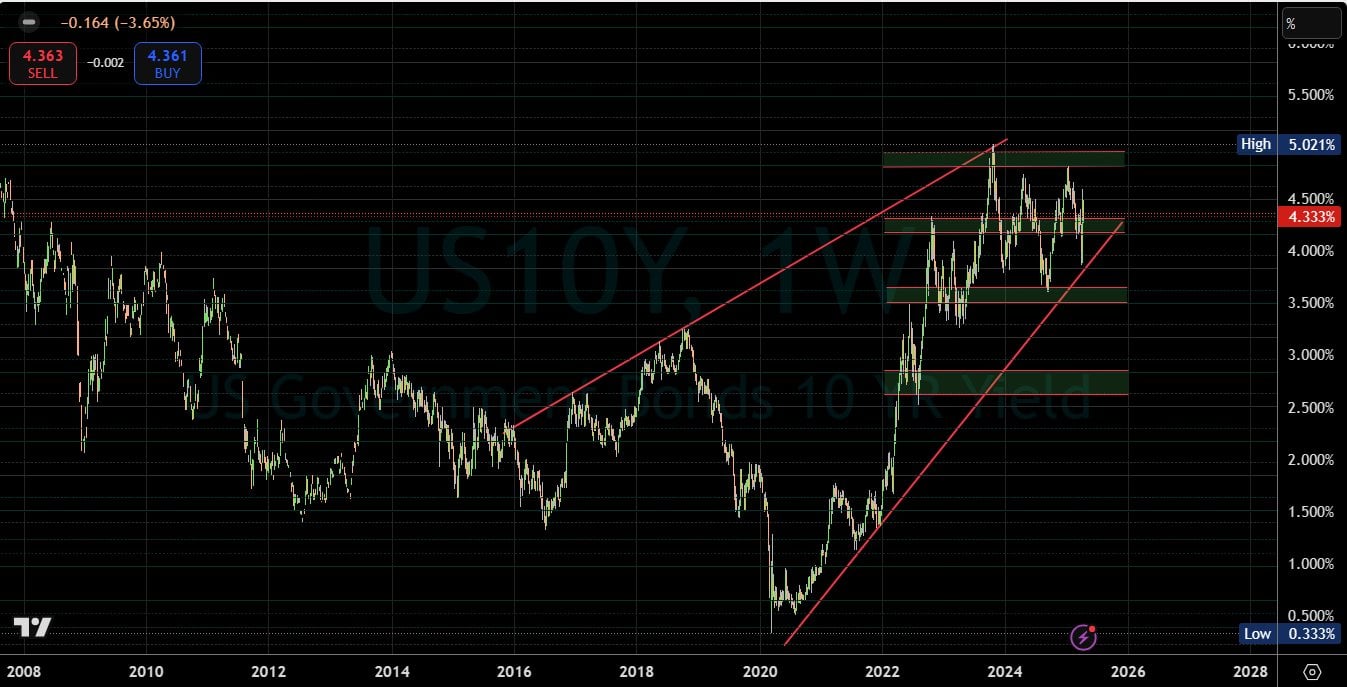
The 10-year US Treasury yield, once the benchmark of global confidence, is now exhibiting signs of a macro top. Since its 2020 low of 0.333%, it surged to 5.00% in October 2023, marking the end of the 40-year bond bull market. It now trades around 4.20%—a key Fibonacci confluence zone and the March 2025 breakout retest area.
A breakdown below 3.95%–3.82% could trigger a cascade to:
- 3.30%
- 3.16%
- 2.85% and 2.63%
This would imply disinflation, economic contraction, or systemic bond market stress.
The consequence? Institutional investors are diversifying out of bonds—once considered the safest asset class—and looking for alternative long-duration stores of value.
Gold has always been the traditional hedge. But now, with bitcoin’s price stabilizing and institutional credibility growing, it’s being seriously considered as a digital parallel to gold.
Institutional rotation: The rise of bitcoin ETFs and safe-haven utility
Several recent developments support the view that bitcoin is evolving into a macro hedge:
- BlackRock, Fidelity, Franklin Templeton, and others have launched US-regulated bitcoin spot ETFs, marking a major milestone in institutional validation.
- MicroStrategy added 6,911 BTC to its balance sheet in March 2025, increasing total holdings to over 214,000 BTC—an institutional vote of confidence.
- Global de-dollarization trends are accelerating. Central banks are accumulating gold, while sovereign wealth funds and hedge funds are experimenting with BTC allocations as fiat uncertainty grows.
There is a noticeable behavioural shift in how public and private entities are positioning around bitcoin—as a hedge, a reserve diversification play, and a long-term insurance policy against fiat failure.
Conclusion: Bitcoin and Gold— Digital and physical reserves in a changing world
Gold and bitcoin are increasingly being viewed not as competitors but as complementary tools in future portfolio construction.
As legacy systems show signs of strain:
- USD/JPY is breaking long-term support
- DXY is teetering at cycle lows
- 10YR yields are rolling over structurally
Bitcoin is diverging upward, carving a path that suggests more than just a short-term trade. The price structure, macro alignment, and institutional behaviour are signalling a fundamental transformation.
In the next five years, we may not just see bitcoin as a digital asset—but as a strategic safe-haven asset class alongside gold—a modern counterpart to the oldest reserve in history.