S&P 500 — US Large Cap Index
 FTSE 100 — UK Blue Chips
 Euro Stoxx 50 — Eurozone Leaders
 DAX 40 — German Equities
 CAC 40 — French Market Index
 Nikkei 225 — Japan Benchmark
 Hang Seng — Hong Kong Index
 Shanghai Composite — China Mainland
 ASX 200 — Australian Market
 TSX Composite — Canada Index
 Nifty 50 — India Large Cap
 STI Index — Singapore Market
 KOSPI — South Korea Index
 Bovespa — Brazil Equities
 JSE Top 40 — South Africa Index
 IPC Index — Mexico Market
- EUR/USD climbs to near 1.1400 as the US Dollar faces an intense sell-off amid an escalating US-China trade war.
- US consumer sentiment has deteriorated, and one-year forward inflation expectations have accelerated in April.
- The ECB is expected to cut interest rates on Thursday.
EUR/USD jumps to near 1.1400 in Monday’s European session. The major currency pair aims to reclaim the over-three-year high of 1.1474, which it posted on Friday. The pair demonstrates sheer strength as the US Dollar (USD) continues to dive amid growing fears of United States (US) stagflation, a situation in which inflation increases, the economy deteriorates, and employment cools down.
The US Dollar Index (DXY), which gauges the Greenback’s value against six major currencies, sees more downside below the recent lows of 99.00.
Financial market participants are anticipating US stagflation amid deteriorating consumer sentiment and de-anchoring consumer inflation expectations. The University of Michigan (UoM) showed on Friday that the preliminary Consumer Sentiment Index came in significantly lower at 50.8 in April, the lowest level seen since June 2022. US households are worried about the deepening risks of a recession due to the escalating tariff war with China.
On Friday, China raised counter-tariffs on US goods imports to 125%, effective on Saturday. The Asian giant retaliated after US President Donald Trump increased tariffs on Chinese imports to 145%. Market participants expect the scenario of retaliation and countermeasures by both nations to hinder plans of fresh investments by business owners, which eventually would result in moderate economic growth.
Meanwhile, flash 12-month forward UoM Consumer Inflation Expectations accelerated to 6.7% in April from 5% in March. Declining consumer sentiment and soaring consumer inflation expectations are expected to dampen the Federal Reserve’s (Fed) efforts to bring price pressures down in the last few years.
On Friday, St. Louis Fed Bank President Alberto Musalem said that if the public begins to expect “inflation will remain high over the long term”, the job of restoring “price stability and maximum employment would be much more difficult”.
Daily digest market movers: EUR/USD strengthens at the start of ECB monetary policy week
- EUR/USD edges higher as the Euro (EUR) shows strength at the start of monetary policy week. The European Central Bank (ECB) is scheduled to announce its interest rate decision on Thursday, and it is expected to cut its Deposit Facility Rate by 25 basis points (bps) to 2.25%. This would be the seventh 25 bps interest rate reduction by the ECB since June.
- Traders have become increasingly confident that the ECB will cut interest rates again amid expectations that the Trump-driven trade war will not be inflationary for the Eurozone. Investors expect that the escalating tariff war between the US and China would force the latter to export its products to the old continent. Eurozone importers would prefer Chinese products over domestically produced goods, given China’s low-cost competitive advantage. Such a scenario would offset the impact of Trump’s tariff-led inflation.
- Last week, ECB Governing Council member Gediminas Šimkus said that a “25 bps rate cut is needed in April.” Šimkus added that the US tariff announcement warrants “more accommodative” monetary policy, and therefore, we need to move to a “less restrictive policy stance”.
- On trade relations with the US, European Union (EU) finance ministers have pledged unity in negotiating a trade deal with Washington. The unified response from the Euro area would slightly improve their position while discussing trade talks with the White House.
Technical Analysis: EUR/USD climbs to near 1.1400
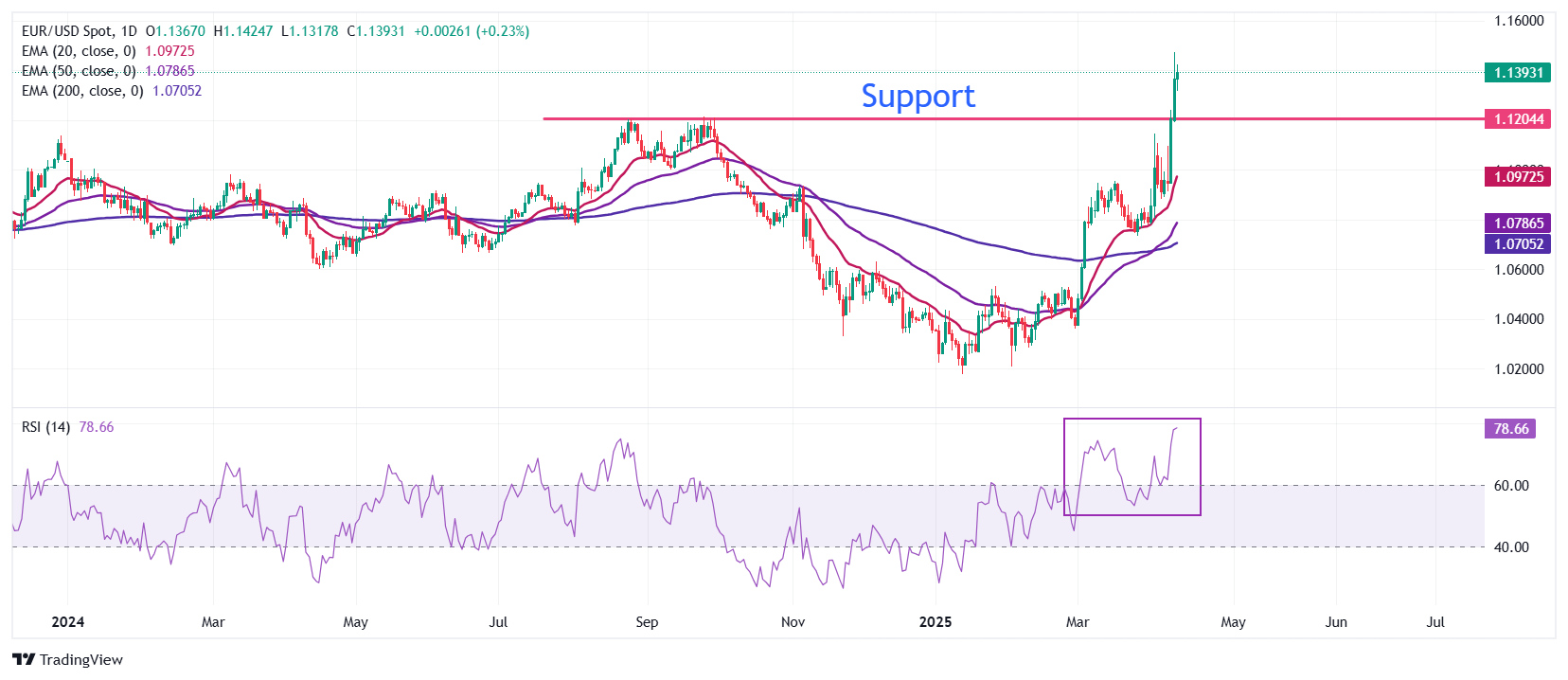
EUR/USD rises to near 1.1400 during European trading hours on Monday. The major currency pair trades firmly as all short-to-long Exponential Moving Averages (EMAs) slope higher, suggesting a strong uptrend.
The 14-day Relative Strength Index (RSI) jumps to near 80.00, indicating a strong bullish momentum.
Looking up, the psychological resistance of 1.1500 will be the major resistance for the pair. Conversely, the 1.1200 region, which limited the EUR/USD advance in August and September, will be the key support for the Euro bulls.