S&P 500 — US Large Cap Index
 FTSE 100 — UK Blue Chips
 Euro Stoxx 50 — Eurozone Leaders
 DAX 40 — German Equities
 CAC 40 — French Market Index
 Nikkei 225 — Japan Benchmark
 Hang Seng — Hong Kong Index
 Shanghai Composite — China Mainland
 ASX 200 — Australian Market
 TSX Composite — Canada Index
 Nifty 50 — India Large Cap
 STI Index — Singapore Market
 KOSPI — South Korea Index
 Bovespa — Brazil Equities
 JSE Top 40 — South Africa Index
 IPC Index — Mexico Market
Google and Amazon Are “Drowning” in Debt. The AI Race Is Drastically Eroding Free Cash Flow


The global artificial intelligence (AI) ecosystem has entered the most capital-intensive phase in its history. On Thursday, Bloomberg reported that Alphabet is aiming to raise as much as $25 billion from its latest bond issue on the US market. The regulatory filing indicates that the tech giant is offering debt securities in as many as 10 tranches, with maturities ranging from 2 to 40 years, with the aim of attracting a broad spectrum of investors – from short-term funds to long-term pension funds. This aggressive expansion in the debt market comes just a few weeks after Alphabet raised its annual capital expenditure (CAPEX) forecasts for the second time this year. The surge in spending triggered a sell-off in shares, fuelling investors’ concerns about the pace of return on investment in AI, particularly in the face of growing unease over delays to the company’s flagship AI model. The situation was exacerbated by the fact that, in its results for the second quarter of 2026, Alphabet reported the company’s first-ever negative free cash flow (FCF) of minus $5.85 billion, whilst capital expenditure alone during that period amounted to an astronomical $44.9 billion. As a result, Alphabet is currently financing almost all of its capital expenditure (CAPEX) through debt. The market’s reaction to these fundamental changes in the capital structure is clear – Google’s shares are down by more than 1 per cent ahead of today’s opening, reflecting growing scepticism about the ‘spend now, earn later’ strategy.
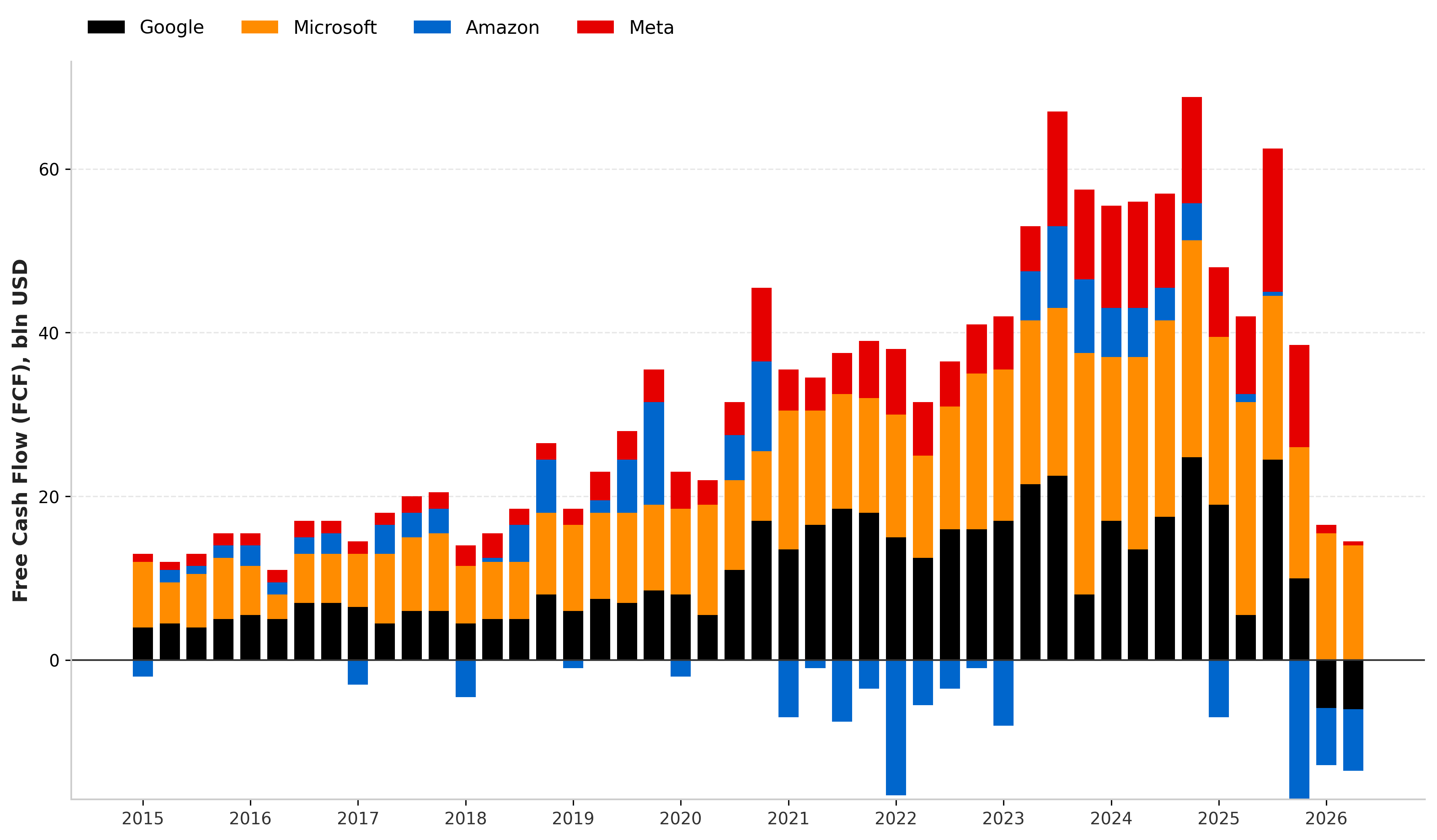
Source: XTB, Visible Alpha
The Spiral of Capital Expenditure and Massive Debt Issuance
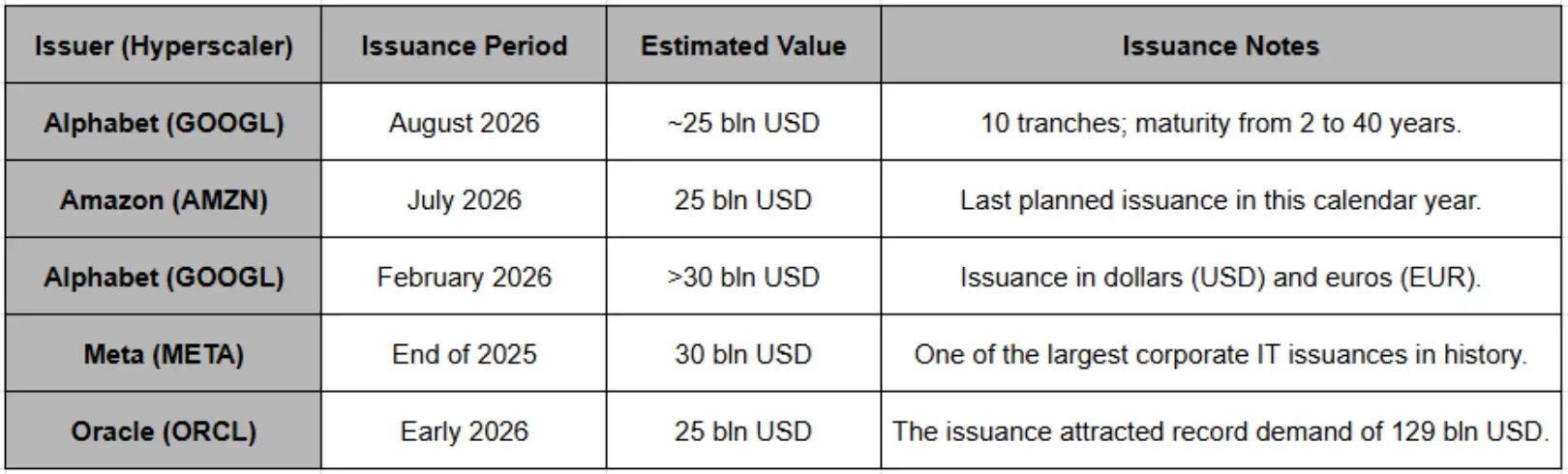
It is estimated that the tech giants (Big Tech) will spend a total of over 730 billion dollars this year, focusing mainly on artificial intelligence infrastructure. Such massive demand for capital is forcing a drastic change in financing models, transforming technology companies from entities generating huge cash surpluses into massive debt issuers. Exactly one month ago (in July 2026), Amazon raised $25 billion on the bond market, deliberately using these funds to finance over $200 billion of capital expenditure planned for this year, mainly for the development of AWS data centres and custom integrated circuits. Amazon has clearly indicated to insurers that this tranche will satisfy its borrowing requirements until the end of this year. For Alphabet, on the other hand, today’s bond issue is merely the latest step in an unprecedented series of debt-raising measures. It is worth recalling that Alphabet had already raised over $30 billion in debt in February and $25 billion in November last year. At the same time, Meta Platforms completed a $30 billion bond issue, whilst Oracle issued bonds worth $25 billion.
Market Fatigue and Widening Credit Spreads
Despite initial optimism, the debt market is beginning to show signs of so-called ‘debt fatigue’. Coverage ratios for hyperscaler bonds – which indicate how many dollars investors have pledged for every dollar of debt issued – have fallen sharply from nearly 5 times in February 2026 to below 2 times in July. For example, Amazon’s March bond issue was 3.4 times oversubscribed, whilst the one a month ago generated demand just 1.6 times higher than the amount on offer. This cooling of investor sentiment is reflected in widening credit spreads and rising risk costs. As the tech giants flood the markets with new debt, investors are demanding a higher term premium for holding long-term assets linked to AI development. The costs of CDSs (Credit Default Swaps) – derivatives that hedge against the default of issuers such as Amazon, Meta, Alphabet and Oracle – have soared to record levels. Oracle’s CDS spread reached a local high of over 196 basis points following a negative outlook revision by rating agencies (including a downgrade by S&P to BBB-). Moody’s warned that Oracle’s leverage could temporarily approach 5x due to negative cash flows from operating activities, exacerbated by the burden of leases and CAPEX. This turn of events was accurately predicted in the recent OECD Global Debt Report 2026, which warns of an unprecedented volume of global borrowing set to reach $29 trillion in 2026. The report points out that the nine major players in the AI sector plan to raise a total of $1.2 trillion in debt between 2026 and 2030, which necessitates the use of complex off-balance-sheet instruments and special purpose vehicles (SPVs) to cushion the burden.
Accounting Controversies and Component Inflation
At the same time, concerns are being raised about the quality of the accounting for this capital. Well-known investor Michael Burry (famous for predicting the subprime crisis before 2008) has published a widely discussed thesis on ‘creative accounting’ in the Big Tech sector. Burry points out that hyperscalers are artificially inflating their profits by extending the estimated ‘useful life’ of graphics processing units (GPUs) and servers to 5–6 years. Given that the physical and technological life cycle of Nvidia’s chips (such as the transition from the Hopper architecture to Blackwell, and then immediately to Rubin) is in reality between 2 and 3 years, the companies are grossly underestimating their annual depreciation costs. According to Burry’s calculations, this accounting manoeuvre could artificially inflate the industry’s profits by $176 billion by 2028 (including in the balance sheets of Oracle and Meta). The situation is exacerbated by structural inflation in component costs. The rapid development of AI infrastructure has drastically reduced the supply of conventional DRAM, as manufacturers such as SK Hynix, Samsung and Micron have redirected the lion’s share of their production capacity towards the manufacture of high-margin HBM (High-Bandwidth Memory), which is essential for AI accelerators. This has led to the highest-ever quarterly increases in contract prices for standard memory modules (by 90–95 per cent in early 2026) and has dramatically increased the cost of every data centre under construction.
Conclusions
The expected $730 billion in investment by Big Tech in 2026 marks a new era of tech companies’ dependence on external funding. Faced with dwindling free cash flow (FCF) and a fierce battle for components for the latest AI models, companies such as Alphabet have no choice but to resort to massive bond issues amounting to tens of billions of dollars a year. For debt markets, this means not only significant pressure on supply and wider credit spreads, but also the transfer of enormous risk. Given hardware delays, component inflation, the strain on power grid capacity and allegations of delayed hardware depreciation, the arms race in the AI market is no longer solely a matter of innovation; it has become one of the most significant stress tests for the global financial system. Google’s shares opening today’s session with a loss of over 1 per cent send a clear signal – investors are beginning to calculate the costs of this revolution.