S&P 500 — US Large Cap Index
 FTSE 100 — UK Blue Chips
 Euro Stoxx 50 — Eurozone Leaders
 DAX 40 — German Equities
 CAC 40 — French Market Index
 Nikkei 225 — Japan Benchmark
 Hang Seng — Hong Kong Index
 Shanghai Composite — China Mainland
 ASX 200 — Australian Market
 TSX Composite — Canada Index
 Nifty 50 — India Large Cap
 STI Index — Singapore Market
 KOSPI — South Korea Index
 Bovespa — Brazil Equities
 JSE Top 40 — South Africa Index
 IPC Index — Mexico Market
Half of the car must be “Made in the USA” — Trump is planning a revolution in the USMCA


The Trump administration is preparing one of the most controversial moves in the history of North American trade. According to the Wall Street Journal, a proposal is on the negotiating table that would require at least 50% of the value of the components in every car sold under preferential tariff rates under the USMCA to come directly from the United States. The U.S. delegation is currently in Mexico City for the first round of talks.
Today, the USMCA requires that 75% of a vehicle’s value originate in North America—but this is a broad concept that encompasses the United States, Mexico, and Canada collectively. The new proposal introduces, for the first time, a strict threshold exclusively for U.S.-sourced components. The difference is fundamental. Manufacturers who have spent years building cost-optimized supply chains between Detroit, Monterrey, and Ontario would suddenly have to overhaul their entire logistics operations.
Who “can” make money from this?
The biggest beneficiaries would be automotive component manufacturers based in the U.S. Leading this group are Aptiv (APTV) and BorgWarner (BWA) — both supply advanced electrical and powertrain systems, largely manufactured in the US. Lear Corporation (LEA) and Gentex (GNTX) are other companies with exposure to domestic production of seats and electronic systems. In the steel and aluminum sector, Nucor (NUE) and Steel Dynamics (STLD) , as demand for domestic metal for body production would likely increase. Companies that have opened or expanded factories in the U.S. under the previous Inflation Reduction Act are also in a better position. Tesla (TSLA) manufactures in Fremont and Texas, so its local supply chains already have a higher “US-made” ratio than traditional manufacturers.
Who can “lose”
Mexico is at the heart of the problem. Stellantis (STLA) has significant exposure to Mexican production—the Jeep Compass and Ram 1500 Classic models are assembled in Toluca and Saltillo. A revision of the rules would mean either a costly relocation or the loss of tariff preferences. General Motors (GM) relies on its Mexican plants for over 30% of its North American production. Ford (F) is slightly less exposed, but its supply chain for the F-Series pickups is also less than 50% American. Japanese and Korean manufacturers building in Mexico for export to the U.S. will find themselves in a difficult position. Toyota , Honda and Hyundai/Kia have plants whose suppliers would often fail to meet the new threshold.
The broader context If the U.S. pushes for a sector-specific “Made in America” clause for automobiles, the next round could target electronics, pharmaceuticals, or semiconductors. Canada and Mexico understand this all too well, which is why the talks in Mexico City are likely to be tense.
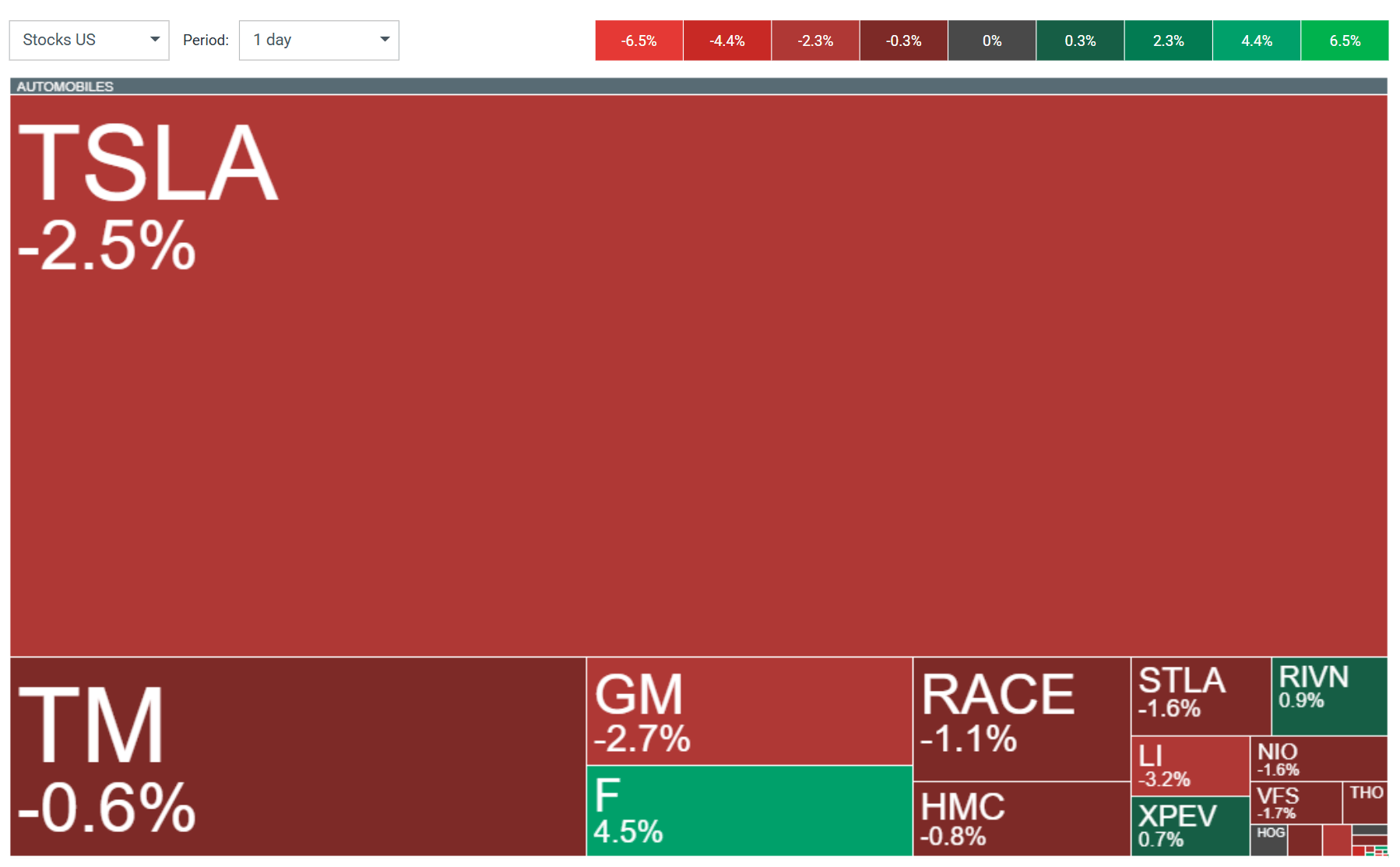
The volatility currently seen in the stocks of the largest automotive companies. Source: xStation