S&P 500 — US Large Cap Index
 FTSE 100 — UK Blue Chips
 Euro Stoxx 50 — Eurozone Leaders
 DAX 40 — German Equities
 CAC 40 — French Market Index
 Nikkei 225 — Japan Benchmark
 Hang Seng — Hong Kong Index
 Shanghai Composite — China Mainland
 ASX 200 — Australian Market
 TSX Composite — Canada Index
 Nifty 50 — India Large Cap
 STI Index — Singapore Market
 KOSPI — South Korea Index
 Bovespa — Brazil Equities
 JSE Top 40 — South Africa Index
 IPC Index — Mexico Market
- The Japanese Yen gains positive traction amid intervention fears and the risk-off mood.
- Fiscal concerns and BoJ uncertainty might keep a lid on any further upside for the JPY.
- Reduced Fed rate cut bets could act as a tailwind for the USD and the USD/JPY pair.
The Japanese Yen (JPY) stages an intraday recovery from the lowest level since early February, touched against its American counterpart during the Asian session on Tuesday, though it lacks follow-through buying or bullish conviction. The recent fall in the JPY prompted some verbal intervention from Japan’s Finance Minister Satsuki Katayama. This, along with the prevalent risk-off mood, provides a modest lift to the safe-haven JPY. Apart from this, the lack of follow-through US Dollar (USD) buying drags the USD/JPY pair below the 155.00 psychological mark in the last hour.
Meanwhile, reports that Japan’s Prime Minister Sanae Takaichi plans tax cuts to boost consumption add to concerns about the government’s long-term fiscal health. This comes on top of Japan’s weak Q3 GDP print on Monday and could put additional pressure on the Bank of Japan (BoJ) to delay raising interest rates, which could act as a headwind for the JPY. Moreover, less dovish Federal Reserve (Fed) expectations could support the buck and the USD/JPY pair. Traders might also wait for the FOMC Minutes and the delayed US Nonfarm Payrolls (NFP) report this week.
Japanese Yen bears turn cautious amid intervention fears
- Nikkei Asia reported late Monday that Japan’s Prime Minister Sanae Takaichi will launch tax-reform talks this week, aiming to cut certain taxes to stimulate investment and consumption while raising others and eliminating breaks to fill the fiscal hole.
- The report added that the ruling Liberal Democratic Party (LDP) and its coalition partner will discuss next year’s tax package, including the agreed-upon removal of gasoline and diesel surcharges, a move that will leave a ¥1.5 trillion revenue gap.
- Government data released on Monday showed that Japan’s economy contracted for the first time in six quarters during the July-September period. This tempers bets that the Bank of Japan will hike rates soon amid increasing political resistance.
- Japan’s Finance Minister Satsuki Katayama said at a regular news conference this Tuesday that we have been alarmed by the recent one-sided, rapid moves in the foreign exchange market, fueling speculations about government intervention.
- In fact, Katayama added that the government will thoroughly monitor for excessive fluctuations and disorderly movements in the forex market, with a high sense of urgency, which holds back traders from placing fresh bearish bets around the JPY.
- Several Fed officials recently signaled caution on further monetary easing amid the lack of economic data, forcing investors to scale back their expectations for a rate cut in December. This acts as a tailwind for the US Dollar and the USD/JPY pair.
- The USD bulls, however, seem reluctant and opt to wait for more cues about the Fed’s rate-cut path. Hence, the market focus will remain glued to the FOMC Minutes on Wednesday and the delayed US Nonfarm Payrolls report on Thursday.
- In the meantime, traders will scrutinize speeches from influential FOMC members later this Tuesday, which should continue to play a key role in driving the USD demand and producing short-term trading opportunities around the USD/JPY pair.
USD/JPY corrective slide below 155.00 is likely to be short-lived
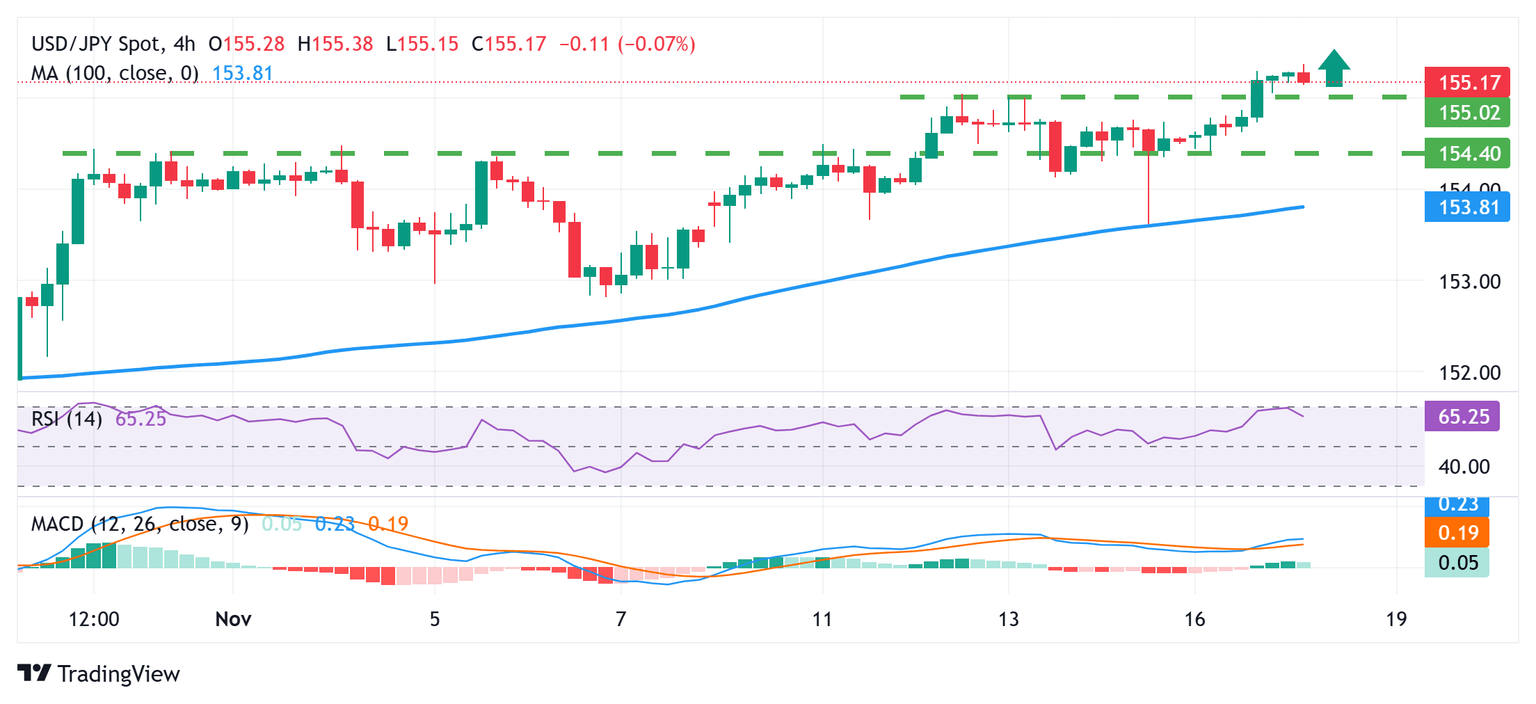
From a technical perspective, the overnight close above the 155.00 psychological mark could be seen as a fresh trigger for the USD/JPY bulls. Furthermore, oscillators on the daily chart are holding in positive territory and are still away from being in the overbought zone, suggesting that the path of least resistance for spot prices remains to the upside. Hence, some follow-through strength beyond the 155.60-155.65 intermediate hurdle, towards reclaiming the 156.00 round figure, looks like a distinct possibility.
On the flip side, any corrective pullback below the 155.00 mark is more likely to find decent support and attract fresh buyers near the 154.50-154.45 region. The latter should act as a key pivotal point, which, if broken decisively, might prompt some technical selling and drag the USD/JPY pair to the 154.00 round figure. The downfall could extend further towards the next relevant support near the 153.60-153.50 region en route to the 153.00 mark.