S&P 500 — US Large Cap Index
 FTSE 100 — UK Blue Chips
 Euro Stoxx 50 — Eurozone Leaders
 DAX 40 — German Equities
 CAC 40 — French Market Index
 Nikkei 225 — Japan Benchmark
 Hang Seng — Hong Kong Index
 Shanghai Composite — China Mainland
 ASX 200 — Australian Market
 TSX Composite — Canada Index
 Nifty 50 — India Large Cap
 STI Index — Singapore Market
 KOSPI — South Korea Index
 Bovespa — Brazil Equities
 JSE Top 40 — South Africa Index
 IPC Index — Mexico Market
JPY adds to BoJ-inspired losses; looks to post-meeting presser for fresh impetus

- The Japanese Yen drifts lower for the third straight day after the BoJ announced its policy decision.
- The BoJ decided to keep rates steady and lowered its GDP growth/median core CPI forecasts.
- Traders now look to BoJ Governor Ueda’s comments for cues about the future rate-hike path.
The Japanese Yen (JPY) weakens across the board in reaction to the Bank of Japan’s (BoJ) dovish outlook, pushing the USD/JPY pair back closer to the 144.00 mark during the Asian session on Thursday. The Japanese central bank decided to keep the short-term policy rate unchanged at 0.5% by a unanimous vote, as was widely expected, and slashed its growth forecasts amid concerns over higher US tariffs. This, along with the optimism over the potential de-escalation of the US-China trade war, contributes to the safe-haven JPY’s relative underperformance against its American counterpart.
Investors, however, still seem convinced that the BoJ will raise interest rates in 2025 amid signs of broadening inflation in Japan. This might hold back the JPY bears from placing aggressive bets ahead of the post-meeting press conference. BoJ Governor Kazuo Ueda’s remarks will be scrutinized closely for cues about the future rate-hike path, which, in turn, will play a key role in influencing the near-term JPY price dynamics. In the meantime, the prospects for more aggressive policy easing by the Federal Reserve (Fed) should cap the US Dollar (USD) and benefit the lower-yielding JPY.
Japanese Yen bears look to seize control in the wake of BoJ’s relatively dovish outlook
- The Bank of Japan announced its policy decision this Thursday and as was widely expected, decides to keep the policy interest rate steady at 0.5% amid the uncertainty surrounding US tariffs. In the accompanying policy statement, the BoJ reiterated that it will continue to raise policy rate if economy, prices move in line with its forecast.
- Meanwhile, the BoJ lowered its median core CPI forecast for fiscal 2026 to 1.7% vs 2.0% in January. The central bank, however, said that consumer inflation is likely to be at level generally consistent with 2% target in second half of projection period through 2027.
- The focus now shifts to the post-meeting press conference, where comments from BoJ Governor Kazuo Ueda will be scrutinized closely to assessing the future rate-hike path, which, in turn, will play a key role in influencing the Japanese Yen in the near term.
- The final au Jibun Bank Japan Manufacturing PMI stood at 48.7 in April 2025, higher than a flash reading of 48.5 and March’s 12-month low of 48.4. This, however, still marks the 10th straight month of decline in factory activity, though it does little to provide any meaningful impetus ahead of the key central bank event risk.
- From the US, Automatic Data Processing (ADP) reported on Wednesday that private-sector employment rose by 62,000 in April. This represented a notable decline from the 147,000 increase (revised from 155,000) recorded in March and also missed the market expectation for a reading of 108,000 by a wide margin.
- According to the advance estimates by the Bureau of Economic Analysis, the US economy contracted at an annualized rate of 0.3% during the first quarter of 2025 after growing at a solid pace of 2.4% in the previous quarter. The data revives fears about a looming US recession amid signs of easing inflationary pressures.
- The US Personal Consumption Expenditures (PCE) Price Index edged lower to 2.3% on a yearly basis in March from 2.5% in February. Adding to this, the core PCE Price Index, which excludes volatile food and energy prices, rose 2.6% compared to the 3% increase reported in February and was in line with analysts’ estimates.
- This comes on top of worries about US President Donald Trump’s erratic trade policies and reaffirms bets that the Federal Reserve will resume its rate-cutting cycle in June. In fact, Trump said this Thursday we have “potential” trade deals with India, South Korea and Japan, and that there is a “very good probability we’ll reach a deal with China.”
- Meanwhile, traders are pricing in the possibility that the US central bank will lower borrowing costs by a full percentage point by the end of the year. This keeps the US Dollar well within striking distance of a multi-year low touched last week and suggests that the path of least resistance for the lower-yielding JPY remains to the upside.
USD/JPY needs to surpass 143.55-143.60 hurdle to support prospects for further gains
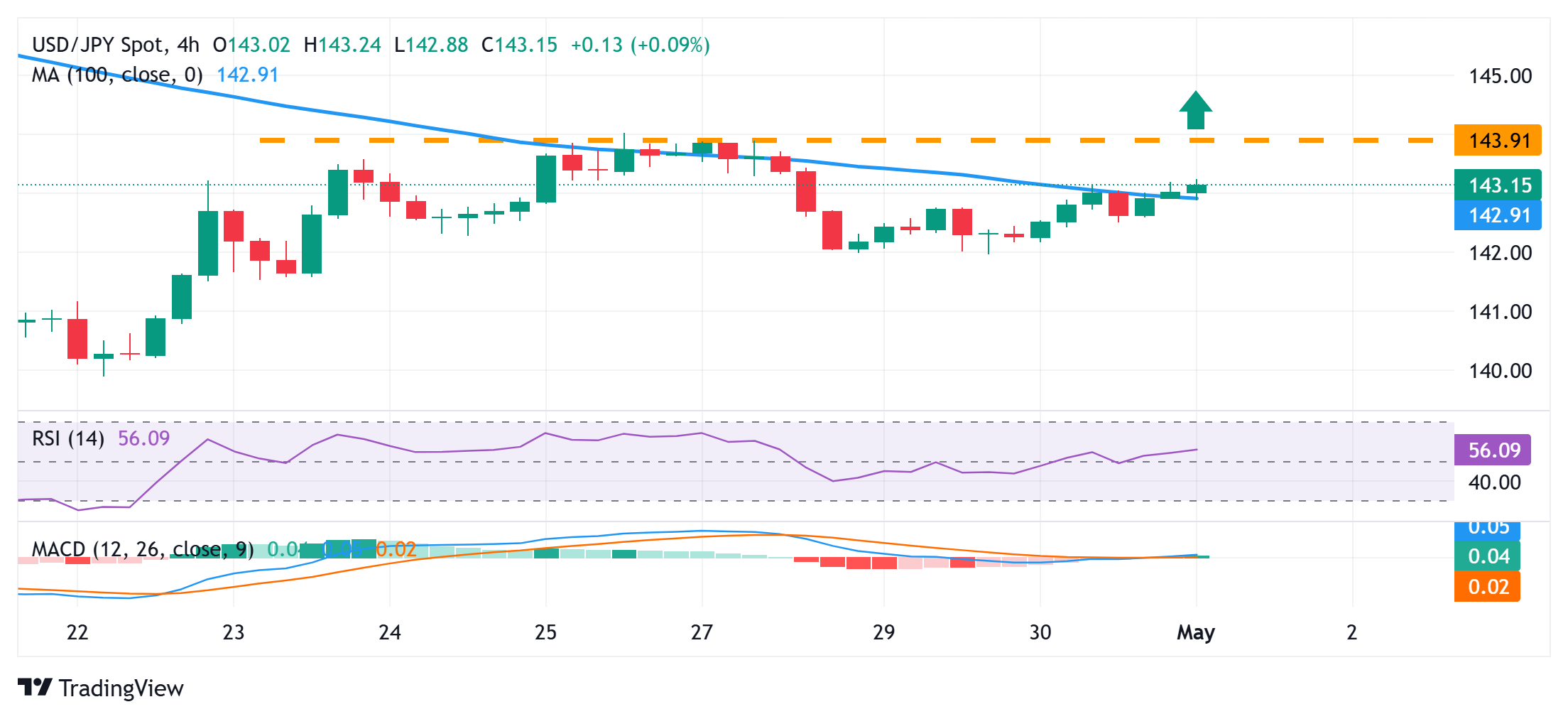
From a technical perspective, the USD/JPY pair builds on its strength beyond the 143.00 mark and the 100-period Simple Moving Average (SMA) on the 4-hour chart. Any subsequent move up beyond the 144.00 round figure will set the stage for an extension of the recent recovery from a multi-month low and lift spot prices to the next relevant hurdle near the 144.60-144.65 region. The upward trajectory could extend further and allow bulls to reclaim the 145.00 psychological mark.
On the flip side, the 142.65-142.60 area now seems to protect the immediate downside, below which the USD/JPY pair could drop to the 142.00 mark. A convincing break below the latter will be seen as a fresh trigger for bearish traders and make spot prices vulnerable to accelerate the fall towards mid-141.00s en route to the 141.10-141.00 region. The downward trajectory could extend further towards intermediate support near the 140.50 area and eventually expose the multi-month low – levels below the 140.00 psychological mark touched last week.