S&P 500 — US Large Cap Index
 FTSE 100 — UK Blue Chips
 Euro Stoxx 50 — Eurozone Leaders
 DAX 40 — German Equities
 CAC 40 — French Market Index
 Nikkei 225 — Japan Benchmark
 Hang Seng — Hong Kong Index
 Shanghai Composite — China Mainland
 ASX 200 — Australian Market
 TSX Composite — Canada Index
 Nifty 50 — India Large Cap
 STI Index — Singapore Market
 KOSPI — South Korea Index
 Bovespa — Brazil Equities
 JSE Top 40 — South Africa Index
 IPC Index — Mexico Market
JPY retains its bullish bias amid tariff jitters; USD/JPY languishes near 140.00 mark

- The Japanese Yen continues to attract safe-haven flows amid persistent trade-related uncertainties.
- BoJ rate hike bets also lend support to the JPY and weigh on the USD/JPY pair amid a weaker USD.
- Trump’s threat to the Fed’s independence keeps the USD depressed near a multi-year low set on Monday.
The Japanese Yen (JPY) attract safe-haven flows for the third straight day on Tuesday amid worries that US President Donald Trump’s tariffs and the escalating US-China trade war might trigger a global recession. Apart from this, the growing acceptance that the Bank of Japan (BoJ) will continue raising interest rates in 2025 turns out to be another factor underpinning the JPY. This, along with the prevalent US Dollar (USD) selling bias, drags the USD/JPY pair closer to the 140.00 psychological mark, or a fresh low since September 2024 during the Asian session.
Trump’s back-and-forth tariff announcements have weakened investors’ confidence in the US economic growth. Furthermore, Trump’s fresh attack on Federal Reserve (Fed) Chair Jerome Powell raised doubts about the central bank’s independence. Apart from this, bets for aggressive policy easing by the Fed, which marks a big divergence in comparison to hawkish BoJ expectations, keep the USD depressed near its lowest level since April 2022 touched on Monday. This, in turn, suggests that the path of least resistance for the lower-yielding JPY remains to the upside.
Japanese Yen bulls retain control as US tariff woes continue to boost safe-haven demand
- Following the first Japan-US negotiations last week, Japan’s Economic Revitalization Minister Ryosei Akazawa said that any agreement would likely take some time as it’s difficult to say how long it will take to bridge the gap between the two sides.
- Akazawa added that agriculture will not be compromised to protect the auto industry in US tariff talks. Meanwhile, Japan’s Finance Minister Katsunobu Kato will meet US Treasury Secretary Scott Bessent later this week to discuss currency rates.
- Investors remained on edge amid the uncertainty over US President Donald Trump’s steep tariffs and the effect of the erratic trade war on the global economy. Moreover, Trump’s fresh attack on Federal Reserve Chair Jerome Powell rattled markets.
- Trump accused Powell of not moving fast enough to bring down interest rates. Powell last week said that the central bank was not inclined to cut interest rates in the near future amid the possible inflationary pressures stemming from the new tariffs.
- Meanwhile, White House economic adviser Kevin Hassett has suggested that Trump and his team are studying if they could fire Powell. This raises doubts over the independence of the central bank and keeps the US Dollar bulls on the defensive.
- The Bank of Japan is reportedly planning to signal next week that there is almost no need to change its basic stance on raising interest rates as the potential impact of increased US tariffs will not disrupt the ongoing cycle of wage growth and inflation.
- This marks a big divergence in comparison to expectations that the Fed will resume its rate-cutting cycle in June and lower borrowing costs by one full percentage point by the end of this year. This should further benefit the lower-yielding JPY.
- Traders now look forward to the release of the Richmond Manufacturing Index from the US later this Tuesday. This, along with speeches from influential FOMC members, will drive the USD and provide short-term impetus to the USD/JPY pair.
- The focus will then shift to the global flash PMIs on Wednesday, which would offer a fresh insight into the global economic health. Apart from this, trade-related developments will play a key role in driving the market sentiment and the JPY demand.
USD/JPY seems vulnerable to weaken further; break below the 140.00 psychological mark awaited
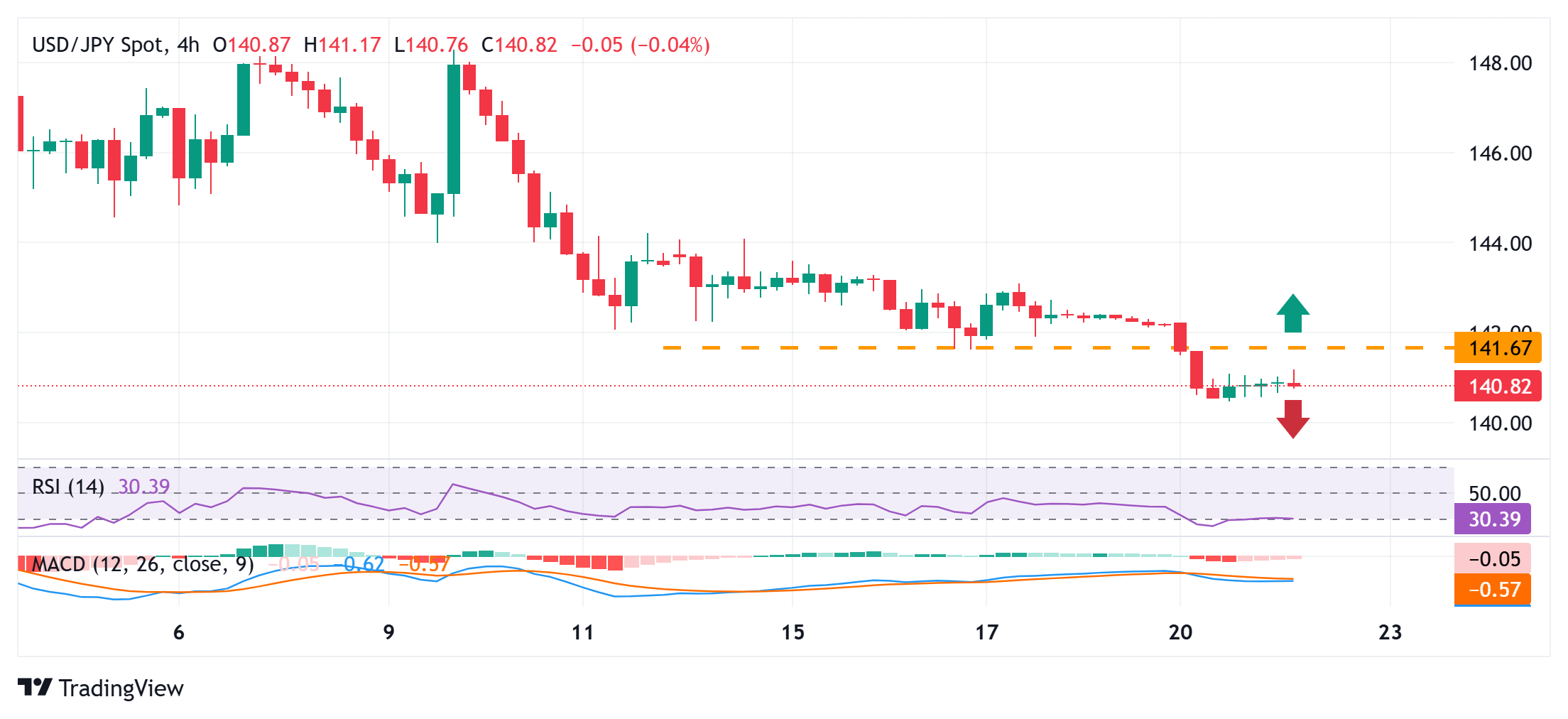
From a technical perspective, the slightly oversold daily Relative Strength Index (RSI) is holding back traders from placing fresh bearish bets around the USD/JPY pair. Any subsequent move up, however, is likely to confront stiff resistance near the 141.65-141.60 horizontal support breakpoint. That said, a sustained strength above could trigger a short-covering rally and lift spot prices beyond the 142.00 round figure, toward the next relevant hurdle near the 142.35-142.40 region.
On the flip side, the 140.45 area, or the multi-month low touched on Monday, now seems to protect the immediate downside, below which the USD/JPY pair could accelerate the fall toward the 140.00 psychological mark. The downward trajectory could extend further towards challenging the 2024 yearly swing low, around the 139.60-139.55 region.
US Dollar PRICE Last 30 days
The table below shows the percentage change of US Dollar (USD) against listed major currencies last 30 days. US Dollar was the strongest against the Australian Dollar.
| USD | EUR | GBP | JPY | CAD | AUD | NZD | CHF | |
|---|---|---|---|---|---|---|---|---|
| USD | -5.87% | -3.26% | -5.80% | -3.64% | -1.98% | -4.41% | -8.37% | |
| EUR | 5.87% | 2.79% | 0.08% | 2.41% | 4.15% | 1.63% | -2.66% | |
| GBP | 3.26% | -2.79% | -2.63% | -0.37% | 1.32% | -1.14% | -5.29% | |
| JPY | 5.80% | -0.08% | 2.63% | 2.31% | 4.06% | 1.51% | -2.77% | |
| CAD | 3.64% | -2.41% | 0.37% | -2.31% | 1.70% | -0.75% | -4.93% | |
| AUD | 1.98% | -4.15% | -1.32% | -4.06% | -1.70% | -2.42% | -6.61% | |
| NZD | 4.41% | -1.63% | 1.14% | -1.51% | 0.75% | 2.42% | -4.21% | |
| CHF | 8.37% | 2.66% | 5.29% | 2.77% | 4.93% | 6.61% | 4.21% |
The heat map shows percentage changes of major currencies against each other. The base currency is picked from the left column, while the quote currency is picked from the top row. For example, if you pick the US Dollar from the left column and move along the horizontal line to the Japanese Yen, the percentage change displayed in the box will represent USD (base)/JPY (quote).